
The Application Gallery features COMSOL Multiphysics® tutorial and demo app files pertinent to the electrical, structural, acoustics, fluid, heat, and chemical disciplines. You can use these examples as a starting point for your own simulation work by downloading the tutorial model or demo app file and its accompanying instructions.
Search for tutorials and apps relevant to your area of expertise via the Quick Search feature. Note that many of the examples featured here can also be accessed via the Application Libraries that are built into the COMSOL Multiphysics® software and available from the File menu.
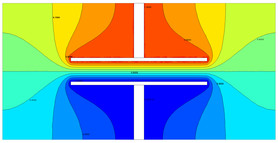
A capacitor, in its simplest form, is a two terminal electrical device that stores electric energy when a voltage difference is applied across the terminals. The stored electric energy is proportional to the applied voltage squared and is quantified by the capacitance of the device. This ... Read More
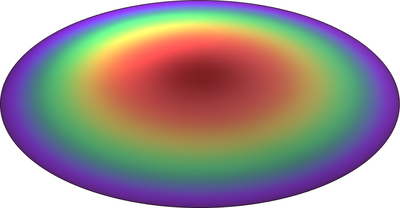
This tutorial shows how to evaluate the harmonic response of a structure with a moderately nonlinear behavior. A nonlinear problem can only be solved using time-domain analysis. A way to speed up the computation is to use a linearized frequency response analysis to provide good initial ... Read More
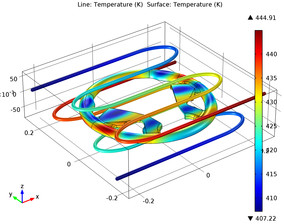
This model shows how you can use the Non-Isothermal Pipe Flow interface together with the Heat Transfer in Solids interface to model the cooling of a injection molded polyurethane part for a car steering wheel. The equations describing the cooling channels are fully coupled to the heat ... Read More
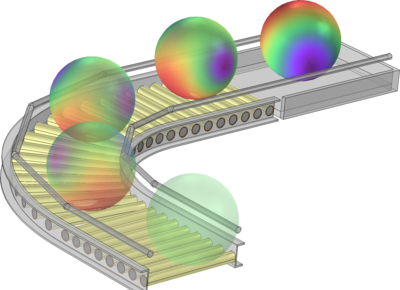
Roller conveyors are commonly used in warehouses, manufacturing units and baggage handling applications to transport objects from one place to other by gravity, power, or manually. A typical roller conveyor consists of an array of moving rollers arranged either in a straight or curved ... Read More
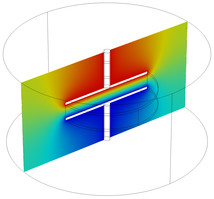
A capacitor with an applied sinusoidally time-varying voltage difference is modeled. A wide frequency range is considered and the impedance of the device is computed. Solver accuracy is addressed. The relationship between the frequency domain impedance and the steady-state capacitance ... Read More

In this example, wear of the friction material in a disc brake is studied. Quasistatic friction forces are prescribed from simple kinematic considerations. The geometry of the brake pad is continuously updated to account for the material removal due to wear following the well-known ... Read More
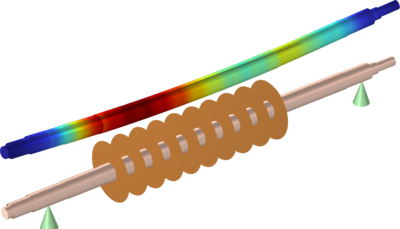
The fluid flow in seals causes a strong restoring radial force, opposing the shaft motion. Also, there is a cross coupled force due to the axial variation of the circumferential flow. The first type of force always has a stabilizing effect on the rotor, whereas the second one in certain ... Read More
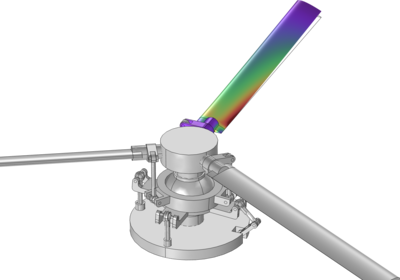
This model illustrates the operation of a swashplate mechanism used in helicopters to translate the input of helicopter flight control into the motion of the rotor blades, and hence controls the orientation of the rotor blades. In this model, the rotor blades are modeled as either rigid ... Read More
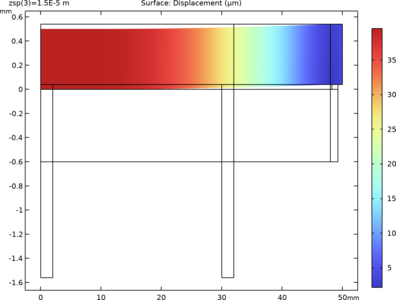
This models pressure-dependent heating of 4 inch wafer on unipolar electrostatic chuck. Wafer sits on top of ring with electrostatic force holdong down wafer to counter upward pressure from gas flowing in gap between wafer and chuck surface. It is a problem involving 4 coupled physics ... Read More
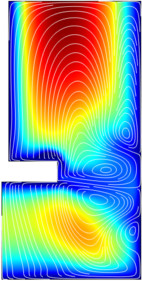
Swirl flow is an application that involves steady rotational flow around an axis. Rather than modeling this process in 3D, COMSOL Multiphysics provides a 2D axisymmetric interface where the flow in the rotational direction is still included in the equations. This example shows the ... Read More