
The Application Gallery features COMSOL Multiphysics® tutorial and demo app files pertinent to the electrical, structural, acoustics, fluid, heat, and chemical disciplines. You can use these examples as a starting point for your own simulation work by downloading the tutorial model or demo app file and its accompanying instructions.
Search for tutorials and apps relevant to your area of expertise via the Quick Search feature. Note that many of the examples featured here can also be accessed via the Application Libraries that are built into the COMSOL Multiphysics® software and available from the File menu.
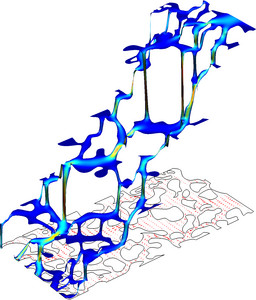
This non-conventional model of porous media flow utilizes creeping (Stokes) flow in the interstices of a porous media. The model comes from the pore-scale flow experiments conducted by Arturo Keller, Maria Auset, and Sanya Sirivithayapakorn of the University of California, Santa Barbara. ... Read More
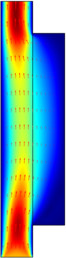
This is a tutorial model of the coupling between flow of a fluid in an open channel and a porous block attached to one of the channel walls. The flow is described by the Navier-Stokes equation in the free region and a Forchheimer-corrected version of the Brinkman equations in the porous ... Read More
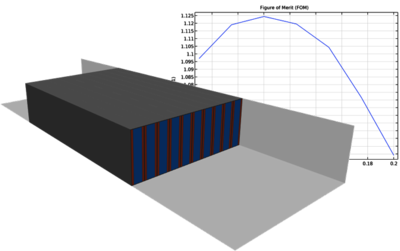
This example computes the effectiveness of a porous microchannel heat sink over a conventional microchannel heat sink. The model is fully parameterized. A parameter study on the thickness of the porous substrate is used to determine the optimal configuration. Read More

This app is an example of how the poroelastic properties of a porous material can be determined based on measurement done with an impedance tube and parameter estimation. Being able to determine the characteristics of a porous material from a single and simple measurement opens the door ... Read More
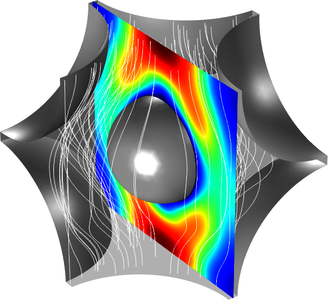
This example shows how to estimate the permeability of a porous material by creating a detailed fluid flow model in a small unit cell. The result of the model is a lumped permeability of the material, which can be used in homogenized models using Darcy's law or the Brinkman equations. ... Read More
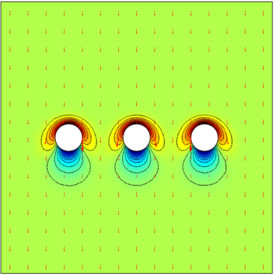
This example utilizes the Richards’ Equation interface to assess how well geophysical irrigation sensors see the true level of fluid saturation in variably saturated soils. The challenge to characterizing fluid movement in variably saturated porous media lies primarily in the need to ... Read More
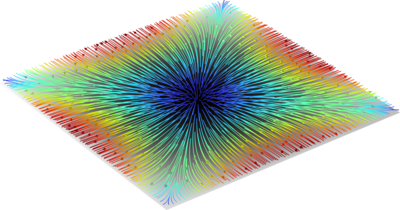
This example describes how to simulate the flow of a thin film of fluid in the gap between two rectangular plates, one of them with a porous facing, when the fluid is squeezed as a consequence of the relative motion between the plates. The model accounts for the ingress and egress of ... Read More
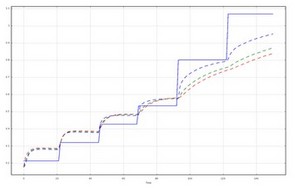
The first model describes the simultaneous flow of two immiscible fluids in porous media - here air displaces water in a multi-step inlet pressure experiment. We solve for the pressure and the degree saturation for the air and water within a representative volume and so track saturation ... Read More
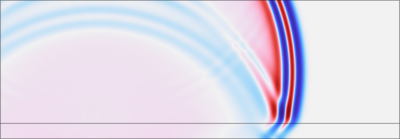
This tutorial studies the propagation of sound in the presence of a porous absorber in the time domain. It demonstrates how to model a porous absorber using the local and extended reacting approximations and compares the two approaches for absorbers of various thickness. The dissipative ... Read More
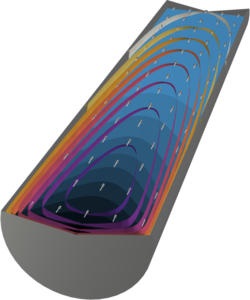
This model uses the Reacting Flow multiphysics interface to simulate a methane steam reformer. The model accounts for the interactions between the chemical reactions, the transport of species, the fluid flow, and the heat transfer in a porous medium. Read More