
The Application Gallery features COMSOL Multiphysics® tutorial and demo app files pertinent to the electrical, structural, acoustics, fluid, heat, and chemical disciplines. You can use these examples as a starting point for your own simulation work by downloading the tutorial model or demo app file and its accompanying instructions.
Search for tutorials and apps relevant to your area of expertise via the Quick Search feature. Note that many of the examples featured here can also be accessed via the Application Libraries that are built into the COMSOL Multiphysics® software and available from the File menu.
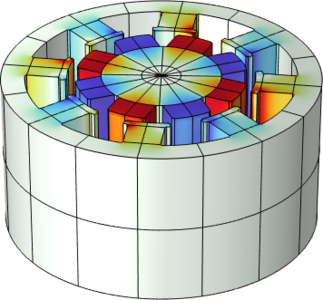
This application illustrates how to model an electric machine, such as a generator, motor, or drive, by exploiting its sector symmetry to reduce the size of the problem. The machine being studied is a simplified electric generator in 3D, based on the geometry used in the generator_2d ... Read More
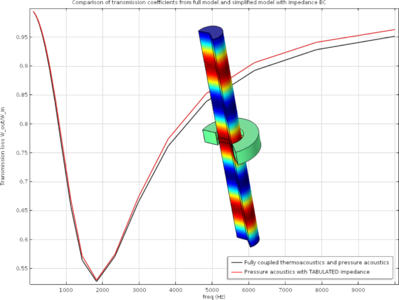
This application illustrates a modeling approach for deriving physically consistent simplified models in the Acoustics Module. The approach consists of converting complex sub-components to an impedance boundary condition and otherwise using simple acoustics throughout the COMSOL model. ... Read More
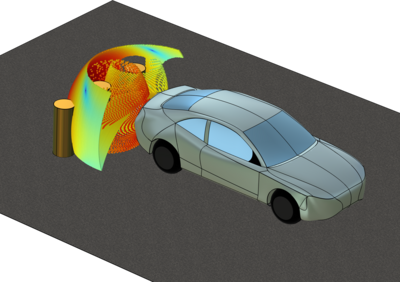
This tutorial demonstrates how to compute the response of an ultrasonic car parking sensor transducer coupling Pressure Acoustics, Frequency Domain, Solid Mechanics, and Piezoelectric Materials. The far-field radiation pattern of the transducer is then used as a source for a Ray ... Read More

This tutorial demonstrate the use of a Cross Grating feature in an échelle spectrograph. A cross grating is a periodic surface with two directions of periodicity. In this model the cross grating is used in high order in one direction and in first order in the orthogonal ("cross") ... Read More
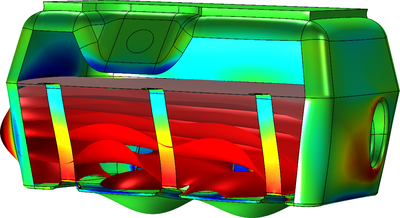
This model analyzes the frequency response of a fuel tank partially filled with fluid. The tank is submitted to a vertical acceleration. Two modeling methods are considered to represent the fluid: a traditional method of smearing the mass of the fluid through the wetted surface of the ... Read More
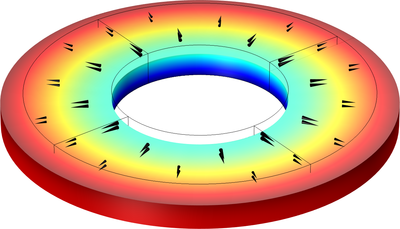
This tutorial model shows how a user-defined coordinate system can be used to create any type of directional polarization of a piezoelectric material. Results are shown for the case of radial polarization of a piezoelectric disk. The piezoelectric material is PZT-5H. The example shows a ... Read More

This small tutorial model studies energy conservation in a small conceptual test setup. The model has an inlet and outlet (modeled using ports) and a Helmholtz resonator with a very narrow neck. The acoustics in the narrow neck are modeled with Thermoviscous Acoustic for a detailed ... Read More

This model utilizes the thermoviscous acoustic interface in a sub-model to obtain detailed results for the transfer impedance of a perforated plate (including the thermal and viscous losses). The impedance is in turn used as an internal impedance in a pressure acoustic model of a ... Read More
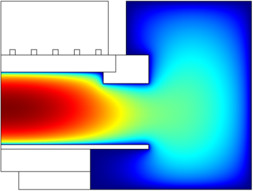
The GEC cell was introduced by NIST in order to provide a standardized platform for experimental and modeling studies of discharges in different laboratories. The plasma is sustained via inductive heating. The Reference Cell operates as an inductively-coupled plasma in this model. This ... Read More
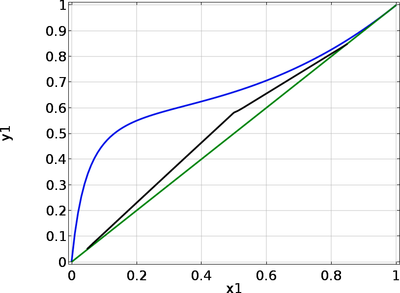
This example shows how to make a simple model for a binary distillation process. A thermodynamics property package, available in the Chemical Reaction Engineering Module, is created to study the separation of a nonideal mixture of ethanol and water. The required equilibrium relationship ... Read More