
The Application Gallery features COMSOL Multiphysics® tutorial and demo app files pertinent to the electrical, structural, acoustics, fluid, heat, and chemical disciplines. You can use these examples as a starting point for your own simulation work by downloading the tutorial model or demo app file and its accompanying instructions.
Search for tutorials and apps relevant to your area of expertise via the Quick Search feature. Note that many of the examples featured here can also be accessed via the Application Libraries that are built into the COMSOL Multiphysics® software and available from the File menu.
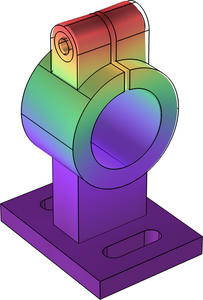
This example analyzes the deformation of a feeder clamp under stress. The clamp secures a feeder that carries high-frequency electromagnetic fields, and it’s important that it remains as straight as possible. Forces on the clamp include both those from the feeder as well as those on the ... Read More
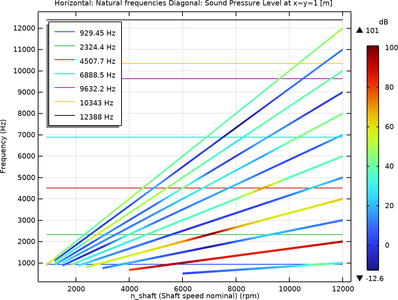
The noise emitted from an electrical machine can have many sources. In this example, acoustic noise from vibrations created by magnetic force variation is studied. Such noise is often audible at twice the excitation frequency but can also occur at higher frequencies or harmonics of the ... Read More
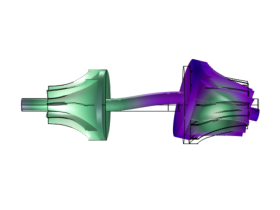
Cross-coupled forces present in a hydrodynamic bearing often act as a negative damping in a rotor. Near the critical speed, this may lead to uncontrolled vibration of the turbocharger causing a risk of bearing failure. In this example, the influence of the cross-coupling forces on the ... Read More
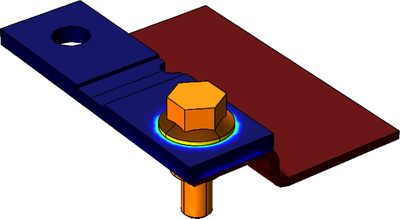
This model simulates atmospheric galvanic corrosion of a busbar, which includes a copper flange, an aluminum alloy flange in contact with a zinc nut and bolt. The Secondary Current Distribution interface is used to solve for the electric potential in electrode domain and Current ... Read More
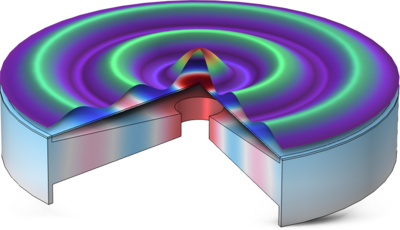
This example of a simple axisymmetric condenser microphone includes all the relevant physics and determines the microphone sensitivity as well as microphone capacitance for the specific simplified microphone geometry and material parameters. It solves a fully coupled multiphysics model ... Read More
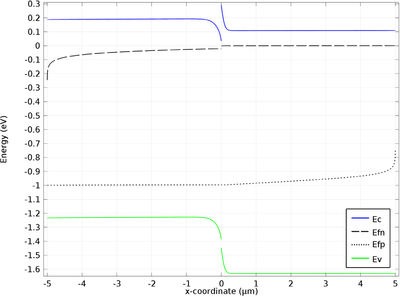
This benchmark model simulates three different heterojunction configurations under forward and reverse bias. It shows the difference in using the continuous quasi-Fermi level formulation versus the thermionic emission formulation for the charge transfer across the heterojunction. The ... Read More
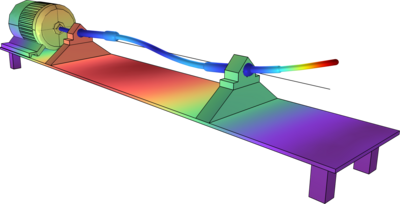
Active magnetic bearings are often used for controlling the vibration level in mechanical systems. In this example, a motor driven rotor system in which the speed of the system is gradually increased is considered. The system vibrates due to existing imbalances. As the rotor speed ... Read More
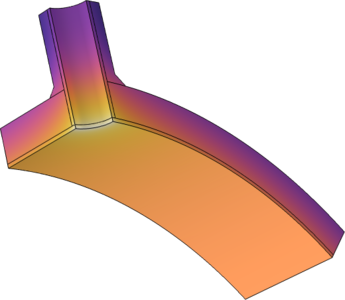
This example demonstrates how to use temperature dependent materials within the Nonlinear Structural Materials Module. A large container holds pressurized hot water. Several pipes are attached to the pressure vessel. Those pipes can rapidly transfer cold water in case of an emergency ... Read More
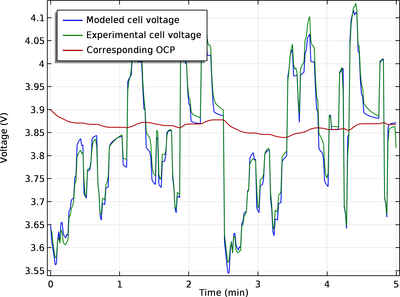
This tutorial uses a “black-box” approach to define a battery model based on a small set of lumped parameters, assuming no knowledge of the internal structure or design of the battery electrodes, or choice of materials. The input to the model is the battery capacity, the initial state ... Read More

For models with acoustic-structure couplings it is necessary to calculate the left eigenvectors to use the Frequency Domain, Modal solver. The model shows the necessary changes to the default settings of the eigenfrequency solver. Read More