
The Application Gallery features COMSOL Multiphysics® tutorial and demo app files pertinent to the electrical, structural, acoustics, fluid, heat, and chemical disciplines. You can use these examples as a starting point for your own simulation work by downloading the tutorial model or demo app file and its accompanying instructions.
Search for tutorials and apps relevant to your area of expertise via the Quick Search feature. Note that many of the examples featured here can also be accessed via the Application Libraries that are built into the COMSOL Multiphysics® software and available from the File menu.
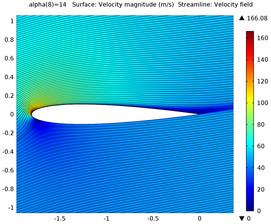
This model simulates the flow around an inclined NACA 0012 airfoil at different angles of attack using the SST turbulence model. The results show good agreement with the experimental lift data of Ladson and the pressure data of Gregory and O’Reilly. Read More
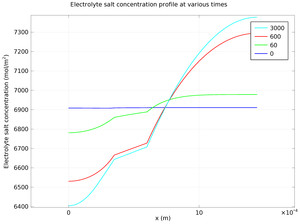
This model simulates the discharge of a Nickel-Metal Hydride (NiMH) battery using the Battery with Binary Electrolyte interface. The geometry is in one dimension and the model is isothermal. The model serves as an introduction to NiMH modeling, and can be further extended to include ... Read More
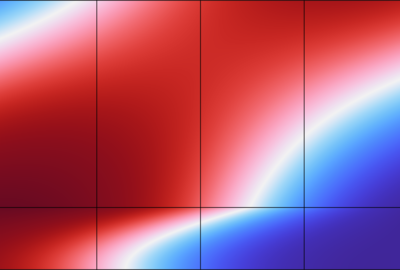
This tutorial investigates the acoustic properties of a porous layer made of glass wool. The porous material has transverse isotropic properties and is modeled with the full anisotropic poroelastic material model. Read More
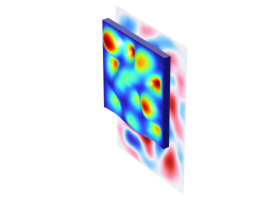
This model presents a practical and efficient method to compute the sound transmission loss (STL) through a building component, specifically this example treats the case of a concrete wall. The method used here is valid as long as the component has little influence on the acoustic field ... Read More
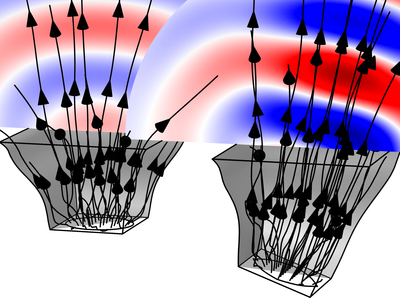
This model demonstrates how to use the Control Function feature to perform shape optimization on a rectangular horn for an improved on axis response. The results of the initial design are exported to a new component via a Filter dataset. Further, the off-axis spatial response is improved ... Read More
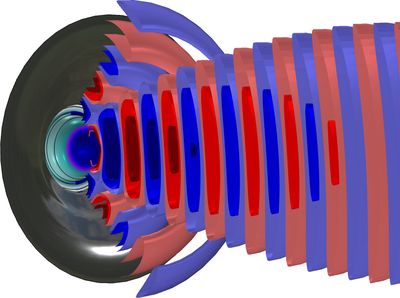
A tweeter is a high frequency driver used in loudspeaker systems. An ideal tweeter will produce a constant sound pressure level at a given distance in front of the driver independently of frequency, that is, a flat response. Ideally the tweeter will also, to a certain degree, maintain ... Read More
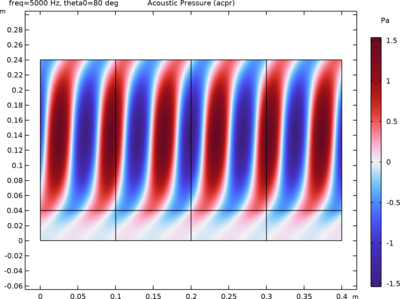
This is a 2D model of an anisotropic porous absorbing material. The absorption coefficient alpha are determined as functions of frequency for three different incidence angles. The example uses Periodic Floquet boundary conditions. The model uses two different methods for modeling the ... Read More
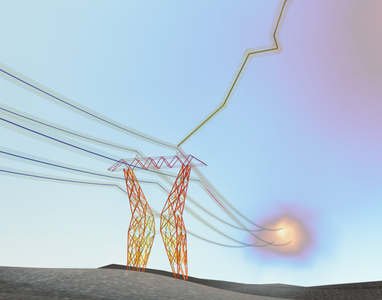
This model demonstrates the analysis of lightning surges on high voltage transmission line towers. Lightning carrying a current of 10 kA struck one of the tower's shielded wires. The induced voltage at the three-phase conductors are computed. Some highlights of this model: Perform ... Read More
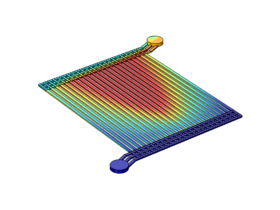
In a polymer electrolyte membrane electrolyzer cell (PEMEC), the two electrode compartments are separated by a polymer membrane. Liquid water is fed to the anode side, forming oxygen gas on the anode, and hydrogen gas on the cathode side, respectively. The respective designs of the ... Read More
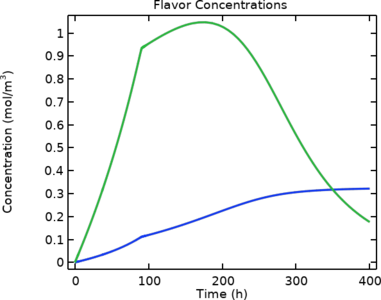
An important step in brewing beer is the fermentation process. Here, alcohol is formed together with various flavor substances from sugars in the presence of yeast. The initial sugar content, temperature, and yeast type dictate how the fermentation proceeds. In this example, the ... Read More


