
The Application Gallery features COMSOL Multiphysics® tutorial and demo app files pertinent to the electrical, structural, acoustics, fluid, heat, and chemical disciplines. You can use these examples as a starting point for your own simulation work by downloading the tutorial model or demo app file and its accompanying instructions.
Search for tutorials and apps relevant to your area of expertise via the Quick Search feature. Note that many of the examples featured here can also be accessed via the Application Libraries that are built into the COMSOL Multiphysics® software and available from the File menu.
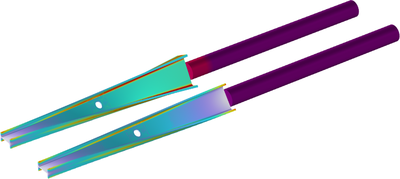
This example demonstrates the use of the Solid-Beam Connection multiphysics coupling to create transitions between the Solid Mechanics and Beam interfaces. Two different connection types are discussed, and a comparison of the stress distributions at the transition is made. Read More
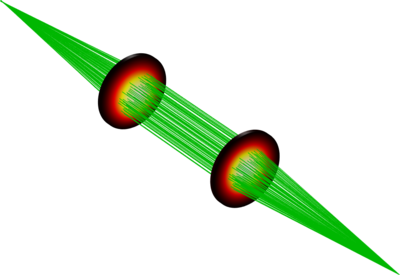
A modern high-power industrial fiber laser system can deliver up to 3kW of single-mode laser radiation on to surfaces to be cut, drilled, welded or marked. Even using highly transmissive materials, the optical component used to focus the laser beam onto target surfaces can be affected ... Read More
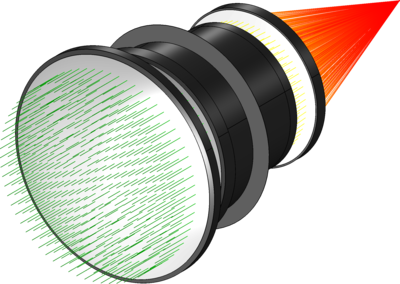
This tutorial shows how to set up a multi-element objective lens. The chosen lens is the Double Gauss described in 'Modern Lens Design (2nd edition)', by W. Smith, 2005, pg 323. The tutorial demonstrates how to create a geometry sequence using the 'Spherical Lens 3D' part found in the ... Read More
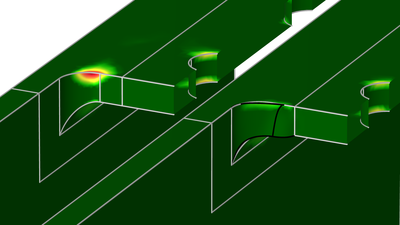
Shape optimization with respect to fatigue properties is not supported, but fatigue properties are well correlated with the maximum stress. The model demonstrates how optimization with respect to a p-norm of the von Mises stress can be used to improve fatigue properties without ... Read More
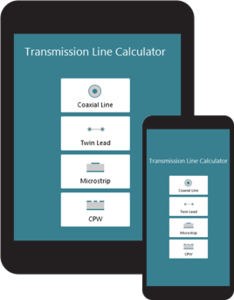
This app demonstrates the following: Creating apps for small screens such as smartphones User-interface navigation with a top menu typically used on websites Dynamically hiding forms using card stacks to minimize the space required by the app Changing appearance by using different ... Read More
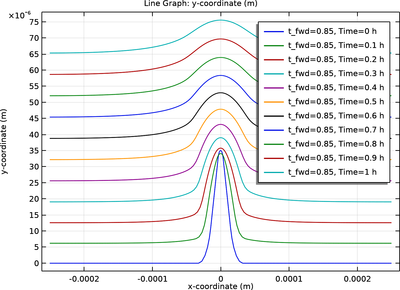
This tutorial explores how pulse reverse plating can be used as an additive-free alternative to attenuate small protrusions during copper metal deposition. By matching the process parameters, including the length of the forward and reverse pulses (duty cycles), a bright mirror-like metal ... Read More
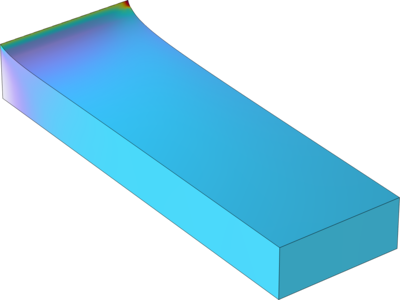
This model shows how you can implement a user defined hyperelastic material, using the strain density energy function. The model used is a general Mooney–Rivlin hyperelastic material model defined by a polynomial. In this example, you will see two material models based on the defined ... Read More
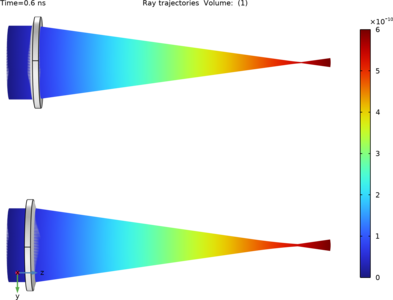
Light collimation or focusing is a basic task often needed when working with lasers in the lab where singlets are used due to their simplicity. If a plano-convex lens is used for the task, there is a correct lens orientation that minimizes aberrations. A useful rule-of-thumb is to ... Read More
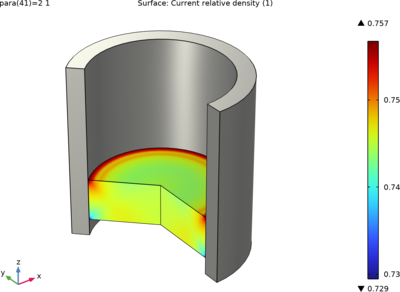
Powder compaction is a popular manufacturing process not only in powder metallurgy, but also in the pharmaceutical industry. The Capped Drucker–Prager model is commonly used for simulating the compaction processes of pharmaceutical powders, where the material properties depend on the ... Read More
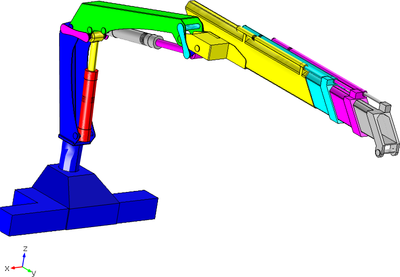
Many trucks are equipped with cranes for load handling. Such cranes have a number of hydraulic cylinders, controlling the motion, and several mechanisms. The cylinders and mechanisms that make up the crane are subjected to large forces when handling heavy loads. In order to determine ... Read More