
The Application Gallery features COMSOL Multiphysics® tutorial and demo app files pertinent to the electrical, structural, acoustics, fluid, heat, and chemical disciplines. You can use these examples as a starting point for your own simulation work by downloading the tutorial model or demo app file and its accompanying instructions.
Search for tutorials and apps relevant to your area of expertise via the Quick Search feature. Note that many of the examples featured here can also be accessed via the Application Libraries that are built into the COMSOL Multiphysics® software and available from the File menu.
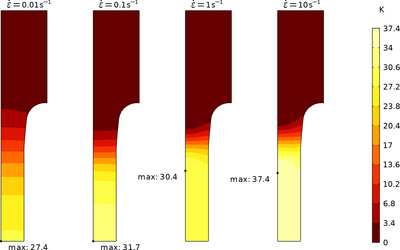
In this example, a tensile test is simulated at four different strain rates. The Johnson–Cook hardening law is used to model the strain rate dependency of the plastic hardening. The temperature distribution and thermal expansion caused by the heating generated by the plastic ... Read More
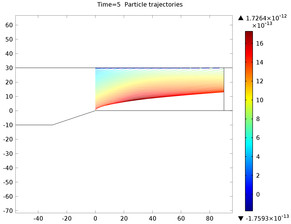
When a temperature gradient in a gas exists, suspended particles will tend to move from regions of high temperature to low. The force which produces this effect is called the thermophoretic force. Gas molecules colliding with a particle from the hot side have a higher velocity than the ... Read More
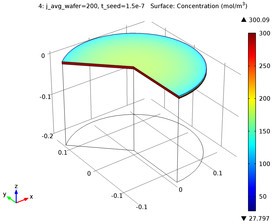
This example extends the analysis made in the model Electrodeposition on a Resistive Patterned Wafer by including the diffusion and convection of copper ions in the electrolyte. The coupled mass transport convection-diffusion effects are of interest in this type of reactor since they ... Read More
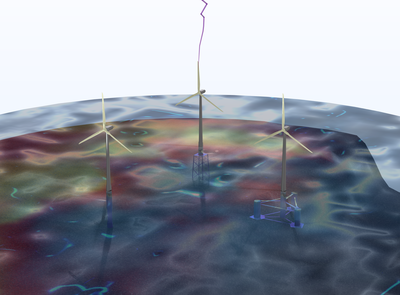
This model analyzes lightning surges in an offshore wind farm. When a lightning strike with a current of 20 kA hit one wind turbine, the induced electric fields in adjacent wind turbines were computed. Read More
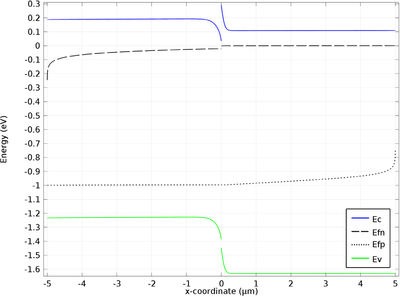
This benchmark model simulates three different heterojunction configurations under forward and reverse bias. It shows the difference in using the continuous quasi-Fermi level formulation versus the thermionic emission formulation for the charge transfer across the heterojunction. The ... Read More
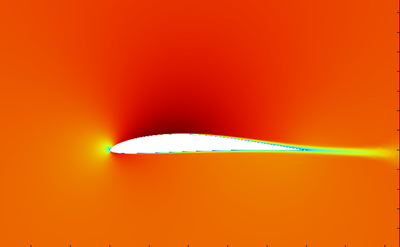
The flow around the Eppler 387 airfoil is computed with the SST turbulence model both with and without the transition model. The reuslts are compared with experimental values. Read More
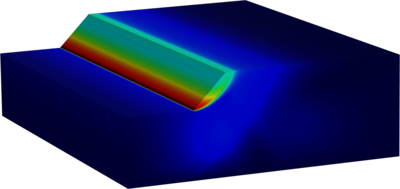
The strength reduction technique is a tool to find the factor of safety (FOS) in geotechnical problems, particularly in slope stability analyses. To determine the factor of safety of the slope, the strength properties in the Mohr–Coulomb model are gradually reduced until failure occurs. ... Read More
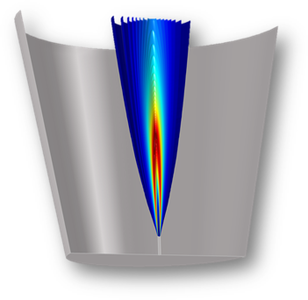
The model simulates non-premixed turbulent combustion of syngas (synthesis gas) in a simple round-jet burner. Syngas is a gas mixture, primarily composed of hydrogen, carbon monoxide and carbon dioxide. The name syngas relates to its use in creating synthetic natural gas. In the model, ... Read More
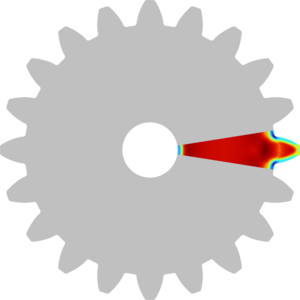
This model shows how to simulate carburization and quenching of a steel gear. Diffusion of carbon into the surface of the gear affects the onset of martensitic transformation. Residual stresses are computed, and it is shown that high residual compressive stresses appear at the root of ... Read More
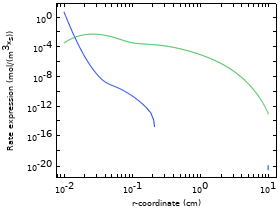
This tutorial presents a study of positive and negative corona discharges in dry air at atmospheric pressure. The discharges are sustained within two electrodes in a coaxial configuration by a high voltage DC source applied to the inner electrode. Two different types of models are used: ... Read More