
The Application Gallery features COMSOL Multiphysics® tutorial and demo app files pertinent to the electrical, structural, acoustics, fluid, heat, and chemical disciplines. You can use these examples as a starting point for your own simulation work by downloading the tutorial model or demo app file and its accompanying instructions.
Search for tutorials and apps relevant to your area of expertise via the Quick Search feature. Note that many of the examples featured here can also be accessed via the Application Libraries that are built into the COMSOL Multiphysics® software and available from the File menu.
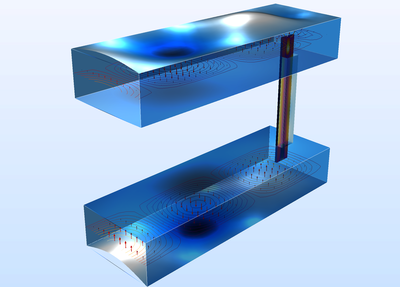
In this model, the electrical performance of a W-band waveguide to microstrip line transition (WMLT) is investigated. A standard WR10 waveguide is used and the transition from waveguide to microstrip line is achieved by utilizing the longitudinal probe (also known as E-plane probe) ... Read More
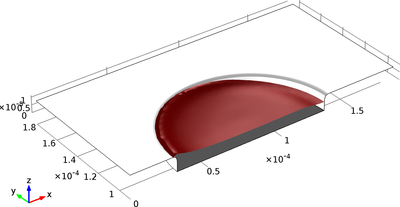
This model simulates the shape evolution of a microconnector bump over time as copper deposits on an electrode surface. Transport of cupric ions in the electrolyte occurs by convection and diffusion. The electrode kinetics are described by a concentration dependent Butler-Volmer ... Read More
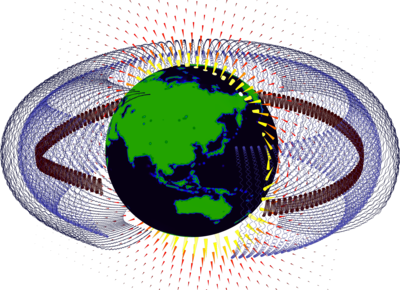
This model demonstrates the path of relativistic protons within Earth's magnetic field. Due to the dipole nature of Earth's magnetic field, charged particles, such as electrons and protons, can get trapped in stable configurations within it for long periods of time. These ... Read More
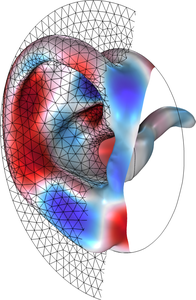
This model is of the P.57 Type 4.3 Full-band Ear Simulator. The model includes the geometry of the ear canal as well as the pinna defined in the ITU-T P.57 standard. The model also includes interpolation data for an ear drum impedance ensuring correct acoustic properties of the ear. The ... Read More
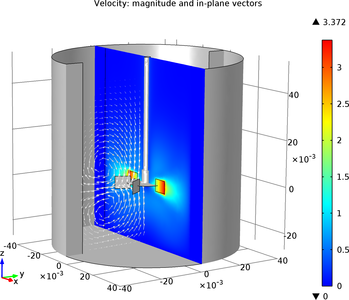
This model provides you with tools to build a variety of mixers by combining two common types of vessels with two types of impellers. The mixers are baffled flat and dished bottom vessels with either pitched blade impellers or Rushton turbines. The model includes three examples using the ... Read More
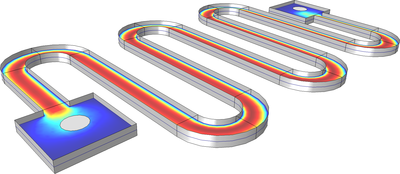
Removing halogen groups from hydrocarbons is an important reaction step in several chemical processes. One application is water purification. Other examples involve organic synthesis, where the removal of halogen groups serves as a starting point for carbon-carbon coupling reactions. ... Read More
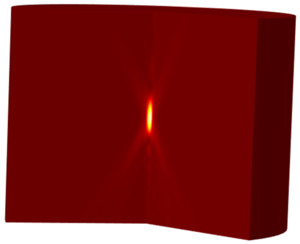
This tutorial shows how to model tissue heating induced by focused ultrasound. First, the stationary acoustic field in the water and the tissue are modeled to obtain the acoustic intensity distribution in the tissue. The absorbed acoustic energy is then calculated and used as the heat ... Read More
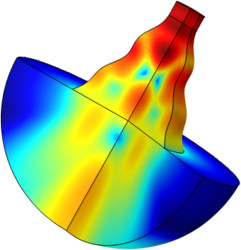
A plane-wave mode feeds an axisymmetric horn radiating from an infinite baffle toward an open half space. The radius of the waveguide attached to the horn throat is assumed to be fixed, as well as the depth of the horn and the size of the horn mouth attached to the baffle. By varying the ... Read More
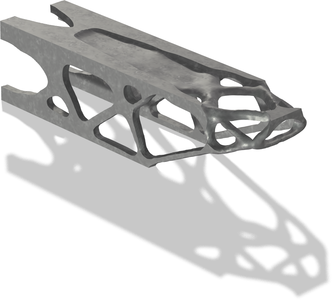
This model demonstrates how to design a beam without low Eigenfrequencies by combining the Density Model feature in the Topology Optimization interface with the Stationary Then Eigenfrequency study step. Read More
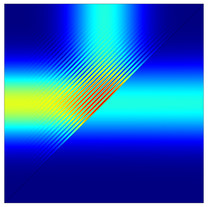
A beam splitter is used to split a single beam of light into two. One way of making a splitter is to deposit a thin layer of metal between two glass prisms. The beam is slightly attenuated within the layer, and split into two paths. In this example, the thin metal layer is modeled using ... Read More