
The Application Gallery features COMSOL Multiphysics® tutorial and demo app files pertinent to the electrical, structural, acoustics, fluid, heat, and chemical disciplines. You can use these examples as a starting point for your own simulation work by downloading the tutorial model or demo app file and its accompanying instructions.
Search for tutorials and apps relevant to your area of expertise via the Quick Search feature. Note that many of the examples featured here can also be accessed via the Application Libraries that are built into the COMSOL Multiphysics® software and available from the File menu.
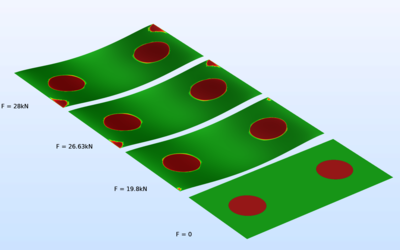
Interfacial failure or delamination in a composite material can be simulated with a cohesive zone model (CZM). A key ingredient of a cohesive zone model is a traction-separation law that describes the softening in the cohesive zone near the delamination tip. This example shows the ... Read More
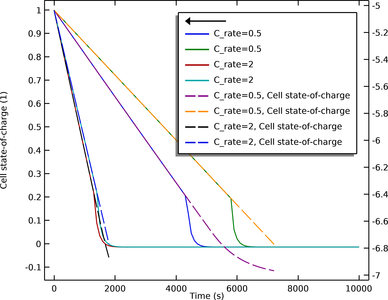
This tutorial demonstrates how to integrate multiple Lumped Battery models into the Electrical Circuit interface. Two batteries are connected in series. Each battery is protected by a shunt resistances that is activated if the battery state-of-charge reaches below a certain threshold ... Read More
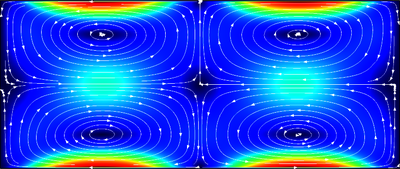
Recent advances in the fabrication of microfluidic systems require handling of live cells and other micro particles as well as mixing. All this can, for example, be achieved using acoustic radiation forces and the viscous drag from the streaming flow. Streaming: Due to the nonlinear ... Read More
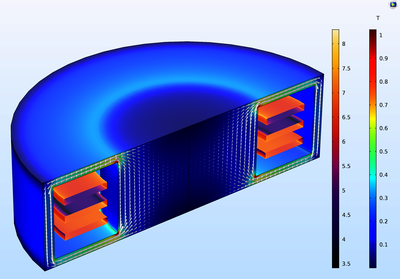
Inductive devices experience capacitative coupling between conductors at high frequencies. Modeling this phenomenon requires that you describe electric fields that have components both parallel with and perpendicular to the wire. This consideration might lead to the conclusion that a 3D ... Read More
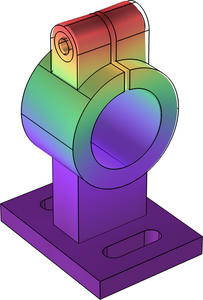
This example analyzes the deformation of a feeder clamp under stress. The clamp secures a feeder that carries high-frequency electromagnetic fields, and it’s important that it remains as straight as possible. Forces on the clamp include both those from the feeder as well as those on the ... Read More
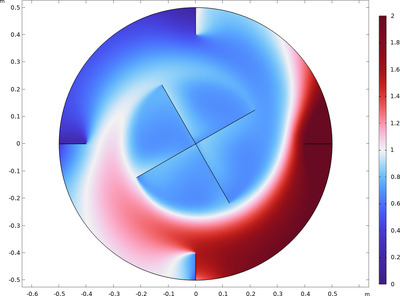
This example shows how the mixing capability of a stirred vessel can be evaluated. To efficiently reach the steady operational conditions the turbulent flow is solved for using a frozen rotor analysis, and a following time dependent simulation. When a quasi-steady flow field has ... Read More
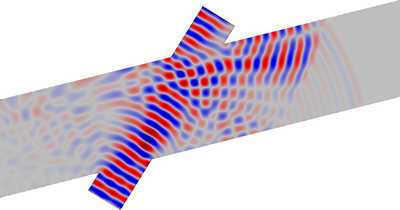
Knowing the velocity of a moving fluid is important in all cases where the fluid is used to transport material or energy. In the time-of-flight or transit-time method for determining flow velocity, an ultrasonic signal is transmitted across the main flow in a pipe to noninvasively ... Read More
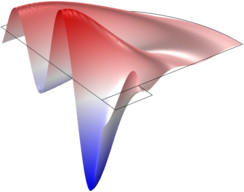
A piezoelectric transducer can be used either to transform an electric current to an acoustic pressure field or, the opposite, to produce an electric current from an acoustic field. These devices are generally useful for applications that require the generation of sound in air and ... Read More
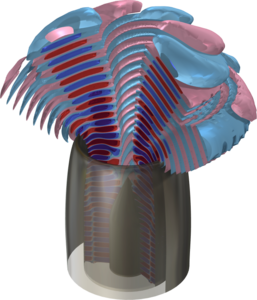
This model demonstrates two approaches to model the acoustics in a generic nacelle with an acoustic liner and a background flow. The first method uses the Compressible Potential Flow and the Linearized Potential Flow, Frequency Domain interfaces, while the second, more detailed approach, ... Read More
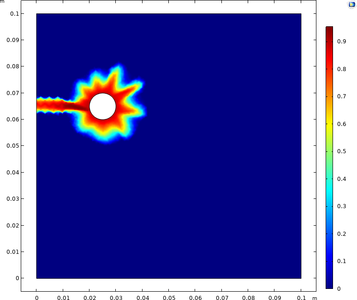
Oxide jacking is the process by which reinforced concrete cracks, due to the corrosion of the reinforcing rebar rods. The corrosion process causes growth of an oxide layer on the rebar, which in turn causes internal stresses in the concrete. If the corrosion process is allowed to ... Read More


