
The Application Gallery features COMSOL Multiphysics® tutorial and demo app files pertinent to the electrical, structural, acoustics, fluid, heat, and chemical disciplines. You can use these examples as a starting point for your own simulation work by downloading the tutorial model or demo app file and its accompanying instructions.
Search for tutorials and apps relevant to your area of expertise via the Quick Search feature. Note that many of the examples featured here can also be accessed via the Application Libraries that are built into the COMSOL Multiphysics® software and available from the File menu.
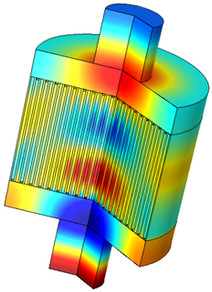
This is the model of the acoustics in a particulate-filter-like system. Real systems, like diesel particulate filters (DPFs), are designed to remove/filter soot (diesel particles) from the exhaust of diesel engine vehicles. The porous medium in such systems are typically structured with ... Read More
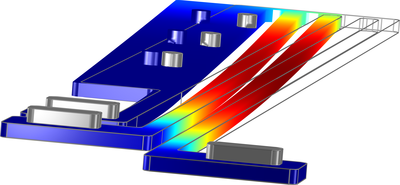
This example model consists of a two-hot-arm thermal actuator made of polysilicon. The actuator is activated through thermal expansion. The temperature increase required to deform the two hot arms, and thus displace the actuator, is obtained through Joule heating (resistive heating). The ... Read More
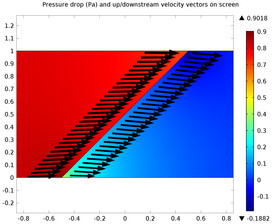
This model simulates the flow through a uniform inclined screen using the Screen feature in Single-Phase Flow physics and compares the results with an analytic solution. Read More
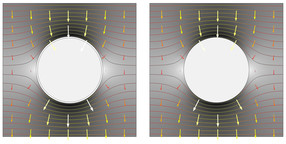
The electric shielding boundary condition is meant to approximate a thin layer of highly conductive material that provides an additional current path tangential to a boundary. This example compares the electric shielding boundary condition to a full-fidelity model and discusses the range ... Read More
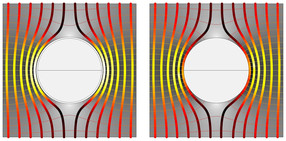
The contact impedance boundary condition is meant to approximate a thin layer of material that impedes the flow of current normal to the boundary, but does not introduce any additional conduction path tangential to the boundary. This example compares the contact impedance boundary ... Read More
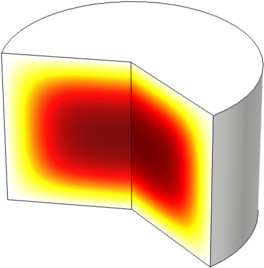
This is a benchmark model for an axisymmetric transient thermal analysis. The temperature on the boundaries changes from 0 degrees C to 1000 degrees C at the start of the simulation. The temperature at 190 s from the anlysis is compared with a NAFEMS benchmark solution. Read More
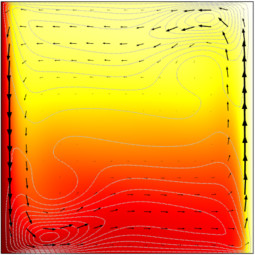
This model couples the Navier Stokes equations and the heat transfer equations to examine density driven flow of free fluids. Here the fluid is in a square cavity with a heated wall. The buoyancy force is a Boussinesq term added to the Navier-Stokes equations. The equation is ... Read More
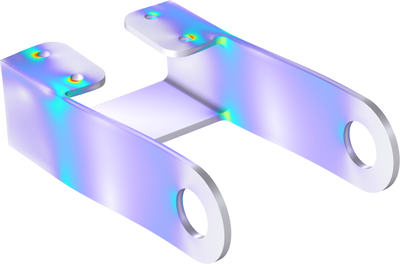
This tutorial illustrates how to use a reduced order model to compute the response of a structure subjected to three simultaneous loads having independent time histories. Reduced order models provide an efficient way to analyze problems within linear structural dynamics. Read More

A magnetic diaphragm is a flexible, thin structure that interacts with magnetic fields to perform mechanical or sensing functions. When subjected to an external magnetic field, the diaphragm deforms due to magnetomechanical interactions, converting magnetic energy into mechanical ... Read More
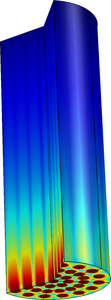
One of the most common reactors in the chemical industry, for use in heterogeneous catalytic processes, is the packed bed reactor. This type of reactor is used both in synthesis as well as in effluent treatment and catalytic combustion. This model is set up to calculate the ... Read More


