
The Application Gallery features COMSOL Multiphysics® tutorial and demo app files pertinent to the electrical, structural, acoustics, fluid, heat, and chemical disciplines. You can use these examples as a starting point for your own simulation work by downloading the tutorial model or demo app file and its accompanying instructions.
Search for tutorials and apps relevant to your area of expertise via the Quick Search feature. Note that many of the examples featured here can also be accessed via the Application Libraries that are built into the COMSOL Multiphysics® software and available from the File menu.
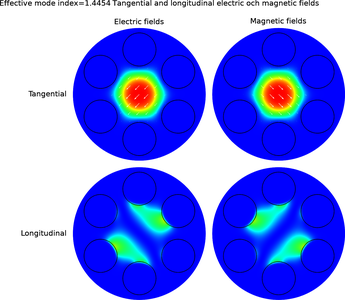
A mode analysis study is used to find the complex effective indices for a microstructured optical fiber (MOF), consisting of air holes in a silica host. As the effective index is smaller than the refractive index of the silica background material, the modes are leaky. The model ... Read More
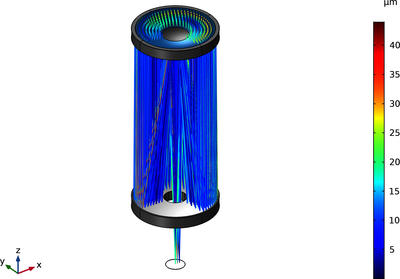
The Gregory-Maksutov telescope is a simple catadioptric telescope comprising a spherical corrector lens and a spherical primary mirror. In this example the corrector lens and mirror are formed using the 'Spherical Lens 3D' and 'Spherical Mirror 3D' parts respectively from the Ray Optics ... Read More
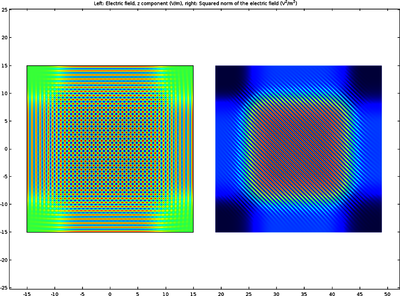
When two coherent light beams intersect, an interference pattern appears. If this occurs in a material that is sensitive to light, with intensities greater than a certain exposure threshold, the interference pattern is recorded in the material as a modulation of the refractive index and ... Read More
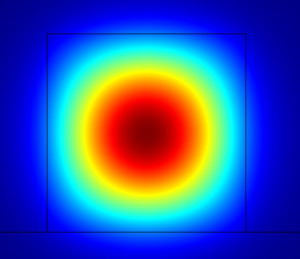
Planar photonic waveguides in silica (SiO2) have great potential for use in wavelength routing applications. The major problem with this type of waveguide is birefringence. Anisotropic refractive indices result in fundamental mode splitting and pulse broadening. The goal is to minimize ... Read More
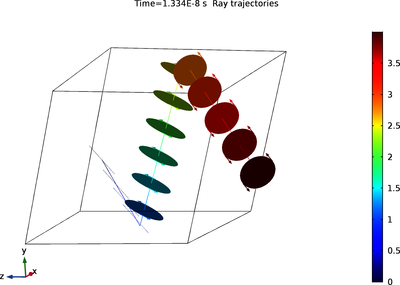
A Fresnel rhomb is a prism that uses total internal reflection to manipulate the polarization of light. In this example, light in the prism is internally reflected at an angle of incidence that induces a 45-degree phase delay between s- and p-polarized radiation. By subjecting the light ... Read More
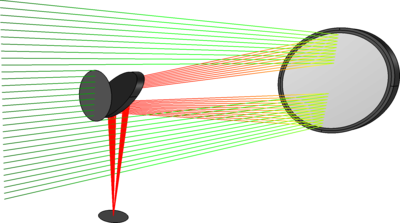
Newtonian telescopes, first invented in 1668 by Isaac Netwon, are still used today because of their low cost and simple design. Rays of light propagate from sources located at infinity, into the telescope. The rays reflect off a parabolic mirror, onto a flat mirror, and into the focal ... Read More
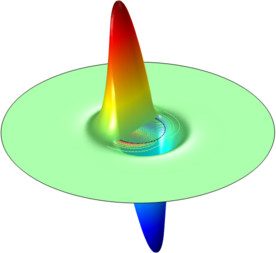
The transmission speed of optical waveguides is superior to microwave waveguides, because optical devices have a much higher operating frequency than microwaves, enabling a far higher bandwidth. This model is an example of a single step-index waveguide made of silica glass. The inner ... Read More
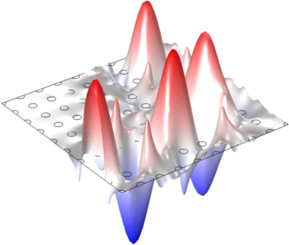
Photonic crystal devices are periodic structures of alternating layers of materials with different refractive indices. Waveguides that are confined inside of a photonic crystal can have very sharp low-loss bends, which may enable an increase in integration density of several orders of ... Read More
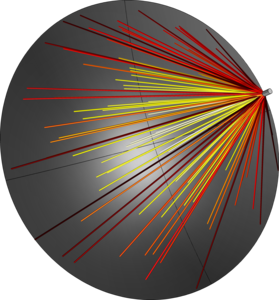
A paraboloidal dish can concentrate solar energy onto a target (receiver), resulting in very high local heat fluxes. This can be used to generate steam, which can be used to power a generator, or hydrogen, which can be used directly as a fuel source. In this model, the heat flux arriving ... Read More
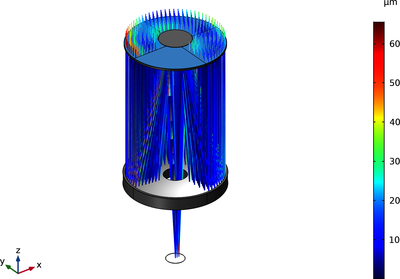
The Schmidt-Cassegrain Telescope demonstrated in this tutorial is a classic design using an aspheric corrector lens and two spherical mirrors. The aspheric corrector is created using the 'Aspheric Even Lens 3D' part from the Ray Optics part library. Read More