
The Application Gallery features COMSOL Multiphysics® tutorial and demo app files pertinent to the electrical, structural, acoustics, fluid, heat, and chemical disciplines. You can use these examples as a starting point for your own simulation work by downloading the tutorial model or demo app file and its accompanying instructions.
Search for tutorials and apps relevant to your area of expertise via the Quick Search feature. Note that many of the examples featured here can also be accessed via the Application Libraries that are built into the COMSOL Multiphysics® software and available from the File menu.

This application demonstrates how you can access and include external thermodynamic and physical property calculations in your simulation, using the Thermodynamics feature. The example shows how you can easily modify the predefined Plug-flow reactor type in the Reaction Engineering ... Read More
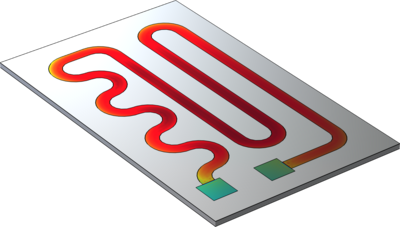
Small heating circuits find use in many applications. For example, in manufacturing processes, they heat up reactive fluids. The device in this tutorial consists of an electrically resistive layer deposited on a glass plate. The layer results in Joule heating when a voltage is applied to ... Read More
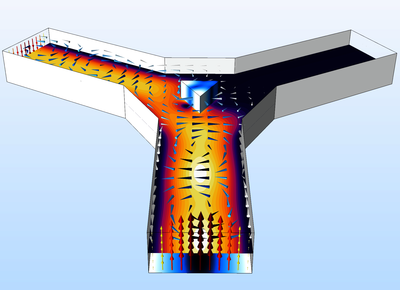
A lossy ferrite circulator at 3GHz is modeled. Geometrical design parameters are varied to match the impedance for minimal reflection of the fundamental TE10 rectangular waveguide mode. Read More
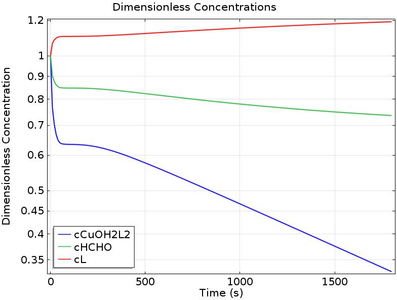
Electroless deposition or plating is a non-galvanic plating method that does not require any external electrical power. This technique is typically used for electroless plating of nickel, silver, gold and copper. In electroless deposition, partial oxidation and reduction reactions ... Read More
This example treats the modeling of electroosmotic flow in porous media. The system consists of a compartment of sintered porous material and two electrodes that generate an electric field. The cell combines pressure and electroosmotic driven flow. The equations that are solved are the ... Read More
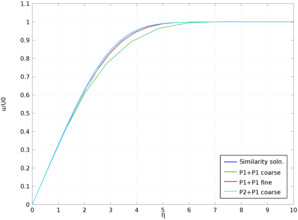
The incompressible boundary layer on a flat plate in the absence of a pressure gradient is usually referred to as the Blasius boundary layer. The steady, laminar boundary layer developing downstream of the leading edge eventually becomes unstable to Tollmien-Schlichting waves and finally ... Read More
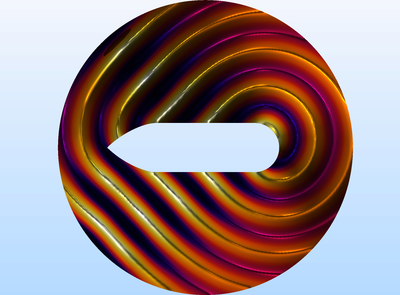
This tutorial model demonstrates the use of a background field in an electromagnetic scattering problem. Although this example is a boat hit by a radar, this same technique can be used in any situation where an isolated object meets electromagnetic waves from a distant source. For ... Read More
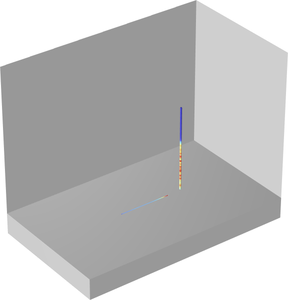
This model computes the lightning-induced voltage on an overhead line positioned above a lossy ground. It includes parameters like the inclination angle of lightning channels and soil conductivity, enabling straightforward analysis of their impacts. The calculated induced voltage aligns ... Read More
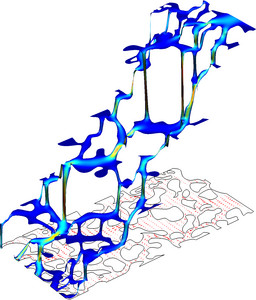
This non-conventional model of porous media flow utilizes creeping (Stokes) flow in the interstices of a porous media. The model comes from the pore-scale flow experiments conducted by Arturo Keller, Maria Auset, and Sanya Sirivithayapakorn of the University of California, Santa Barbara. ... Read More
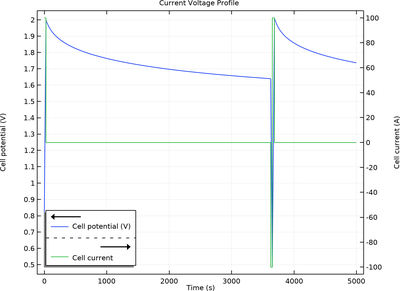
This model illustrates the effect of oxygen and hydrogen formation and recombination on the performance and self-discharge of an electrochemical capacitor with a water-based electrolyte. A load cycle consisting of mixed constant current pulses and rest periods at an open circuit is ... Read More