
The Application Gallery features COMSOL Multiphysics® tutorial and demo app files pertinent to the electrical, structural, acoustics, fluid, heat, and chemical disciplines. You can use these examples as a starting point for your own simulation work by downloading the tutorial model or demo app file and its accompanying instructions.
Search for tutorials and apps relevant to your area of expertise via the Quick Search feature. Note that many of the examples featured here can also be accessed via the Application Libraries that are built into the COMSOL Multiphysics® software and available from the File menu.
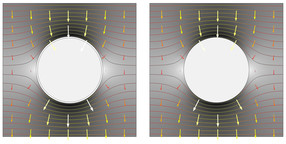
The electric shielding boundary condition is meant to approximate a thin layer of highly conductive material that provides an additional current path tangential to a boundary. This example compares the electric shielding boundary condition to a full-fidelity model and discusses the range ... Read More
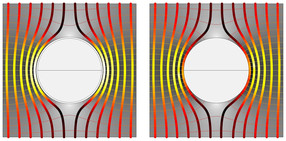
The contact impedance boundary condition is meant to approximate a thin layer of material that impedes the flow of current normal to the boundary, but does not introduce any additional conduction path tangential to the boundary. This example compares the contact impedance boundary ... Read More
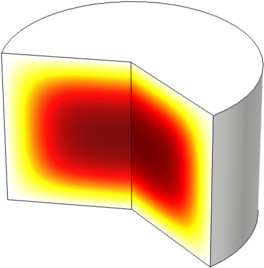
This is a benchmark model for an axisymmetric transient thermal analysis. The temperature on the boundaries changes from 0 degrees C to 1000 degrees C at the start of the simulation. The temperature at 190 s from the anlysis is compared with a NAFEMS benchmark solution. Read More
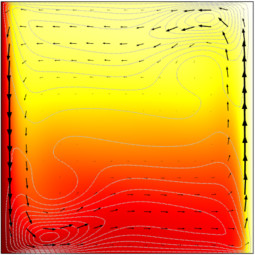
This model couples the Navier Stokes equations and the heat transfer equations to examine density driven flow of free fluids. Here the fluid is in a square cavity with a heated wall. The buoyancy force is a Boussinesq term added to the Navier-Stokes equations. The equation is ... Read More
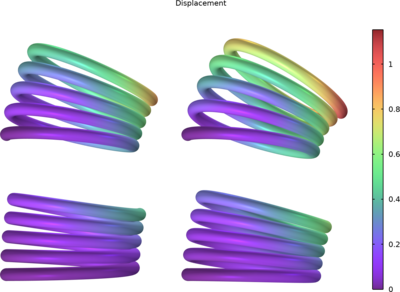
This example shows how to set up self-contact for a coil spring. As the spring is compressed by a vertical force applied to one of its ends, it comes into to contact with itself and starts to rotate. Read More
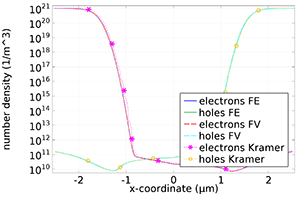
This simple benchmark model computes the potential and carrier concentrations for a one-dimensional p-n junction using both the finite element and finite volume methods. The results are compared with an equivalent device from the book, "Semiconductor Devices: A Simulation Approach," by ... Read More
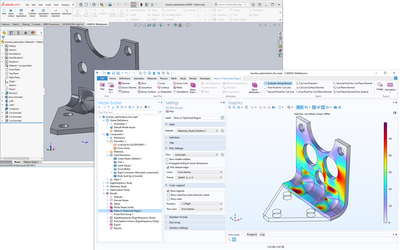
This example minimizes the mass of a bracket that is synchronized from SOLIDWORKS® via the LiveLink™ interface. There are limits both for the lowest natural frequency, and for the maximum stress in a static load case. The size and position for a number of geometrical features ... Read More
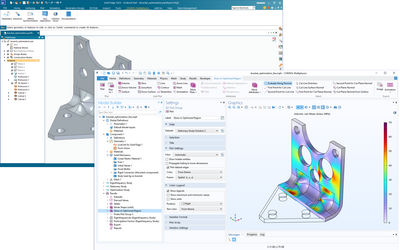
This tutorial minimizes the mass of a bracket that is synchronized from Solid Edge® via the LiveLink™ interface. There are limits both for the lowest natural frequency, and for the maximum stress in a static load case. The size and position for a number of geometrical features ... Read More
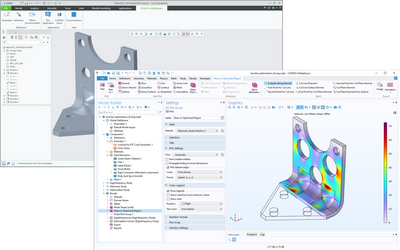
This tutorial minimizes the mass of a bracket that is synchronized from PTC Creo Parametric™ via the LiveLink™ interface. There are limits both for the lowest natural frequency, and for the maximum stress in a static load case. The size and position for a number of ... Read More
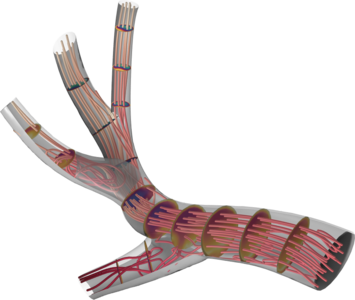
This example treats a pulmonary artery stenosis as a porous medium and demonstrates how to set up a model that combines free and porous media flow of a non-Newtonian fluid. The non-Newtonian behavior of blood is modeled using the Carreau model. Read More


