
The Application Gallery features COMSOL Multiphysics® tutorial and demo app files pertinent to the electrical, structural, acoustics, fluid, heat, and chemical disciplines. You can use these examples as a starting point for your own simulation work by downloading the tutorial model or demo app file and its accompanying instructions.
Search for tutorials and apps relevant to your area of expertise via the Quick Search feature. Note that many of the examples featured here can also be accessed via the Application Libraries that are built into the COMSOL Multiphysics® software and available from the File menu.
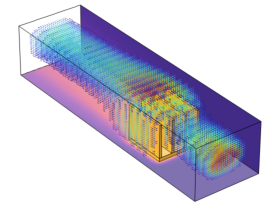
This tutorial model uses a heat sink geometry from the Part Library. The tutorial shows different approaches to heat transfer modeling when studying the cooling of an electronic chip. In the first part, only the solid parts are modeled, while the convective airflow is modeled using ... Read More

These models are featured in the blog post Analyze Violin Tone and Volume with Multiphysics Modeling. One applies acoustic-structure interaction to study how the air mode resonance is affected by the coupled vibrations in the violin body. The other uses a potential flow approximation to ... Read More
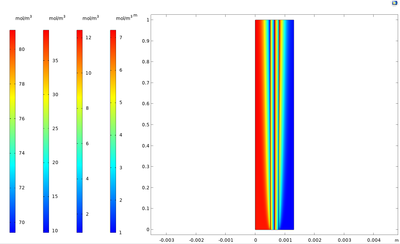
Example of membrane dialysis with a two-layered membrane. A second Reaction Engineering component models a tank connected to the inlet and outlets of the dialysate channel. Read More
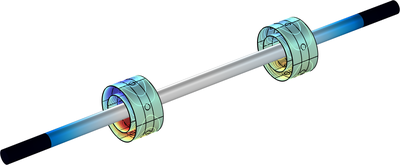
In this model, a turbocharger supported on two floating ring bearings is studied. The film forces on the ring cause it to rotate within the bearing. In steady state, the ring rotates at a constant angular speed and the torque on the ring due to the inner and outer films are balanced. ... Read More
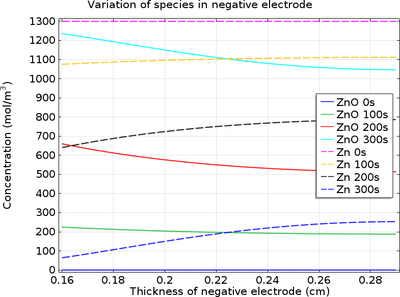
Zinc-Silver oxide (Zn-AgO) batteries are used in different industries due to their high capacity per unit weight. In this work, discharge of a Zn-AgO battery is simulated using the Battery with Binary Electrolyte interface. The electrochemical reactions in the positive and negative ... Read More
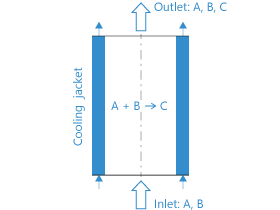
This alternative version of the Tubular Reactor app demonstrates how computational speed can be significantly increased by using a surrogate model instead of a full finite element model. A surrogate model is a simplified, computationally efficient approximation of a more complex and ... Read More
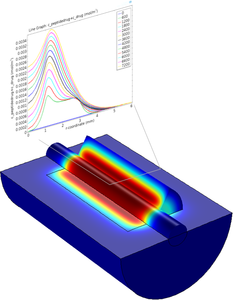
In this example, drug-release from a biomaterial matrix to damaged cell tissue is modeled. Specifically, a nerve guide delivers a regenerating drug to damaged nerve ends. The model involves detailed drug release kinetics, with rate expressions handling drug dissociation/association ... Read More
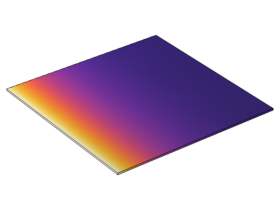
This example models heat transfer in a thin rectangular metal plate. Because the plate’s thickness is only 1/100 of its length and width, you can simulate the process using a 2D approximation. The plate has a fixed temperature at one end and is isolated at the other. A surrounding liquid ... Read More

In this time-dependent model, a silica block of glass, coated with a thin copper layer is subjected to a heat flux. Copper is a highly conductive material, while the silica glass is of poor thermal conductivity, which sets up an highly-varied temperature differential. The model must ... Read More
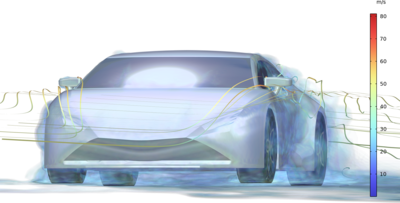
FSI analysis of a sports car side door and side rear view mirror. The model is based on large eddy simulation analysis of a sports car. The flow field is used for a structural analysis of the side mirror and side door to estimate the flow-induced vibrations. Read More