
The Application Gallery features COMSOL Multiphysics® tutorial and demo app files pertinent to the electrical, structural, acoustics, fluid, heat, and chemical disciplines. You can use these examples as a starting point for your own simulation work by downloading the tutorial model or demo app file and its accompanying instructions.
Search for tutorials and apps relevant to your area of expertise via the Quick Search feature. Note that many of the examples featured here can also be accessed via the Application Libraries that are built into the COMSOL Multiphysics® software and available from the File menu.
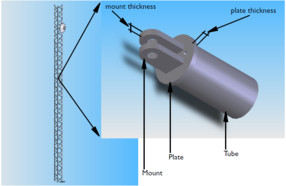
The example Stiffness Analysis of a Communication Mast’s Diagonal Mounting in the COMSOL Multiphysics Model Library shows how you can modify a 3D CAD model to improve its performance. In that case, the applied changes were based solely on the analyst’s experience with similar structures. ... Read More
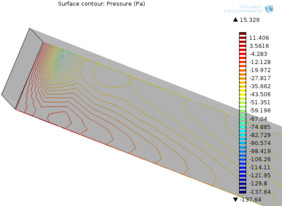
A lab-on-a-chip platform can be realized on a rotating disc by designing channels and other features to use the Coriolis or centrifugal forces to manipulate the flow. These forces are controlled by changing the angular velocity of the disc, so the platform is programmed by using a ... Read More
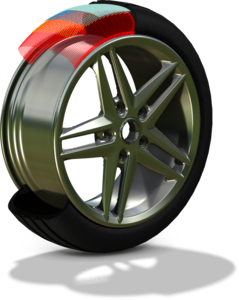
This model showcases how to use fibers in thin layers to model thin anisotropic composites embedded in a solid without explicitly drawing either the layer of material or the reinforcing fibers. Here, it is used to model steel cords in tire belts that are used to provide structural ... Read More
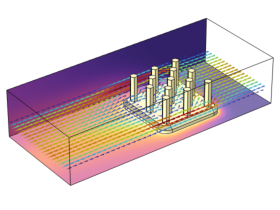
This model is intended as a first introduction to simulations of fluid flow and conjugate heat transfer. It shows you how to: Draw an air box around a device in order to model convective cooling in this box, set a total heat flux on a boundary using automatic area computation, and ... Read More
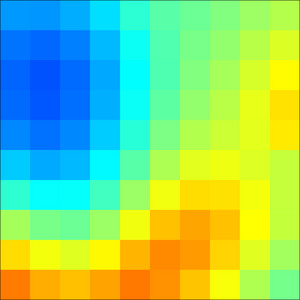
This model uses the Optimization interface to solve the inverse problem for determining the spatially variable hydraulic conductivity on a discretized quadratic grid from a number of aquifer pump tests. Because the number of observations is smaller than the number of unknown parameters, ... Read More
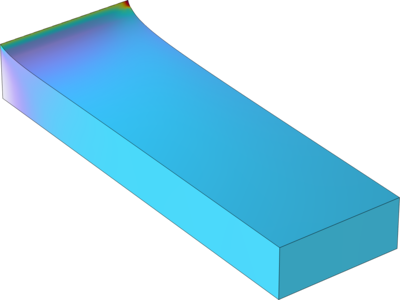
This model shows how you can implement a user defined hyperelastic material, using the strain density energy function. The model used is a general Mooney–Rivlin hyperelastic material model defined by a polynomial. In this example, you will see two material models based on the defined ... Read More
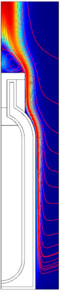
The following example solves a pure conduction and a free-convection problem in which a vacuum flask holding hot coffee dissipates thermal energy. The main interest is to calculate the flask's cooling power; that is, how much heat it loses per unit time. This tutorial model treats the ... Read More
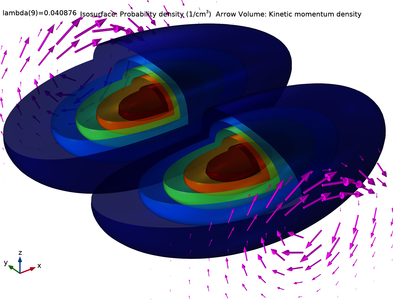
This tutorial model solves a two-component Schrödinger equation for the eigenstates of a simple silicon quantum dot in a uniform magnetic field, based on the paper by Jock et al. on the topic of spin-orbit qubits. The built-in domain condition Lorentz Force for the Schrödinger Equation ... Read More

This tutorial model solves for a hydrogen plasma created in a microwave cavity. The model computes the fluid flow and gas heating self-consistently. Read More
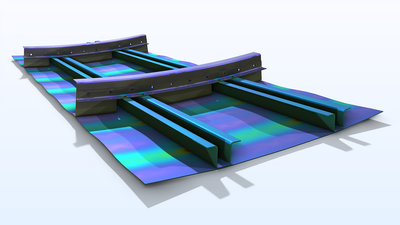
This model studies the structural deformation of an aircraft fuselage structure subjected to buckling loads. The structure is an assembly of panels and skin connected by rivets. The Fasteners feature sets up a large number of connections and computes the forces acting on each rivet. Read More