
The Application Gallery features COMSOL Multiphysics® tutorial and demo app files pertinent to the electrical, structural, acoustics, fluid, heat, and chemical disciplines. You can use these examples as a starting point for your own simulation work by downloading the tutorial model or demo app file and its accompanying instructions.
Search for tutorials and apps relevant to your area of expertise via the Quick Search feature. Note that many of the examples featured here can also be accessed via the Application Libraries that are built into the COMSOL Multiphysics® software and available from the File menu.
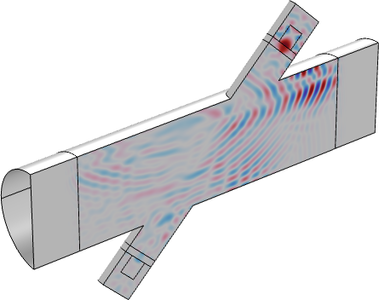
Ultrasonic flowmeters determine the velocity of a fluid flowing through a pipe by sending an ultrasonic signal across the flow at a skew angle. When there is no flow, the transmitting time between the transmitter and the receiver is the same for the signals sent in the upstream and ... Read More
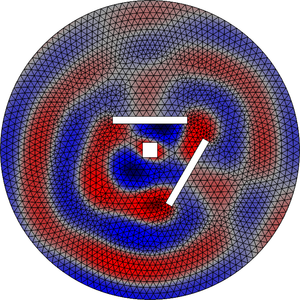
This simple tutorial model shows how to set up a parametric sweep over a number of frequency bands (octaves or 1/3 octaves) and remesh once per band. A frequency sweep is performed within each band, which now has an adequate mesh resolution. This approach saves some computational effort ... Read More
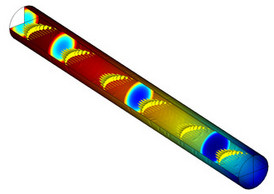
Tubular reactors are often used in continuous large-scale production, for example in the petroleum industry. One key design parameter is the conversion, or the amount of reactant that reacts to form the desired product. In order to achieve high conversion, process engineers optimize the ... Read More
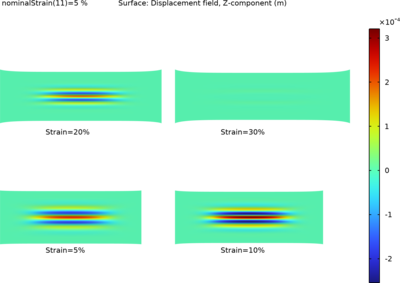
This example demonstrates the wrinkling of a thin rectangular sheet stretched uniaxially. First, a static analysis is performed to determine the region of negative principal stresses without wrinkling. Next, a prestressed buckling analysis is carried out to find out the linearized ... Read More
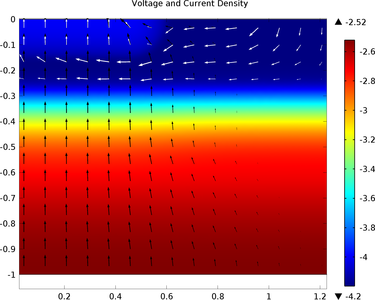
This model shows how to set up a simple Bipolar Transistor model. The output current-voltage characteristics in the common-emitter configuration are computed and the common-emitter current gain is determined. Read More
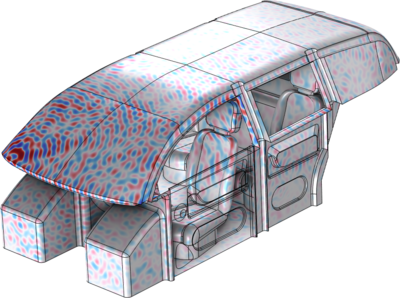
Solving very large pressure acoustics models in the frequency domain can be challenging. Several iterative solver suggestions exist for the default physics setups and the default quadratic Lagrange discretization. For very large models it can be advantageous to switch from quadratic to ... Read More

This tutorial studies the etching of silicon using an inductively coupled plasma reactor with an RF bias in a mixture of CF4/O2. The etching rate is computed along the wafer as a function of the RF bias voltage. Read More
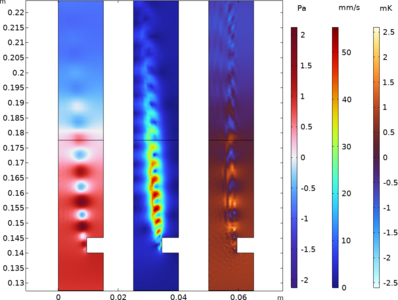
This model studies a small orifice located in a duct. The transmission and reflection coefficients of the system are computed in the presence of a bias flow using the linearized Navier-Stokes equations. For certain frequencies the transmission coefficient shows amplification (T>1). This ... Read More
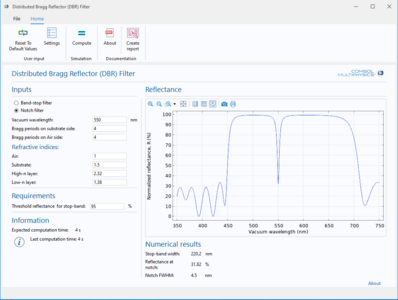
A distributed Bragg reflector (DBR) is a periodic structure formed from alternating dielectric layers that can be used to achieve nearly total reflection within a range of frequencies. The main advantage of DBRs over ordinary metallic mirrors is that DBRs can be engineered to have custom ... Read More
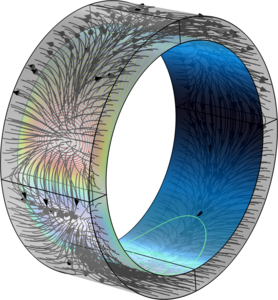
This example describes how to simulate the self-lubricating phenomenon of a liquid lubricant in a journal bearing. A porous bushing is press-fitted to a bearing and saturated with a lubricant. It acts as a reservoir for the redistribution of the thin film of lubricant between regions of ... Read More