
The Application Gallery features COMSOL Multiphysics® tutorial and demo app files pertinent to the electrical, structural, acoustics, fluid, heat, and chemical disciplines. You can use these examples as a starting point for your own simulation work by downloading the tutorial model or demo app file and its accompanying instructions.
Search for tutorials and apps relevant to your area of expertise via the Quick Search feature. Note that many of the examples featured here can also be accessed via the Application Libraries that are built into the COMSOL Multiphysics® software and available from the File menu.
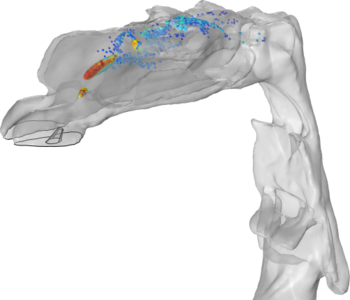
This example demonstrates how to import and repair a surface mesh from an STL file, and to create a mesh to simulate nasal spray application inside the human upper airways. It further demonstrates how to combine the repaired mesh with the geometry of a nasal spray, then to remesh and ... Read More

The present model example is based on Copper Deposition in a Trench model available in Electrodeposition Application Library. The nonuniform deposition along the trench surface leads to formation of a cavity/void. Since the Deformed Geometry interface cannot handle topological changes, ... Read More

A solidly-mounted resonator (SMR) is a piezoelectric MEMS resonator formed on top of an acoustic mirror stack deposited on a thick substrate. This tutorial shows how to simulate an SMR in 2D. In this example, the eigenmodes were computed and the frequency response from 500 to 1200 MHz ... Read More
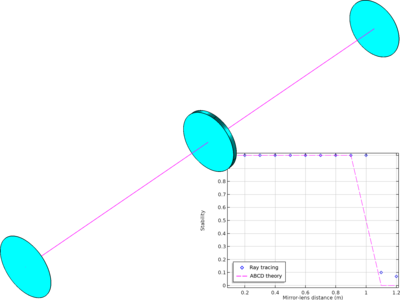
In this model, two flat end mirrors are placed at a distance and a spherical lens is inserted in the middle of the cavity. A ray is released from a point inside the cavity. Then the ray is traced for a predefined time period that is sufficiently long. Ray tracing continues until the ... Read More
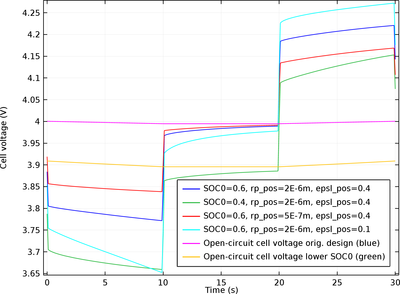
This tutorial digs deeper into the investigation of rate capability in a battery and shows how the Lithium-Ion Battery interface is an excellent modeling tool for doing this. The rate capability is studied in terms of polarization (voltage loss) or the internal resistance causing this ... Read More
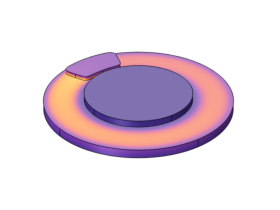
This example models the transient heating, and final temperature, of a disc brake of a car in brake-and-release sequence. It is important to model the transient heating and the following convective cooling to determine the minimum interval between a series of similar brake engagements. ... Read More
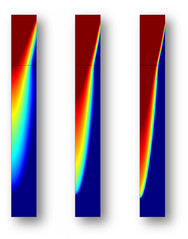
This example is a model of a continuous casting process. Liquid metal is poured into a mold of uniform cross section. The outside of the mold is cooled and the metal solidifies as it flows through. When the metal leaves the mold, it is completely solidified on the outside, but still ... Read More
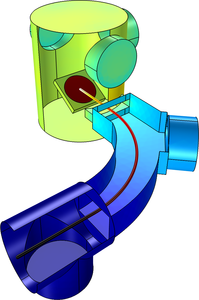
Ion implantation is used extensively in the semiconductor industry to implant dopants into wafers. Within an ion implanter, ions generated within an ion source are accelerated by an electric field to achieve the desired implant energy. Ions of the correct charge state are selected by ... Read More

This model demonstrates how to setup a Time Domain to Frequency FFT study for a distributed Bragg reflector (DBR) structure. The results agree well with the results of a regular Frequency domain study. Read More
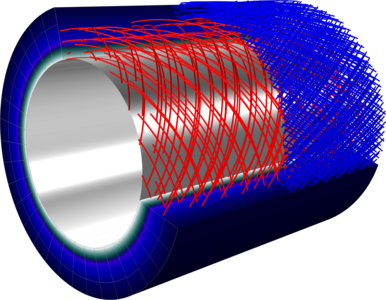
This model shows how to implement an anisotropic, incompressible, hyperelastic material for modeling soft collagenous tissue in arterial walls. The hyperelastic material model implemented is based on the articles: Holzapfel, G. A., Gasser, T. C., & Ogden, R. W. (2000), A new ... Read More


