
The Application Gallery features COMSOL Multiphysics® tutorial and demo app files pertinent to the electrical, structural, acoustics, fluid, heat, and chemical disciplines. You can use these examples as a starting point for your own simulation work by downloading the tutorial model or demo app file and its accompanying instructions.
Search for tutorials and apps relevant to your area of expertise via the Quick Search feature. Note that many of the examples featured here can also be accessed via the Application Libraries that are built into the COMSOL Multiphysics® software and available from the File menu.

The present model example is based on Copper Deposition in a Trench model available in Electrodeposition Application Library. The nonuniform deposition along the trench surface leads to formation of a cavity/void. Since the Deformed Geometry interface cannot handle topological changes, ... Read More
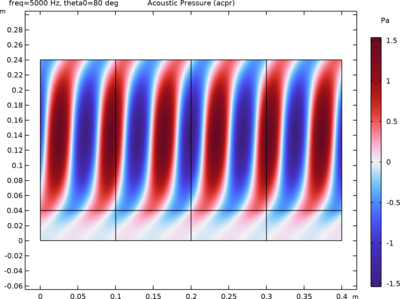
This is a 2D model of an anisotropic porous absorbing material. The absorption coefficient alpha are determined as functions of frequency for three different incidence angles. The example uses Periodic Floquet boundary conditions. The model uses two different methods for modeling the ... Read More
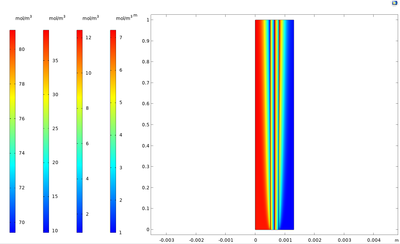
Example of membrane dialysis with a two-layered membrane. A second Reaction Engineering component models a tank connected to the inlet and outlets of the dialysate channel. Read More
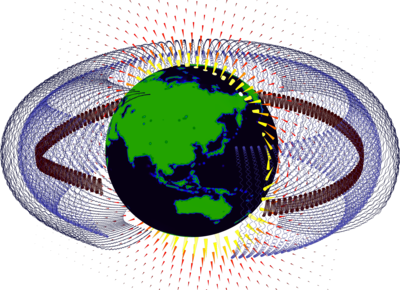
This model demonstrates the path of relativistic protons within Earth's magnetic field. Due to the dipole nature of Earth's magnetic field, charged particles, such as electrons and protons, can get trapped in stable configurations within it for long periods of time. These ... Read More
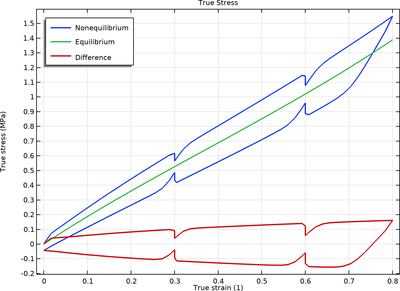
In this example, the Bergstrom–Boyce material model is used to capture the nonequilibrium behavior of carbon-black-filled chloroprene rubber under a strain history that alternates compression with relaxation. Results are verified against experimental and numerical results taken from ... Read More
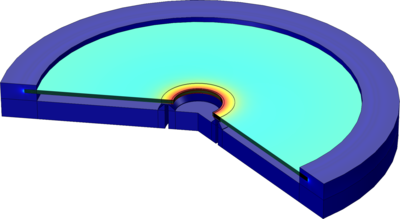
Piezoelectric valves are frequently employed in medical and laboratory applications due to their fast response times and quiet operation. Their energy efficient operation, also dissipates little heat, which is often important for these applications. This model shows how to model a ... Read More
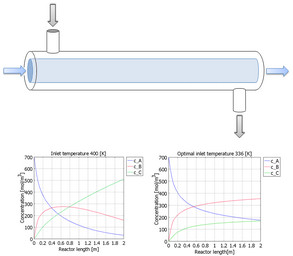
Maximizing product yield is a main task in chemical reaction engineering. This can be especially challenging if the desired product, once formed, can be consumed by further reactions. This example investigates such a series reaction as it occurs in a tubular reactor. You will start by ... Read More
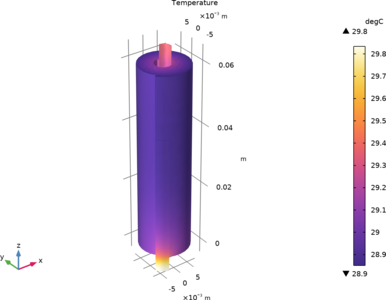
In a cylindrical or prismatic battery cell, the active layers, current collector metal foils and separators are wound into a “jelly roll”. Additional tabs (metal strips) are welded to the current collector foils in order to conduct the current to the exterior of the cell can. The ... Read More

The mutual inductance and induced currents between a single turn primary and twenty turn secondary coil in a concentric coplanar arrangement is computed using a frequency domain model. Each turn of the secondary coil is modeled explicitly. The results are compared against analytic ... Read More
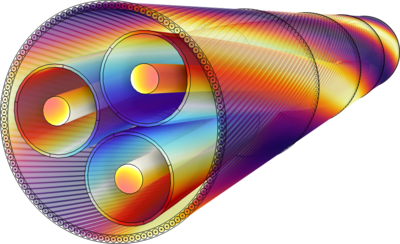
In this set of eight tutorial models and associated documentation, you can investigate the resistive, capacitive, inductive, and thermal properties of a standard three-core lead-sheathed XLPE HVAC submarine cable with twisted magnetic armor (500 mm2, 220 kV). The series includes a 2D, 2D ... Read More