
The Application Gallery features COMSOL Multiphysics® tutorial and demo app files pertinent to the electrical, structural, acoustics, fluid, heat, and chemical disciplines. You can use these examples as a starting point for your own simulation work by downloading the tutorial model or demo app file and its accompanying instructions.
Search for tutorials and apps relevant to your area of expertise via the Quick Search feature. Note that many of the examples featured here can also be accessed via the Application Libraries that are built into the COMSOL Multiphysics® software and available from the File menu.
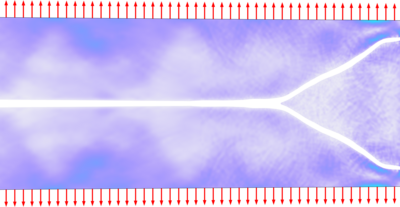
In this example, a benchmark problem in dynamic fracture of brittle materials is analyzed using the AT1 phase-field damage model. An instantaneous tensile load is applied to a planar tension specimen with a pre-existing crack. Initially, the crack propagates perpendicular to the loading ... Read More
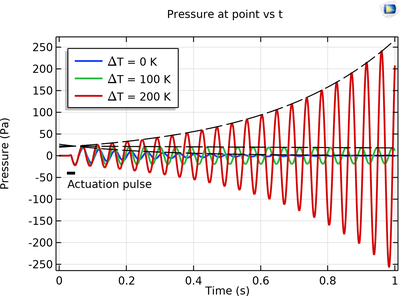
This is a model of a simple thermoacoustic engine that includes a thermal stack to convert thermal energy to acoustic energy. The model is set up using two approaches: 1) Using a linear perturbation (acoustic) approaches solving the fluid motion with the Thermoviscous Acoustics, ... Read More
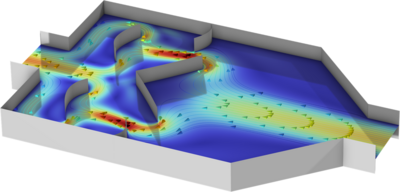
The topology optimized Tesla microvalve is used as an inspiration for an initial geometry. Second order Bernstein polynomials are used to perturb the shape of the geometry. The resulting design is remeshed in the deformed configuration and the performance is investigated for a range of ... Read More
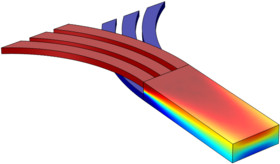
At the macroscopic level, systems usually mix fluids using mechanical actuators or turbulent 3D flow. At the microscale level, however, neither of these approaches is practical or even possible. This model demonstrates the mixing of fluids using laminar-layered flow in a MEMS mixer. This ... Read More

The present model example is based on Copper Deposition in a Trench model available in Electrodeposition Application Library. The nonuniform deposition along the trench surface leads to formation of a cavity/void. Since the Deformed Geometry interface cannot handle topological changes, ... Read More

The present model example is based on Copper Deposition in a Trench model available in Electrodeposition Application Library. The nonuniform deposition along the trench surface leads to formation of a cavity/void. Since the Deformed Geometry interface cannot handle topological changes, ... Read More
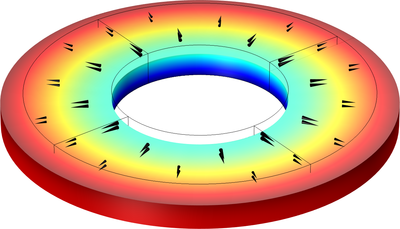
This tutorial model shows how a user-defined coordinate system can be used to create any type of directional polarization of a piezoelectric material. Results are shown for the case of radial polarization of a piezoelectric disk. The piezoelectric material is PZT-5H. The example shows a ... Read More
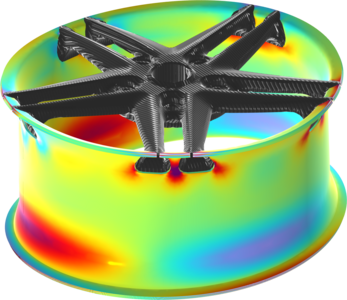
Nowadays, there is a trend to manufacture wheel rim made up of a composite material instead of aluminum. The primary reason is to have lower values of unsprung mass which leads to faster response time and thus better acceleration, braking and cornering performances. Typically a carbon ... Read More
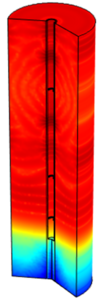
This model demonstrates how to simulate a piezoelectric transducer as both a sound transmitter and a receiver in a well logging setup. Other applications of this setup are, for example, in the field of nondestructive testing. A transmitting transducer is connected to an electrical ... Read More
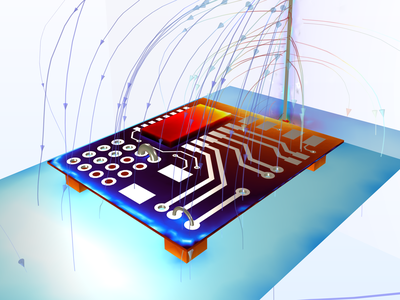
This example demonstrates how an ESD event causes logic error of a microchip on a PCB board. The ESD current is based on the extended HBM (Human Body Model) and it is predefined in the Lumped Port feature. Read More