
The Application Gallery features COMSOL Multiphysics® tutorial and demo app files pertinent to the electrical, structural, acoustics, fluid, heat, and chemical disciplines. You can use these examples as a starting point for your own simulation work by downloading the tutorial model or demo app file and its accompanying instructions.
Search for tutorials and apps relevant to your area of expertise via the Quick Search feature. Note that many of the examples featured here can also be accessed via the Application Libraries that are built into the COMSOL Multiphysics® software and available from the File menu.

This model demonstrates how to set up a fully coupled poroviscoelastic model of biological tissues. The model is benchmarked by simulating a cyclic uniaxial tension–compression test on human brain tissue. Read More
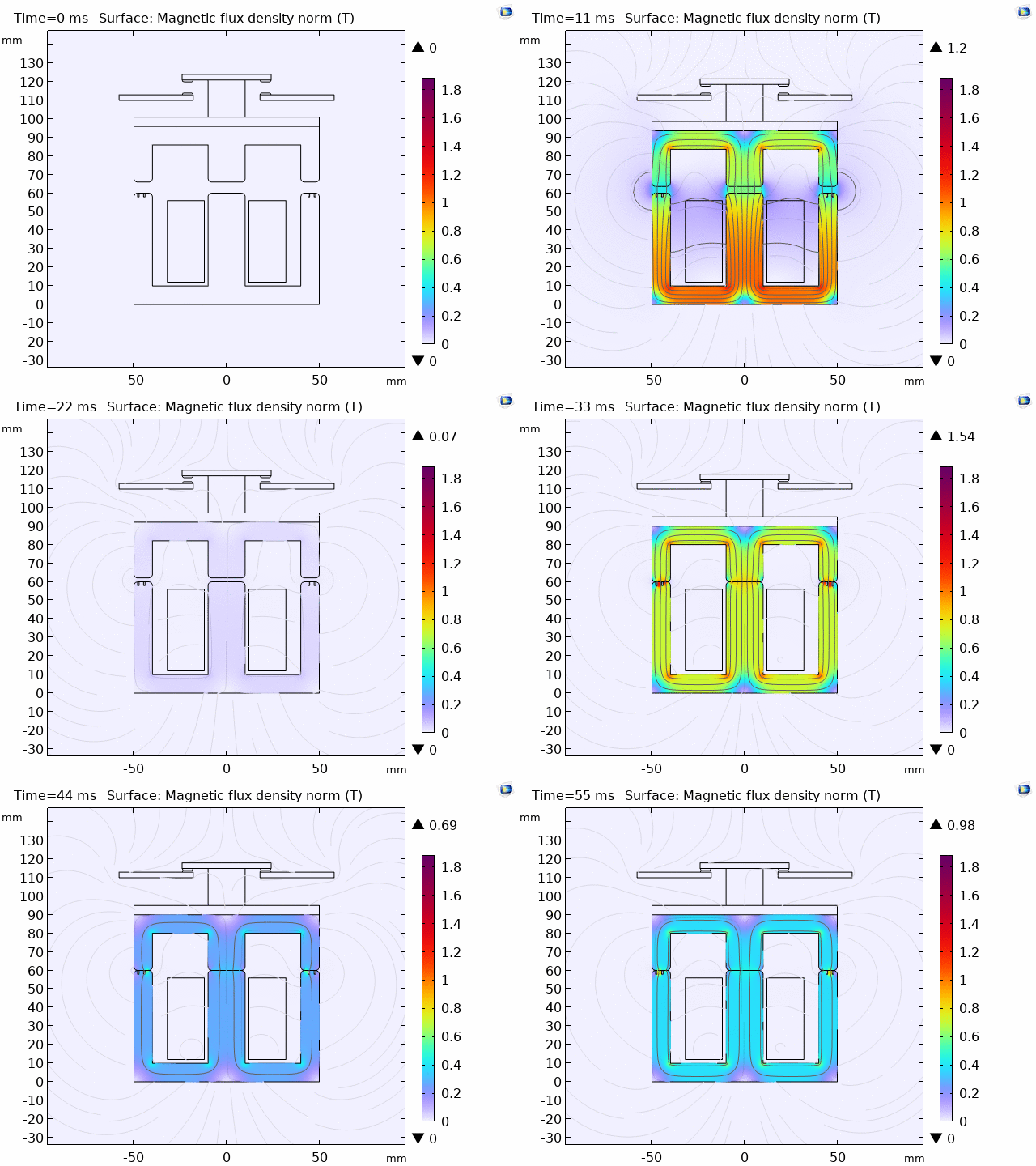
An AC contactor is a particular type of magnetic switch device, which is activated by a primary coil fed by an alternating current. Unlike DC switches, such devices can suffer from a tendency to reopen when the AC current crosses zero. The addition of a shading coil that supports ... Read More
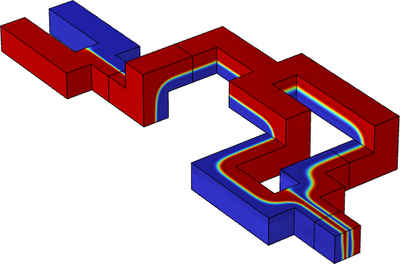
This example models a split-and-recombine mixer channel in which a tracer fluid is introduced and mixed by multilamination. Diffusion is removed from the model using an extremely low diffusion coefficient so that any numerical diffusion can be studied in the lamination interfaces. The ... Read More
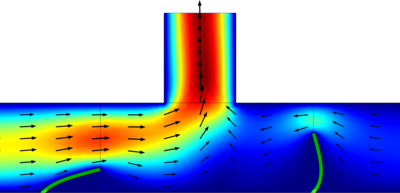
Micropumps are key components of microfluidic systems with applications ranging from biological fluid handling to microelectronic cooling. This model simulates the mechanism of a valveless micropump, that is designed to be effective at low Reynolds numbers, overcoming hydrodynamic ... Read More

Fluence rate is a key parameter for ultraviolet (UV) water purifier. It describes the amount of radiation that pathogens absorb and is then directly related to the disinfection level of the purifier. The aim of this example is to demonstrate the fluence rate calculation with the ... Read More
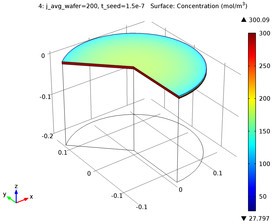
This example extends the analysis made in the model Electrodeposition on a Resistive Patterned Wafer by including the diffusion and convection of copper ions in the electrolyte. The coupled mass transport convection-diffusion effects are of interest in this type of reactor since they ... Read More
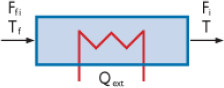
This example considers the thermal cracking of acetone, which is a key step in the production of acetic anhydride. The gas phase reaction takes place under nonisothermal conditions in a plug-flow reactor. As the cracking chemistry is endothermic, control over the temperature in the ... Read More
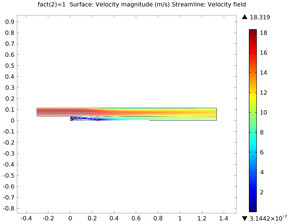
The backward facing step is an interesting case for studying the performance and solution strategy of a turbulence model. In this case, the flow is subjected to a sudden increase of cross-sectional area, resulting in a separation of flow starting at the point of expansion. Spatial ... Read More

This application presents an example of pressure driven flow and electrophoresis in a 3D micro channel system. Researchers often use a device similar to the one in this model as an electrokinetic sample injector in biochips to obtain well-defined sample volumes of dissociated acids and ... Read More
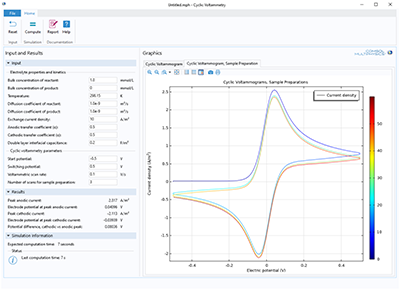
The purpose of the app is to demonstrate and simulate the use of cyclic voltammetry. You can vary the bulk concentration of both species, transport properties, kinetic parameters, as well as the cycling voltage window and scan rate. Cyclic voltammetry is a common analytical technique ... Read More


