
The Application Gallery features COMSOL Multiphysics® tutorial and demo app files pertinent to the electrical, structural, acoustics, fluid, heat, and chemical disciplines. You can use these examples as a starting point for your own simulation work by downloading the tutorial model or demo app file and its accompanying instructions.
Search for tutorials and apps relevant to your area of expertise via the Quick Search feature. Note that many of the examples featured here can also be accessed via the Application Libraries that are built into the COMSOL Multiphysics® software and available from the File menu.
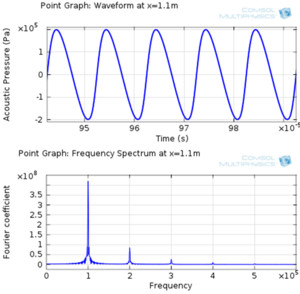
This model example shows how to model nonlinear propagation of 1D finite-amplitude Acoustic waves in fluids using Acoustics Module of COMSOL Multiphysics. The model is based on the 2nd order Westervelt equation. The one dimensional nonlinear wave equation is solved in the time domain by ... Read More
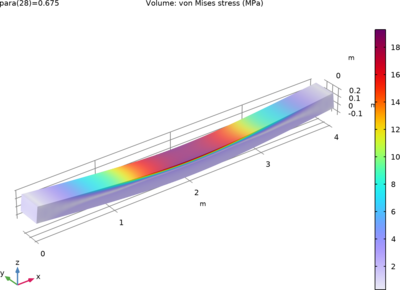
Concrete structures almost always contain reinforcements in the shape of steel bars ("rebars"). In COMSOL, rebars can be modeled either individually by adding a Truss interface to the Solid interface used for the concrete or using the Fiber subfeature to model their global effect. In ... Read More
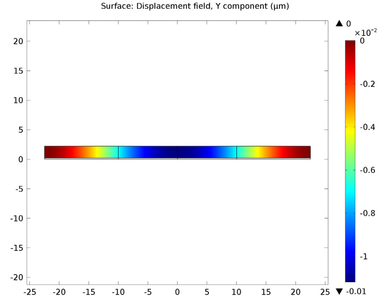
Silicon micromechanical resonators have long been used for designing sensors and are now becoming increasingly important as oscillators in the consumer electronics market. In this series of models, a surface micromachined MEMS resonator, designed as part of a micromechanical filter, is ... Read More
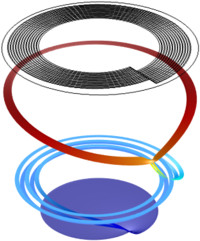
Due to the large differences in length scales in a lithium-ion battery, with the thickness of the different layers typically being several orders of magnitude smaller than the extension in the sheet direction, a lithium-ion battery is often well represented by a one-dimensional model. ... Read More
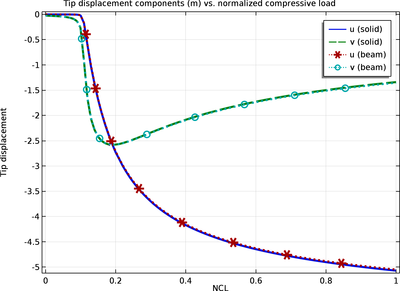
This example studies the deflection of a cantilever beam undergoing very large deflections. The beam is modeled using both the Solid Mechanics interface and the Beam interface. The results are compared with each other and with a benchmark solution from NAFEMS. In addition, a linear ... Read More
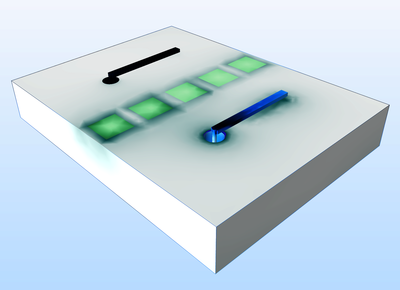
An Electromagnetic Band Gap (EBG) structure can be used to increase the isolation between antennas close to each other. The decoupling effect is not only a function of frequency but also polarization and coupling-plane configuration. When designing an EBG structure, one needs to make ... Read More
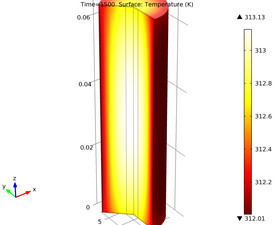
This model example simulates an air-cooled cylindrical 18650 lithium-ion battery during a charge-discharge cycle, followed by a relaxing period. A lumped (0D) cell model is used to model the battery cell chemistry, and a two-dimensional axi-symmetrical model is used to model the ... Read More
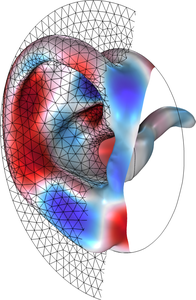
This model is of the P.57 Type 4.3 Full-band Ear Simulator. The model includes the geometry of the ear canal as well as the pinna defined in the ITU-T P.57 standard. The model also includes interpolation data for an ear drum impedance ensuring correct acoustic properties of the ear. The ... Read More
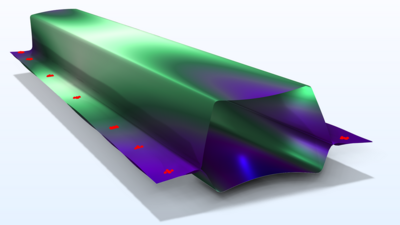
In this example, the natural frequencies of a double hat beam are studied. The beam is made of two thin steel plates, joined together by spot welds along the flanges. The Spot Welds feature sets up multiple mesh-independent connections between the shells. Read More
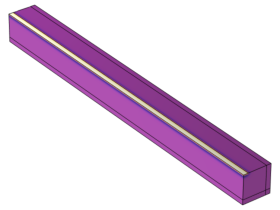
The model demonstrates the basics of the 3-omega method. The coupled electromagnetic heating problem is solved in a solid sample which is heated by a thin copper strip, deposited on the surface of a sample. Analyzing the frequency dependence of the voltage oscillation amplitude, we ... Read More