
The Application Gallery features COMSOL Multiphysics® tutorial and demo app files pertinent to the electrical, structural, acoustics, fluid, heat, and chemical disciplines. You can use these examples as a starting point for your own simulation work by downloading the tutorial model or demo app file and its accompanying instructions.
Search for tutorials and apps relevant to your area of expertise via the Quick Search feature. Note that many of the examples featured here can also be accessed via the Application Libraries that are built into the COMSOL Multiphysics® software and available from the File menu.
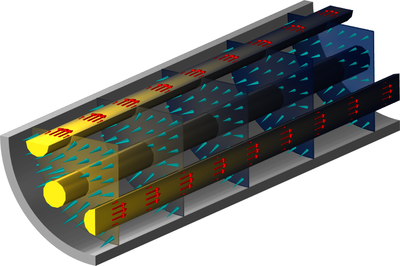
In fuel cell power generators, a steam reformer unit typically produces the hydrogen needed for the cell stack. This example illustrates the modeling of a steam reformer. The reformation chemistry occurs in a porous catalytic bed where energy is supplied through heating tubes to drive ... Read More
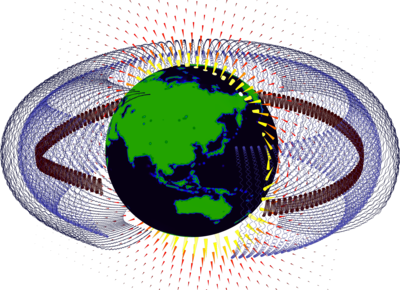
This model demonstrates the path of relativistic protons within Earth's magnetic field. Due to the dipole nature of Earth's magnetic field, charged particles, such as electrons and protons, can get trapped in stable configurations within it for long periods of time. These ... Read More
This model how to build and solve a conductive heat transfer problem using the Heat Transfer interface. The model, taken from a NAFEMS benchmark collection, shows an axisymmetric steady-state thermal analysis. As opposed to the NAFEMS benchmark model, we use the temperature unit kelvin ... Read More

This tutorial example of a comb drive tuning fork gyroscope is kindly provided by Dr. James Ransley at Veryst Engineering, LLC. The model demonstrates fully parameterized geometry, extensive use of selection features, implementation of analytic formulas for the electromechanical forces ... Read More
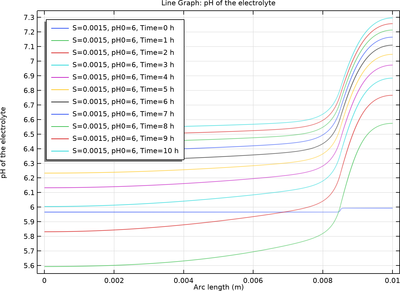
The model simulates atmospheric corrosion of a galvanic couple, comprising of an Al-Co-Ce metallic coating and an aluminum alloy, which is in contact with electrolyte film of 100 micrometer thickness. The corrosion inhibitors are released from the metallic coating and are transported ... Read More

This model defines a zero-gap alkaline water electrolyzer, where oxygen and hydrogen gas are evolved in porous gas diffusion nickel felt electrodes, placed adjacent to a porous separator (diaphragm). The geometry defines a unit cell of an electrolyzer stack, in turn comprising two full ... Read More
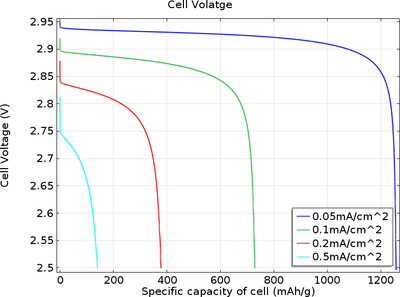
Rechargeable lithium-air batteries have recently attracted great interest mainly due to their high energy density. The theoretical value is about 11400 Wh/kg which is around 10 times greater than the lithium-ion batteries. In this tutorial, discharge of a lithium-air battery is ... Read More
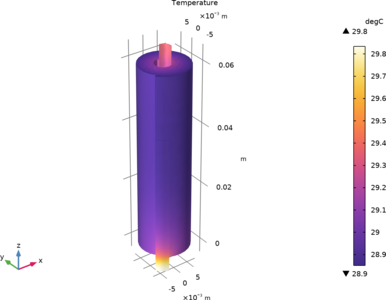
In a cylindrical or prismatic battery cell, the active layers, current collector metal foils and separators are wound into a “jelly roll”. Additional tabs (metal strips) are welded to the current collector foils in order to conduct the current to the exterior of the cell can. The ... Read More
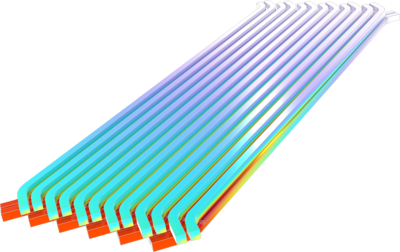
In a polymer electrolyte membrane fuel cell (PEMFC), water is produced at the cathode. The cell is also fed with water vapor via the inlet gas streams, in order to keep the polymer electrolyte membrane humidified. If the water partial pressure in the gas phase exceeds the vapor ... Read More
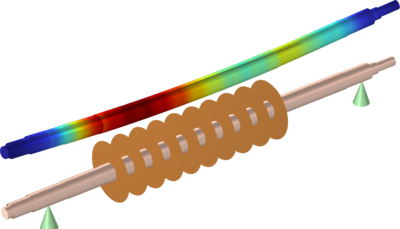
The fluid flow in seals causes a strong restoring radial force, opposing the shaft motion. Also, there is a cross coupled force due to the axial variation of the circumferential flow. The first type of force always has a stabilizing effect on the rotor, whereas the second one in certain ... Read More


