
The Application Gallery features COMSOL Multiphysics® tutorial and demo app files pertinent to the electrical, structural, acoustics, fluid, heat, and chemical disciplines. You can use these examples as a starting point for your own simulation work by downloading the tutorial model or demo app file and its accompanying instructions.
Search for tutorials and apps relevant to your area of expertise via the Quick Search feature. Note that many of the examples featured here can also be accessed via the Application Libraries that are built into the COMSOL Multiphysics® software and available from the File menu.
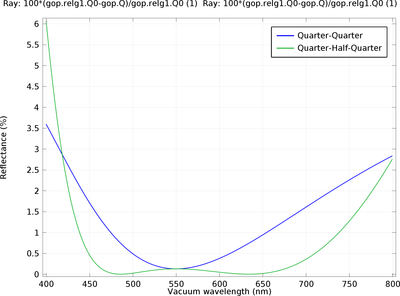
Anti-reflective coatings are frequently used in optical systems to reduce the amount of stray light produced when a beam of light crosses from one medium into another medium with a different refractive index. The simplest example of an anti-reflective coating is a quarter-wavelength ... Read More
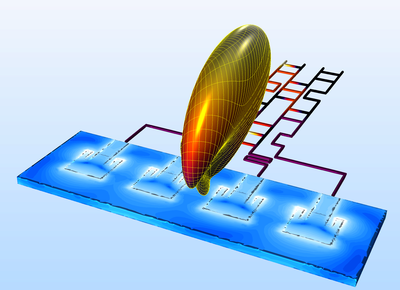
A Butler matrix is a passive beamforming feed network. It is a cost-effective feed network for phased array antennas because the circuit can be fabricated in the form of microstrip lines and is a viable solution for performing beam scanning without deploying expensive active devices. ... Read More
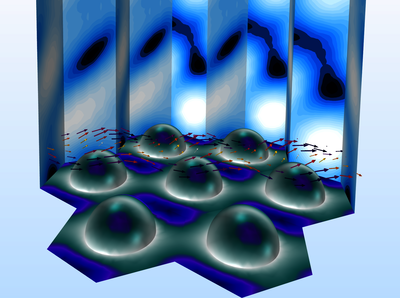
A plane wave is incident on a reflecting hexagonal grating. The grating cell consists of a protruding semisphere. The scattering coefficients for the different diffraction orders are calculated for a few different wavelengths. Read More

In this model of a single-beam optical trap, SiO2 nanospheres in streaming water pass by or get captured depending on where they are released from. The electromagnetic force on the particles is calculated in the Electromagnetic Waves, Frequency Domain interface, with a Gaussian ... Read More

This full-scale, time-dependent model of an offshore oil platform jacket involves modeling coating breakdown and estimating sacrificial anode life and the buildup of calcareous deposits on steel surfaces. The tutorial model aims to answer some of the common questions surrounding ... Read More
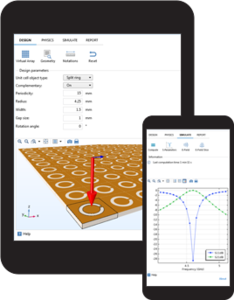
This app demonstrates the following: Designing an app for small screens such as smartphones User-interface navigation with a top menu typically used on websites Geometry parts and parameterized geometries Visualizing periodicity of a geometry with material rendering Warning messages on ... Read More
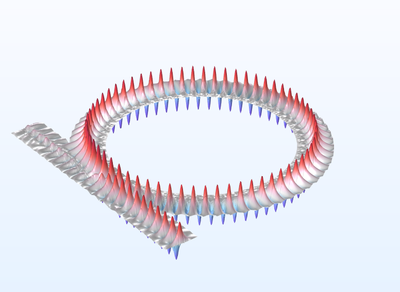
This example calculates the spectral properties of a 3D optical ring resonator. The model demonstrates how to use parts from the Wave Optics Parts Library and how to setup the Field Continuity boundary condition at boundaries, where there is a jump in the predefined phase approximation. Read More

Frequency selective surfaces (FSS) are periodic structures with a bandpass or a bandstop frequency response. This model shows that only signals around the center frequency can pass through the periodic complementary split ring resonator layer. Read More
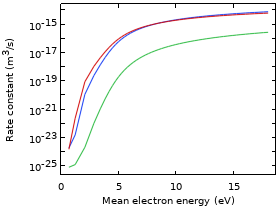
This model solves the Boltzmann equation in the two-term approximation for a background of molecular and atomic hydrogen. Electron mobility and source terms are computed by suitable integration of the electron energy distribution function over electron impact cross sections. Read More
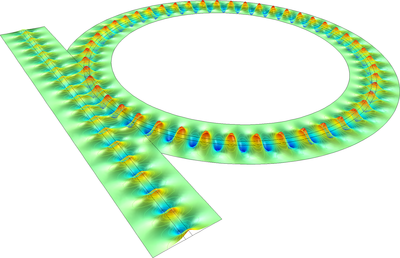
In its simplest form, an optical ring resonator consists of a straight waveguide and a ring waveguide. The waveguides are placed close to each other, making the light affect each between the two structures. If the propagation length around the ring is an integral number of wavelengths, ... Read More


