
The Application Gallery features COMSOL Multiphysics® tutorial and demo app files pertinent to the electrical, structural, acoustics, fluid, heat, and chemical disciplines. You can use these examples as a starting point for your own simulation work by downloading the tutorial model or demo app file and its accompanying instructions.
Search for tutorials and apps relevant to your area of expertise via the Quick Search feature. Note that many of the examples featured here can also be accessed via the Application Libraries that are built into the COMSOL Multiphysics® software and available from the File menu.
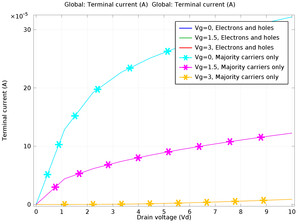
In a MESFET, the gate forms a rectifying junction that controls the opening of the channel by varying the depletion width of the junction. In this model we simulate the response of a n-doped GaAs MESFET to different drain and gate voltages. For a n-doped material the electron ... Read More
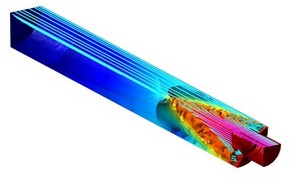
This example models the casting process of a metal rod from liquid to solid state using the Non-Isothermal Flow multiphysics interface, which combines heat transfer and fluid flow. The model describes the fluid and solid flow and heat transport, including the phase transfer from melt to ... Read More
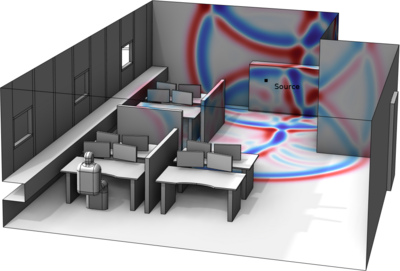
In this tutorial, the acoustics of an open-plan office space are analyzed using a wave-based approach in the time domain. An initial pulse is released and the room response is analyzed. Realistic frequency-dependent impedance conditions for the ceiling, carpet, and gypsum walls are ... Read More
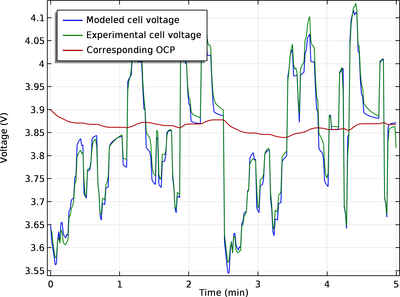
This tutorial uses a “black-box” approach to define a battery model based on a small set of lumped parameters, assuming no knowledge of the internal structure or design of the battery electrodes, or choice of materials. The input to the model is the battery capacity, the initial state ... Read More
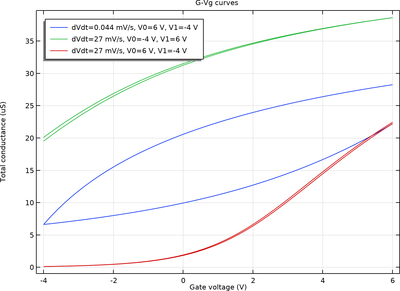
This tutorial analyzes the hysteresis of the conductance-gate-voltage (G-Vg) curves of an InAs nanowire FET, using the density-gradient theory to add the effect of quantum confinement to the conventional drift-diffusion formulation, without a large increase of computational costs. The ... Read More
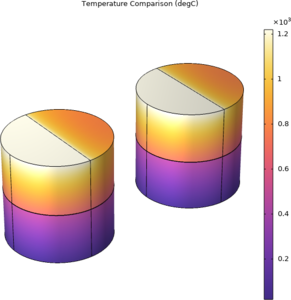
This example is a variant of the Composite Thermal Barrier tutorial and shows how to set up multiple sandwiched thin layers with different thermal conductivities in two different ways. First, the composite is modeled as a 3D object. In the second approach the Lumped Thermal System ... Read More
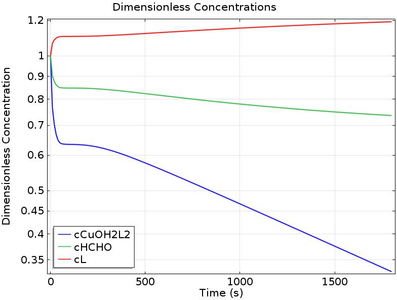
Electroless deposition or plating is a non-galvanic plating method that does not require any external electrical power. This technique is typically used for electroless plating of nickel, silver, gold and copper. In electroless deposition, partial oxidation and reduction reactions ... Read More

In this model a Knowles ED23146 receiver (miniature loudspeaker) is connected to a test set-up consisting of a 50 mm (1 mm diameter) earmold tube and a so-called 0.4-cc coupler. The receiver is modeled using a lumped spice network and connected to the finite element domain at the tube ... Read More
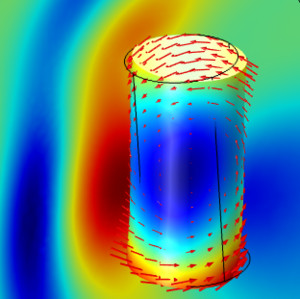
Liquid or gas acoustics coupled to structural objects such as membranes, plates or solids are important applications in many engineering fields. This model is a general demonstration of an acoustic fluid phenomenon in 3D that is coupled to a solid object. The walls of the solid object ... Read More
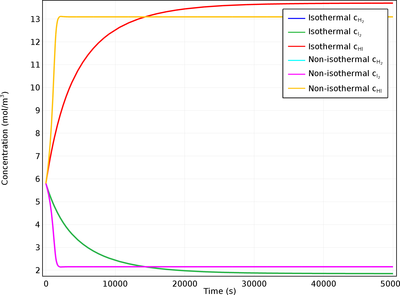
This tutorial example illustrates the versatility of the Reaction Engineering interface. The hydrogen iodine reaction is modeled in a batch reactor with constant volume. Both isothermal and non-isothermal conditions are modeled. Read More