
The Application Gallery features COMSOL Multiphysics® tutorial and demo app files pertinent to the electrical, structural, acoustics, fluid, heat, and chemical disciplines. You can use these examples as a starting point for your own simulation work by downloading the tutorial model or demo app file and its accompanying instructions.
Search for tutorials and apps relevant to your area of expertise via the Quick Search feature. Note that many of the examples featured here can also be accessed via the Application Libraries that are built into the COMSOL Multiphysics® software and available from the File menu.
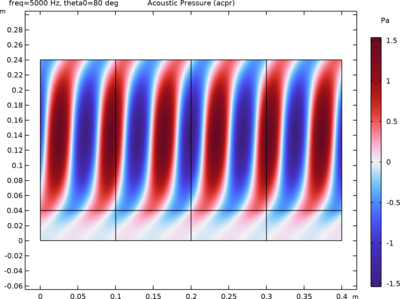
This is a 2D model of an anisotropic porous absorbing material. The absorption coefficient alpha are determined as functions of frequency for three different incidence angles. The example uses Periodic Floquet boundary conditions. The model uses two different methods for modeling the ... Read More
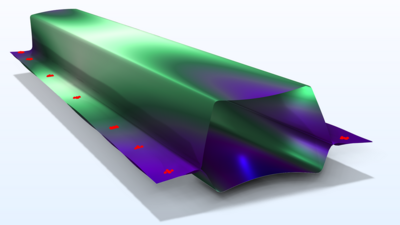
In this example, the natural frequencies of a double hat beam are studied. The beam is made of two thin steel plates, joined together by spot welds along the flanges. The Spot Welds feature sets up multiple mesh-independent connections between the shells. Read More
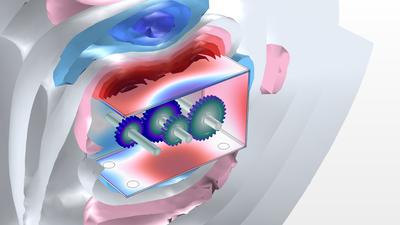
Predicting the noise radiation from a dynamic system gives designers insight into the behavior of moving mechanisms early in the design process. For example, consider a gearbox in which the change in the gear mesh stiffness causes vibrations. These vibrations are transmitted to the ... Read More
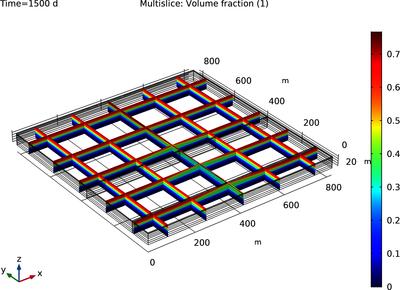
This example models an oil reservoir with two horizontal wells. The reservoir contains two phases, water and oil. Oil is recovered by injecting water through the bottom well, so the oil production rate and the water-oil production ratio over time are computed. Read More
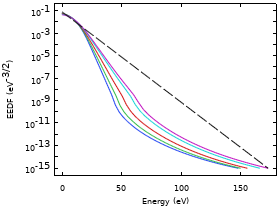
This tutorial models an ICP reactor by solving plasma fluid type equations fully coupled with the homogeneous and time-independent electron Boltzmann equation in the classical two-term approximation. The approximated Boltzmann equation is solved for each position of space and is coupled ... Read More
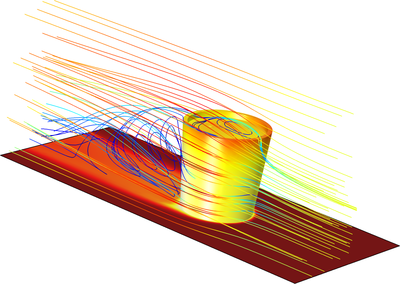
This tutorial shows how to couple three physics interfaces to model evaporative cooling. The effects that need to be taken into account are heat transfer, transport of water vapor, and fluid flow. The Wet Surface feature is used to implement the source term for the water vapor and to ... Read More
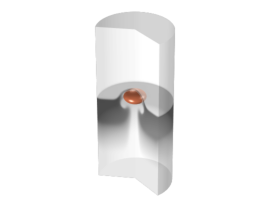
This example simulates an oil droplet rising through a suspension. The suspension is initially stratified, with a dense layer between two clear layers. The droplet is initially located in the bottom clear layer. The particles in the suspension start to sediment toward the bottom of the ... Read More
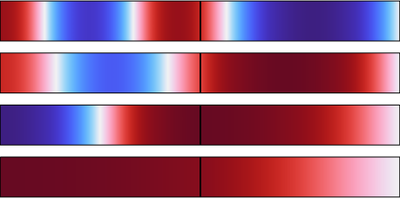
This tutorial demonstrates how to model the interaction between an acoustic field and the heat release from a flame, using the Flame Model domain feature. Modeling this interaction is important in order to understand and predict unstable acoustic modes in gas turbines and jet engines. ... Read More
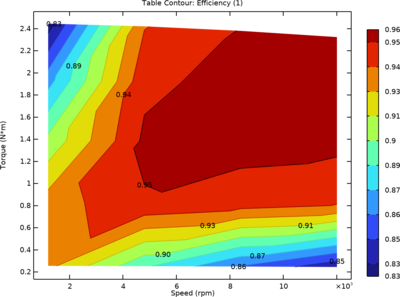
When electrical energy is converted into mechanical work in an electrical motor, the "wasted" energy that causes device heating is usually referred to as loss. The ratio of useful work to input energy, or the efficiency of the motor, is an important property for the overall energy ... Read More
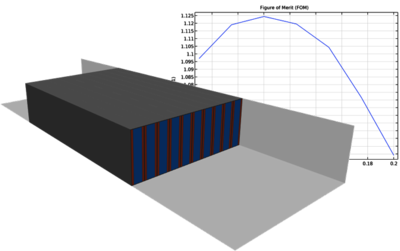
This example computes the effectiveness of a porous microchannel heat sink over a conventional microchannel heat sink. The model is fully parameterized. A parameter study on the thickness of the porous substrate is used to determine the optimal configuration. Read More