
The Application Gallery features COMSOL Multiphysics® tutorial and demo app files pertinent to the electrical, structural, acoustics, fluid, heat, and chemical disciplines. You can use these examples as a starting point for your own simulation work by downloading the tutorial model or demo app file and its accompanying instructions.
Search for tutorials and apps relevant to your area of expertise via the Quick Search feature. Note that many of the examples featured here can also be accessed via the Application Libraries that are built into the COMSOL Multiphysics® software and available from the File menu.
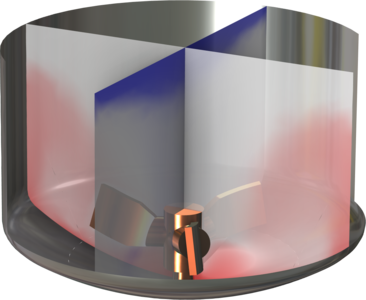
This model simulates the separation and mixing of a suspension with light and heavy particles. Initially the distribution of both particle populations is homogeneous throughout the fluid. Before the impeller starts rotating, the fluid and the two particle populations tend to separate ... Read More
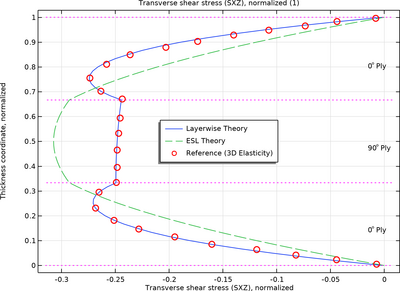
This example demonstrates the bending analysis of a simply supported composite laminate under sinusoidal distributed transverse load. The composite laminate is thick, with a thickness to side length ratio of 1/4. The laminate has three layers in a cross-ply layup. The model is solved ... Read More
This model verifies that the onset of streamer formation between two spheres separated by atmospheric pressure dry air at a distance of 2cm occurs at 51.8kV. The electrical breakdown is detected by integrating Townsend coefficients along the electric field lines between the two spheres. ... Read More
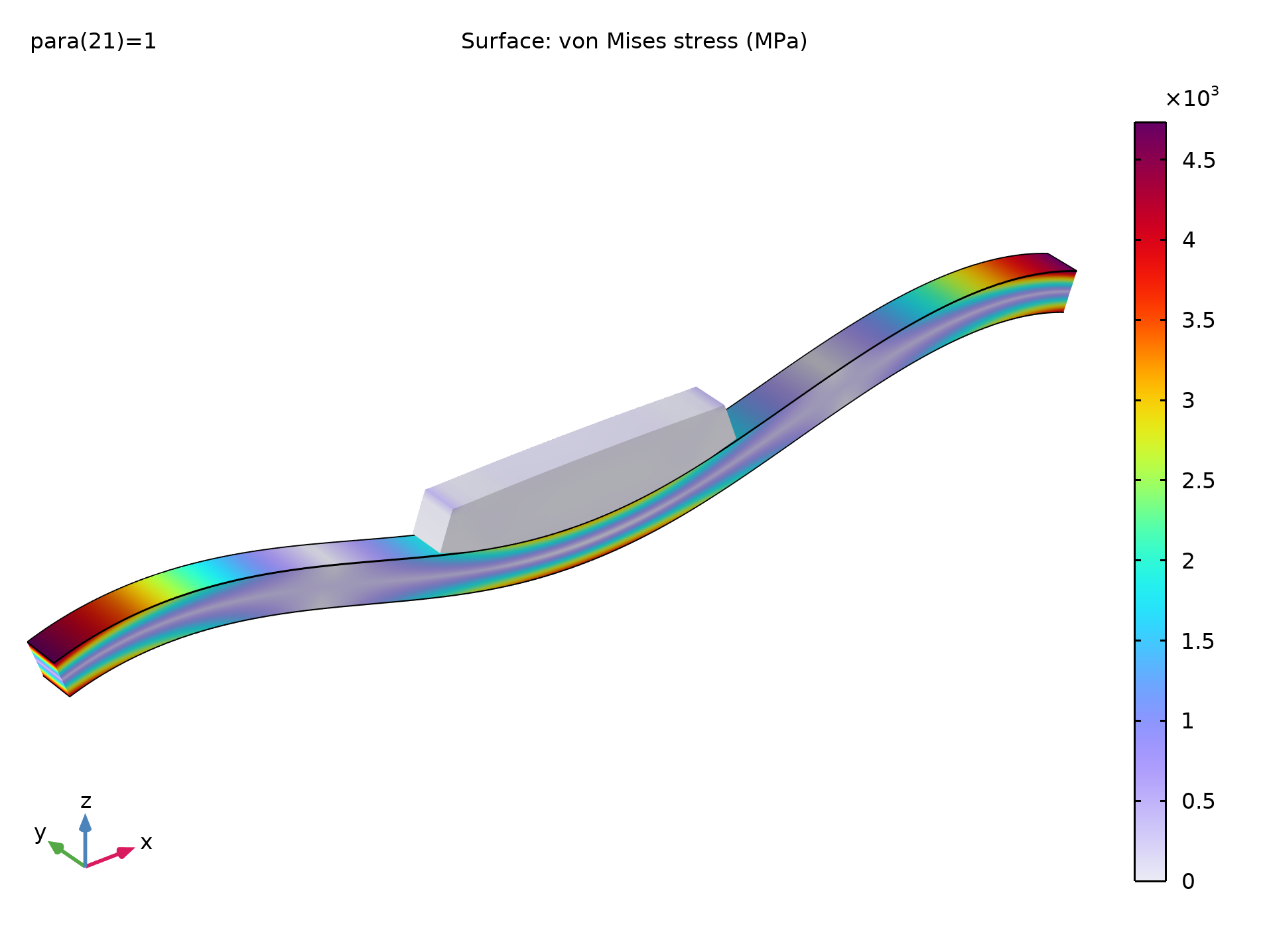
This conceptual example shows how to calculate critical points in models with contact. The model consists of a block modeled with the Solid Mechanics interface pressing on an arch modeled with the Shell interface. The contact problem is solved using the augmented Lagrangian method. The ... Read More
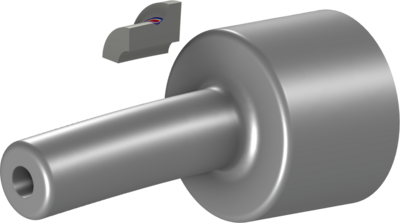
In this tutorial model, it is demonstrated how to incorporate a localized nonlinearity in a submodel. In this case, an initial elastic analysis reveals that a small region of a structure has stresses above the yield limit. To improve the results, an elastoplastic material model is added ... Read More
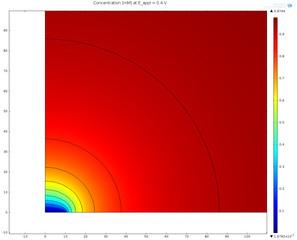
Voltammetry is modeled at a microelectrode of 10um radius. In this common analytical electrochemistry technique, the potential at a working electrode is swept up and down and the current is recorded. The current-voltage waveform ("voltammogram") gives information about the reactivity and ... Read More
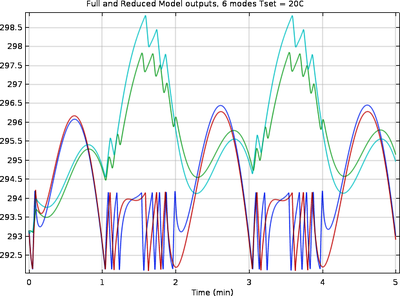
Large FEM simulations can be costly and, if repeated simulations are needed, it can be beneficial to use reduced-order models (ROMs). ROMs are typically valid only in the vicinity of their design conditions and have lower accuracy, but the simulation time is significantly shorter. The ... Read More
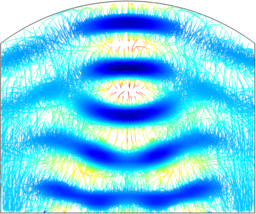
An ultrasonic standing wave levitator, also called acoustic levitator, is a device used for levitating fluid and solid particles in an acoustic field. The standing acoustic waves exert an acoustic radiation force on the particles. The force is a second order effect and stems from a ... Read More
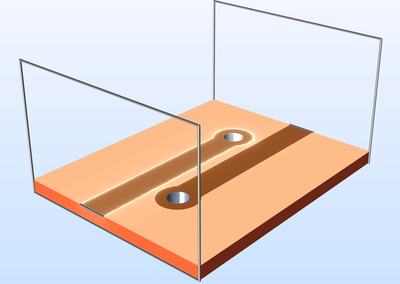
There are multiple ways to excite and terminate transmission lines using different types of port and lumped port features. In this example, transverse electromagnetic (TEM) type ports and a via type lumped port are used to simulate two adjacent microstrip lines. One via end is terminated ... Read More
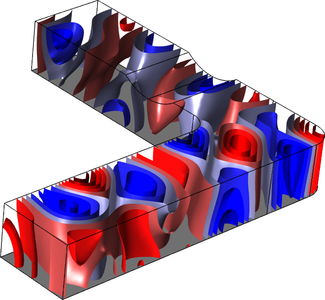
In this tutorial the acoustic behavior of a duct or waveguide with a right angled bend is analyzed. The model uses port boundary conditions at the inlet and outlet. The ports can capture and treat non-plane propagating modes in waveguides, extending the analysis above the first cutoff ... Read More


