
The Application Gallery features COMSOL Multiphysics® tutorial and demo app files pertinent to the electrical, structural, acoustics, fluid, heat, and chemical disciplines. You can use these examples as a starting point for your own simulation work by downloading the tutorial model or demo app file and its accompanying instructions.
Search for tutorials and apps relevant to your area of expertise via the Quick Search feature. Note that many of the examples featured here can also be accessed via the Application Libraries that are built into the COMSOL Multiphysics® software and available from the File menu.
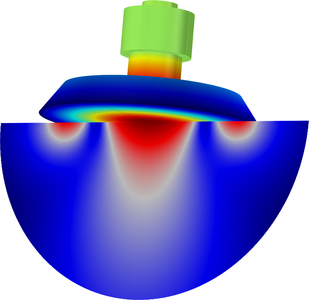
A tonpilz transducer is used for relatively low frequency, high power sound emission. It is one of the popular transducer configurations for SONAR applications. The transducer consists of piezoceramic rings stacked between a head mass and a tail mass which are connected by a central ... Read More
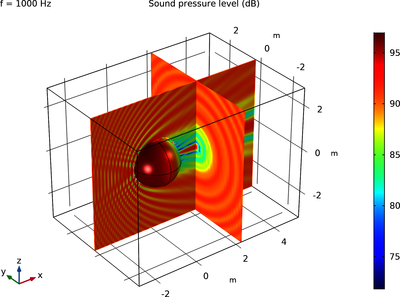
In this classical benchmark model, a spherical scatterer is placed in a plane wave background field. When the sphere is modeled as sound hard, the problem has an analytical solution. The model compares the results using the Pressure Acoustics, Boundary Elements interface with the ... Read More
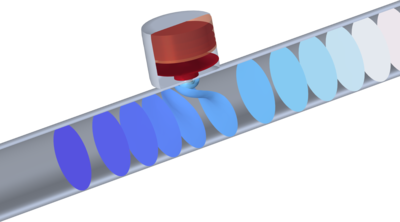
This tutorial model shows a system consisting of a Helmholtz resonator on the side of a main duct. The resonator volume is partly filled with a porous material. The model computes the reflection, transmission, and absorption of the system. Thermoviscous losses are included in the model ... Read More
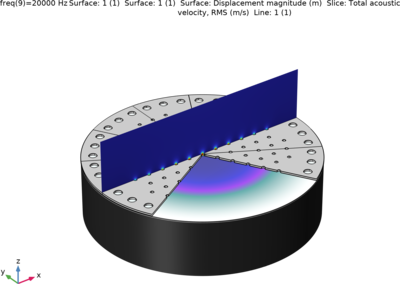
This is a model of a MEMS microphone solved in the frequency domain including the DC prestress effects. The model is set up using the Electromechanics multiphysics interface, Thermoviscous Acoustics, and Pressure Acoustics. The microphone consists of a perforated plate and a prestressed ... Read More
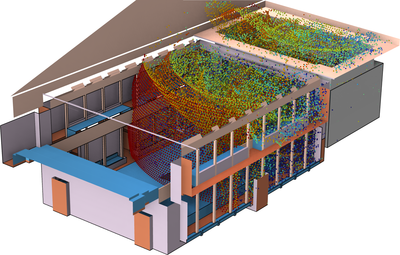
In this model, the acoustics of the Small Hall in the Konzerthaus Berlin is simulated with ray tracing. A full study of the room is performed in 1/3-octave bands with 10 pairs of source-receiver positions. The room acoustic parameters are derived from the calculated impulse responses, ... Read More
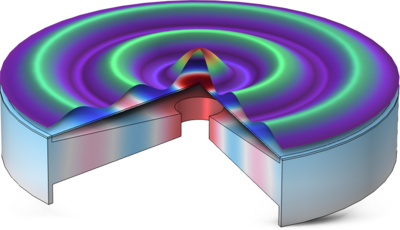
This example of a simple axisymmetric condenser microphone includes all the relevant physics and determines the microphone sensitivity as well as microphone capacitance for the specific simplified microphone geometry and material parameters. It solves a fully coupled multiphysics model ... Read More
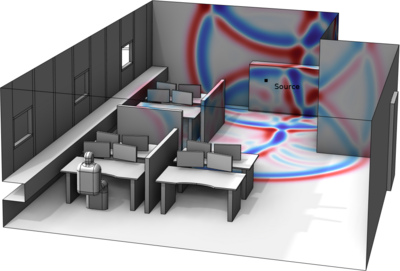
In this tutorial, the acoustics of an open-plan office space are analyzed using a wave-based approach in the time domain. An initial pulse is released and the room response is analyzed. Realistic frequency-dependent impedance conditions for the ceiling, carpet, and gypsum walls are ... Read More
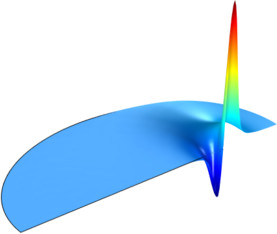
An ellipse with sound-hard walls has the interesting property that an acoustic signal emanating from one of the foci refocuses at the other focal point b/c seconds later, where b (in meters) is the major axis length and c (m/s) is the speed of sound. This model involves a Gaussian ... Read More
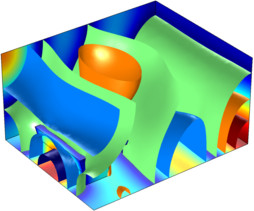
When designing a concert hall, it is extremely important to take the resonances into account. For a clear and neutral sound, the eigenfrequencies should be evenly spread through the registers. For the home stereo owner, who cannot actually change the shape of his living room, another ... Read More
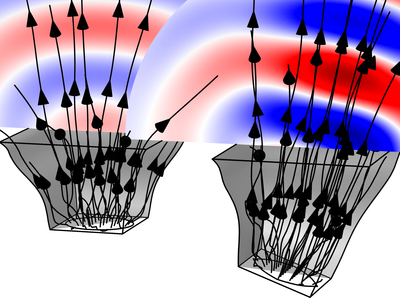
This model demonstrates how to use the Control Function feature to perform shape optimization on a rectangular horn for an improved on axis response. The results of the initial design are exported to a new component via a Filter dataset. Further, the off-axis spatial response is improved ... Read More