
The Application Gallery features COMSOL Multiphysics® tutorial and demo app files pertinent to the electrical, structural, acoustics, fluid, heat, and chemical disciplines. You can use these examples as a starting point for your own simulation work by downloading the tutorial model or demo app file and its accompanying instructions.
Search for tutorials and apps relevant to your area of expertise via the Quick Search feature. Note that many of the examples featured here can also be accessed via the Application Libraries that are built into the COMSOL Multiphysics® software and available from the File menu.
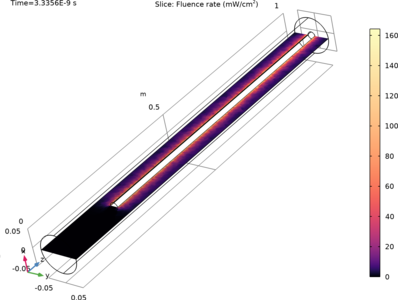
This model demonstrates how to compute the volumetric fluence rate in an ultraviolet (UV) reactor. The geometry is the annular fluid region surrounding a cylindrical lamp. The effect of reflection at the reactor walls on the radial fluence rate distribution is considered. Read More

A plane TE-polarized electromagnetic wave is incident on a gold nanoparticle on a dielectric substrate. The absorption and scattering cross-sections of the particle are computed for a few different polar and azimuthal angles of incidence. The model first computes a background field from ... Read More
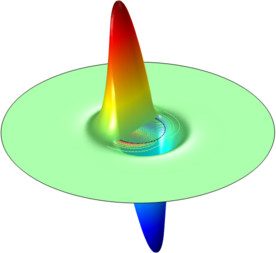
The transmission speed of optical waveguides is superior to microwave waveguides, because optical devices have a much higher operating frequency than microwaves, enabling a far higher bandwidth. This model is an example of a single step-index waveguide made of silica glass. The inner ... Read More
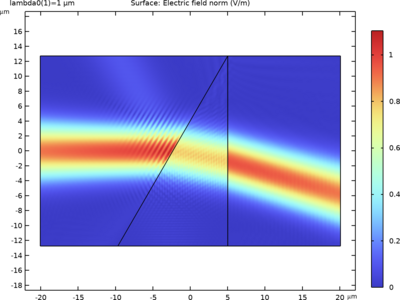
This model illustrates the refraction of light while passing through an optical prism using s– and p–polarized incident Gaussian beams. The prism boundaries are coated with anti–reflection coatings. It also calculates the reflectance and transmittance to analyze the performance of anti ... Read More
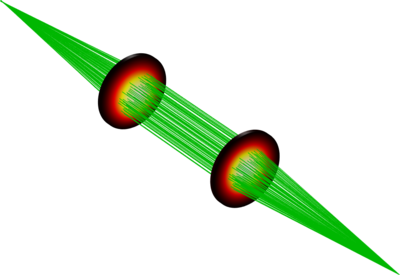
A modern high-power industrial fiber laser system can deliver up to 3kW of single-mode laser radiation on to surfaces to be cut, drilled, welded or marked. Even using highly transmissive materials, the optical component used to focus the laser beam onto target surfaces can be affected ... Read More

This model shows how to build and solve a radiative heat transfer problem using the Heat Transfer interface. In particular, this 2D model illustrates the use of the surface-to-surface radiation feature. In this model, three surfaces form a cavity. Heat flux is set at two outer ... Read More
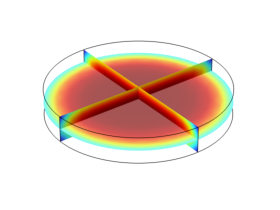
When producing glass, the glass melt is cooled down through radiation to form the final shape, subjecting it to stresses. Numerical treatment of radiative heat transfer, using the Radiative Transfer Equation (RTE), helps to optimize this process. COMSOL Multiphysics provides three ... Read More
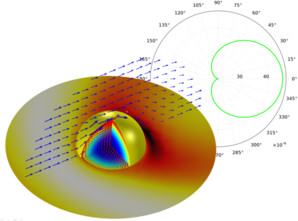
This model demonstrates the simulation of the scattering of a plane wave of light by a gold nanosphere. The scattering is computed for the optical frequency range over which gold can be modeled as a material with negative complex-valued permittivity. The far-field pattern and losses are ... Read More
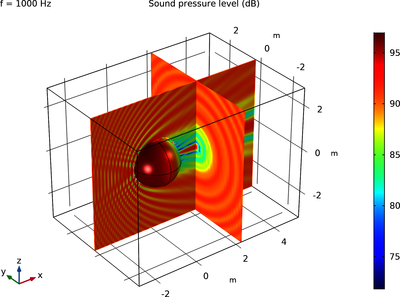
In this classical benchmark model, a spherical scatterer is placed in a plane wave background field. When the sphere is modeled as sound hard, the problem has an analytical solution. The model compares the results using the Pressure Acoustics, Boundary Elements interface with the ... Read More
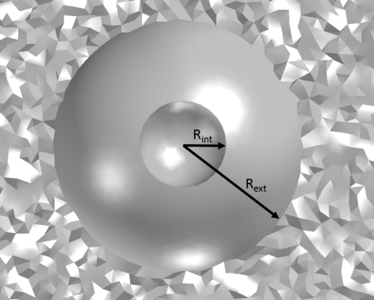
When simulating surface-to-surface radiation, we rely on the view factors between elements of diffuse surfaces that emit and receive radiation. To compute surface-to-surface radiation in a given geometry, operators are created by the heat interface and can be used to evaluate view ... Read More