
The Application Gallery features COMSOL Multiphysics® tutorial and demo app files pertinent to the electrical, structural, acoustics, fluid, heat, and chemical disciplines. You can use these examples as a starting point for your own simulation work by downloading the tutorial model or demo app file and its accompanying instructions.
Search for tutorials and apps relevant to your area of expertise via the Quick Search feature. Note that many of the examples featured here can also be accessed via the Application Libraries that are built into the COMSOL Multiphysics® software and available from the File menu.
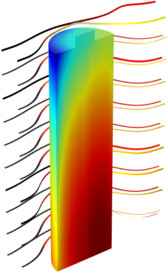
This example simulates the heat profile in an air-cooled cylindrical battery in 3d. The battery is placed in a matrix in a battery pack. The thermal model is coupled to a 1d-battery model that is used to generate a heat source in the active battery material. The model requires the ... Read More
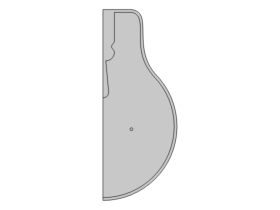
This tutorial introduces a workflow typical of creating geometry for simulation by using Sketch mode to draw complex shapes. Follow the step-by-step instructions to draw the geometry for the analysis of a light bulb. The physics setup is described in the model Free Convection in a Light ... Read More
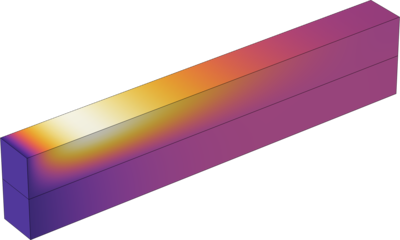
This example models heat generation in a beam-like structure subjected to small amplitude vibrations. The model computes the linear elastic response in the frequency domain. The transient heat-transfer analysis simulates the slow-rising temperature in the beam using the heat generated ... Read More
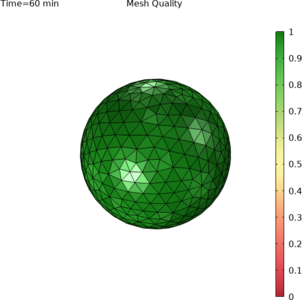
Droplet evaporation is ubiquitous in everyday life and is essential in many industrial processes, such as inkjet printing, cleaning/coating of surfaces, and phase change heat transfer. This model demonstrates how to model phase transition by a moving exterior boundary condition using ... Read More

This is a conceptual model illustrating how to couple fluid-structure interaction, heat transfer, and thermal expansion. A bimetallic strip in an air channel is heated so that it bends. After some time, an airflow with an inlet temperature which varies in time is introduced. As a ... Read More
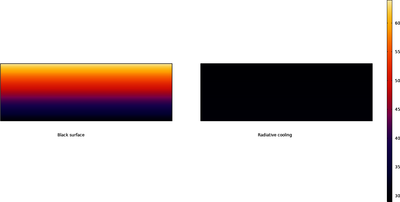
Because the atmosphere is nearly transparent to wavelengths in the range 8 to 13 µm (atmospheric window) for a clear sky, it is possible to cool down a surface even during a sunny day. This model compares the temperature distribution on a concrete block exposed to ambient and solar ... Read More
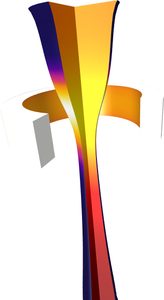
This example is about the modeling of the fiber drawing process. Thermal fiber drawing is a process in which a comparatively thicker structure is heated and drawn into extended lengths of microstructured fiber. This process is done by passing them through the furnace and pulling them ... Read More
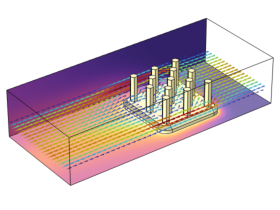
This model is intended as a first introduction to simulations of fluid flow and conjugate heat transfer. It shows you how to: Draw an air box around a device in order to model convective cooling in this box, set a total heat flux on a boundary using automatic area computation, and ... Read More

Nucleate boiling occurs when a liquid is heated by a source hotter than the saturated fluid temperature but with a heat flux below the critical heat flux. In this regime, high heat flux are possible due to the evaporation of the liquid. This model aims to demonstrate the calculation of ... Read More
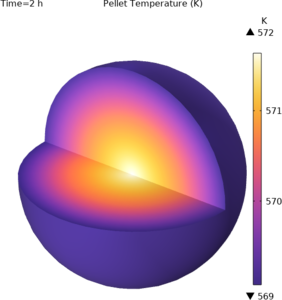
1D model of a thermal energy storage (TES) system consisting of a packed bed of pellets. Three approaches for heat transfer in porous media are compared: A one-equation local thermal equilibrium (LTE) model A two-equations local thermal nonequilibrium (LTNE) model A multiscale ... Read More