
The Application Gallery features COMSOL Multiphysics® tutorial and demo app files pertinent to the electrical, structural, acoustics, fluid, heat, and chemical disciplines. You can use these examples as a starting point for your own simulation work by downloading the tutorial model or demo app file and its accompanying instructions.
Search for tutorials and apps relevant to your area of expertise via the Quick Search feature. Note that many of the examples featured here can also be accessed via the Application Libraries that are built into the COMSOL Multiphysics® software and available from the File menu.
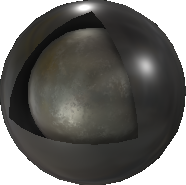
The purpose of this model is to introduce the specular reflection in Surface-to-Surface Radiation using the ray-shooting algorithm. Different parameters are available to the user to yield better accuracy in the results when using the ray-shooting algorithm. The model is a standard ... Read More
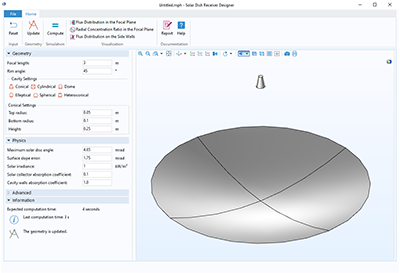
Solar concentrator/cavity receiver systems can be used to focus incident solar radiation into a small region, generating intense heat which can then be converted to electrical or chemical energy. A common figure of merit in solar thermal power systems is the concentration ratio, or the ... Read More
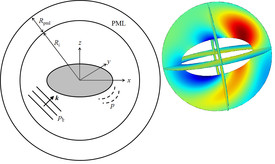
This is a tutorial model that illustrates the use of the scattered field formulation in acoustics. A solid object (here an ellipsoid) is hit by an incident plane wave field (background pressure field). The model solves for the scattered field. The model uses a PML and a far-field ... Read More
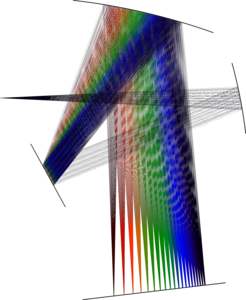
A Czerny-Turner monochromator spatially separates polychromatic light into a series of monochromatic rays. This model simulates a crossed Czerny-Turner configuration that consists of a spherical collimating mirror, a planar diffraction grating, a spherical imaging mirror, and an array ... Read More
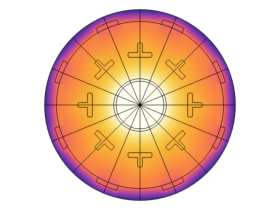
This model illustrates an application that maximizes surface-to-surface radiative fluxes and minimizes conductive heat fluxes. A thermo-photo-voltaic (TPV) cell generates electricity from the combustion of fuel and through radiation. The fuel burns inside an emitting device that ... Read More
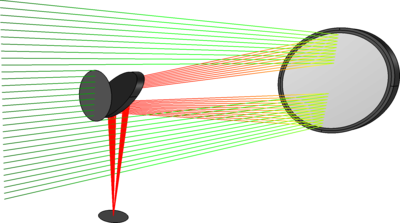
Newtonian telescopes, first invented in 1668 by Isaac Netwon, are still used today because of their low cost and simple design. Rays of light propagate from sources located at infinity, into the telescope. The rays reflect off a parabolic mirror, onto a flat mirror, and into the focal ... Read More
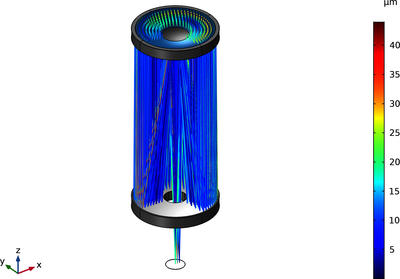
The Gregory-Maksutov telescope is a simple catadioptric telescope comprising a spherical corrector lens and a spherical primary mirror. In this example the corrector lens and mirror are formed using the 'Spherical Lens 3D' and 'Spherical Mirror 3D' parts respectively from the Ray Optics ... Read More
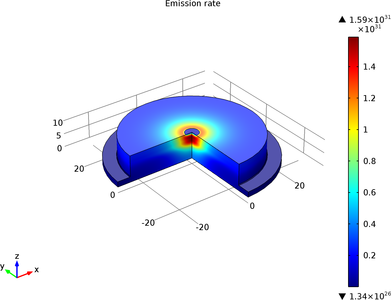
This model simulates an LED that emits in the infrared part of the electromagnetic spectrum. The device structure is made up of a single p-n junction formed by a layer of p-type doping near the top surface of an otherwise n-type wafer. This kind of device geometry is simple and cheap to ... Read More
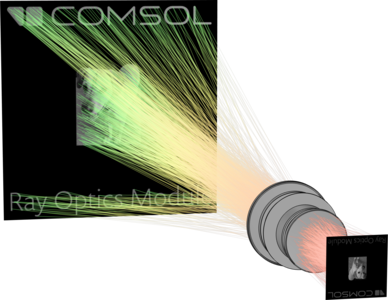
This example demonstrates how to import a bitmap which can be used to simulate an image using ray tracing. The example is based on the Double Gauss Lens tutorial from the Ray Optics Module Application Library. The first study has been modified so that the Spot Diagram "auto-focus" tool ... Read More
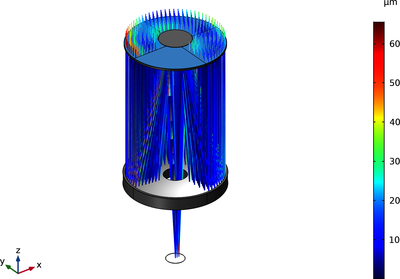
The Schmidt-Cassegrain Telescope demonstrated in this tutorial is a classic design using an aspheric corrector lens and two spherical mirrors. The aspheric corrector is created using the 'Aspheric Even Lens 3D' part from the Ray Optics part library. Read More