
The Application Gallery features COMSOL Multiphysics® tutorial and demo app files pertinent to the electrical, structural, acoustics, fluid, heat, and chemical disciplines. You can use these examples as a starting point for your own simulation work by downloading the tutorial model or demo app file and its accompanying instructions.
Search for tutorials and apps relevant to your area of expertise via the Quick Search feature. Note that many of the examples featured here can also be accessed via the Application Libraries that are built into the COMSOL Multiphysics® software and available from the File menu.

In this model a Knowles ED23146 receiver (miniature loudspeaker) is connected to a test set-up consisting of a 50 mm (1 mm diameter) earmold tube and a so-called 0.4-cc coupler. The receiver is modeled using a lumped spice network and connected to the finite element domain at the tube ... Read More
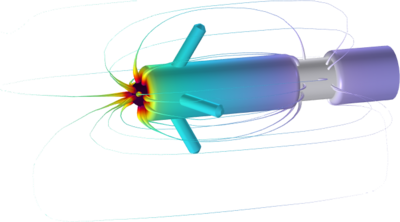
This model illustrates the use of COMSOL Multiphysics for modeling of ionic current distribution problems in electrolytes, in this case in human tissue. The problem is exemplified on a pacemaker electrode, but it can be applied in electrochemical cells like fuel cells, batteries, ... Read More
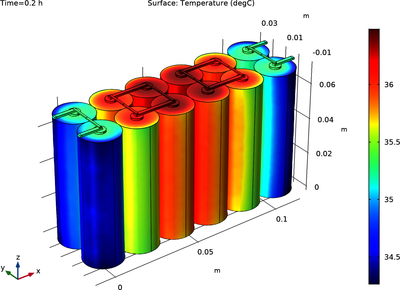
This example demonstrates how to model the temperature distribution in a battery pack during a 4C discharge. The pack is constructed by first coupling two cylindrical batteries in parallel. Six parallel-connected pairs are then connected in series to create the full pack. (This is also ... Read More
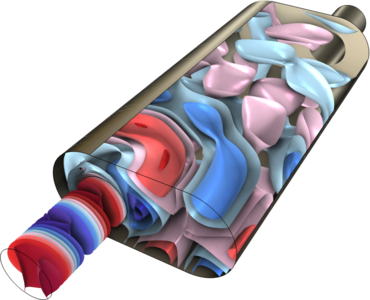
This example describes the pressure wave propagation in a muffler for an internal combustion engine. This example shows how to analyze both inductive and resistive damping in a muffler as well as the use of port boundary conditions. Read More
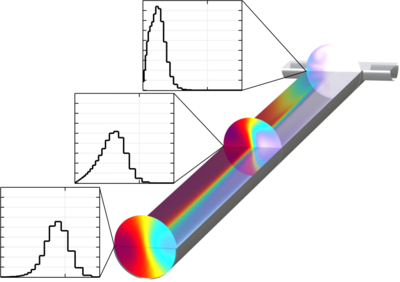
Crystallization is an important separation process in the chemical industry. It is used for the production of pharmaceuticals and industrial chemicals. It can also be used in resource recovery as a way of separating valuable materials from waste. This model solves a discretized ... Read More
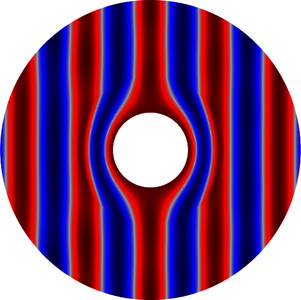
This example demonstrates how to use a background field in a sound scattering problem. The application is an acoustic invisibility cloak made of a metamaterial. Two different types of metamaterials are used, one using an anisotropic acoustic material with varying properties and one using ... Read More

This example considers the natural convection of air above a smoldering incense stick. This kind of flow often shows a transition from laminar to turbulent which is nicely visualized by the smoke produced by the slow burning of the incense. The model uses the Nonisothermal Flow, LES RBVM ... Read More
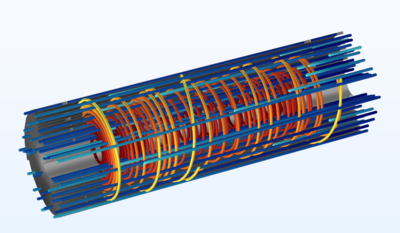
This example models a small reverse osmosis water desalination unit. The unit consists of a spirally wound semi-permeable membrane through which the water is forced under high pressure. The membrane retains the salt, such that on the permeate side fresh water is produced and on the ... Read More
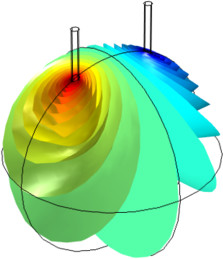
This tutorial example models the currents and the concentration of dissolved metal ions in a battery (corrosion cell) made from an orange and two metal nails. This type of battery is commonly used in chemistry lessons. Instead of an orange, lemons or potatoes can also be used. Read More
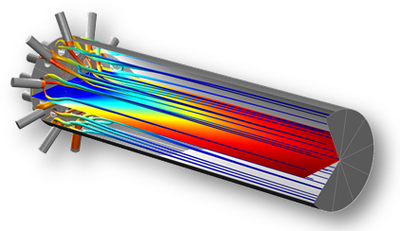
In a polymerization reactor for polyester manufacturing, the mixing in the reactor is achieved by impinging turbulent jets of reactants onto each other. The turbulence affects the reaction kinetics and quality of the polymer linkage. Turbulent flows involving rapid reaction kinetics are ... Read More


