
The Application Gallery features COMSOL Multiphysics® tutorial and demo app files pertinent to the electrical, structural, acoustics, fluid, heat, and chemical disciplines. You can use these examples as a starting point for your own simulation work by downloading the tutorial model or demo app file and its accompanying instructions.
Search for tutorials and apps relevant to your area of expertise via the Quick Search feature. Note that many of the examples featured here can also be accessed via the Application Libraries that are built into the COMSOL Multiphysics® software and available from the File menu.
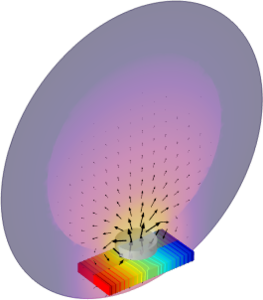
A Hall effect sensor is a semiconductive material with an anisotropic conductivity that is a function of the magnetic field. A magnet, mounted on a wheel, is rotated around nearby the sensor and the variation in the electric potential across the sensor is modeled. For complete ... Read More
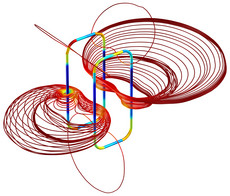
RFIDs are used in a multitude of applications such as tracking or identifying consumer products and their packaging. An RFID system consists of two main parts: A tag or transponder with a printed circuit-board (PCB) antenna A reader unit with a larger RF antennaThe reader antenna ... Read More
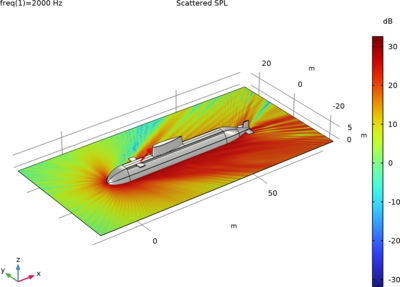
The primary defense of a submarine lies in its capacity to remain hidden during operation. As radio waves are strongly absorbed by sea water, sound navigation ranging, or SONAR, is one of the main methods used for the detection of submarines. SONAR systems are also used for underwater ... Read More
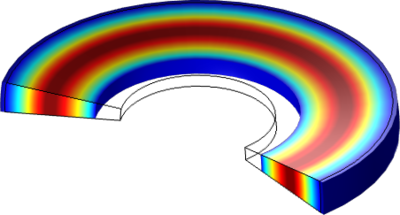
This example illustrates how to combine different Creep material models. Here a Norton–Bailey model (primary creep) is combined with a Norton model (secondary creep). This example is a continuation of the model thermally induced creep. Read More
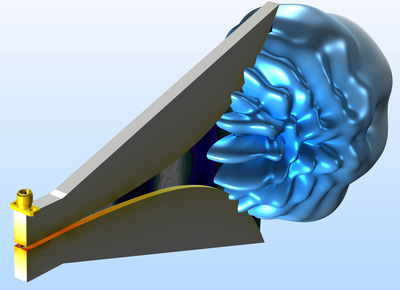
A double-ridged horn antenna is popularly used in anechoic chambers to characterize an antenna under test (AUT), from S-band to Ku-band, due to its reliable performance in a wideband frequency range. This tutorial models a double-ridged horn antenna and computes the voltage standing wave ... Read More
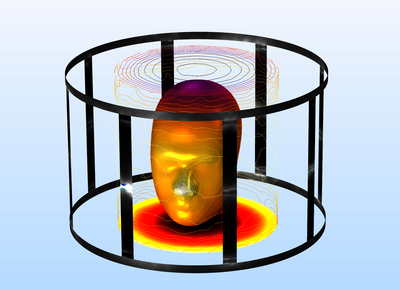
Magnetic resonance imaging (MRI) systems generate a magnetic flux density (B-field) to create images. Providing a homogeneous field distribution within a birdcage coil is a key factor for improving the quality of the scanned data. A homogeneous magnetic field can be found through ... Read More
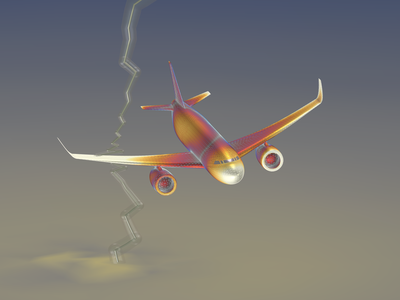
The model demonstrates how to compute the induced voltage of a wire loop inside an airplane under different electromagnetic shielding conditions. Read More
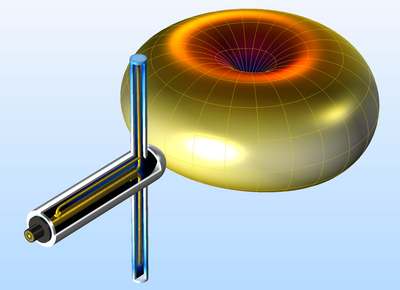
An antenna balun blocks undesirable currents on the outside of a cable. A quarter-wave coaxial balun (1:1) is one of the easiest designs: it works as a transformer and makes the input impedance from the inner conductor to the outer conductor infinite. This model simulates an antenna ... Read More
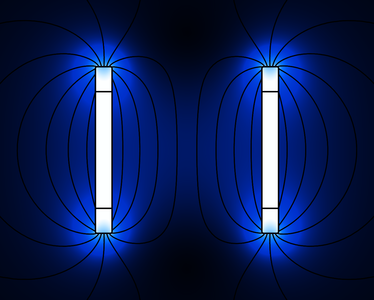
In this set of verification models and associated documentation, the accuracy of electromagnetic force calculations is investigated. Using various techniques, the total force and torque on a rigid body is determined and compared to analytical models. Using fillets, advanced meshing and ... Read More
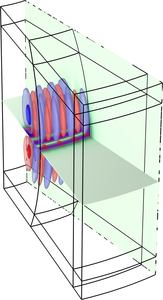
Dielectric microspheres can support whispering gallery modes with high optical quality factors. This model illustrates how to compute the different eigenmodes and resonance frequencies. The resonance frequencies are either filtered by their spatial localization in the resonator or by ... Read More