
The Application Gallery features COMSOL Multiphysics® tutorial and demo app files pertinent to the electrical, structural, acoustics, fluid, heat, and chemical disciplines. You can use these examples as a starting point for your own simulation work by downloading the tutorial model or demo app file and its accompanying instructions.
Search for tutorials and apps relevant to your area of expertise via the Quick Search feature. Note that many of the examples featured here can also be accessed via the Application Libraries that are built into the COMSOL Multiphysics® software and available from the File menu.
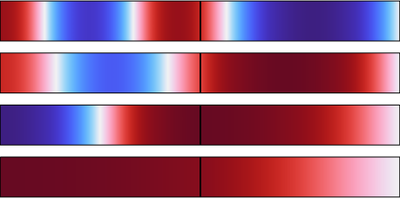
This tutorial demonstrates how to model the interaction between an acoustic field and the heat release from a flame, using the Flame Model domain feature. Modeling this interaction is important in order to understand and predict unstable acoustic modes in gas turbines and jet engines. ... Read More
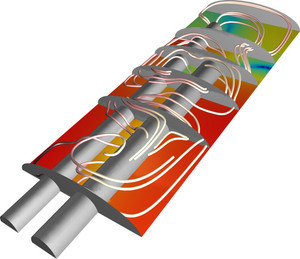
Reflective mufflers are best suited for the low-frequency range where only plane waves can propagate in the system, while dissipative mufflers with fibers are efficient in the mid- to high-frequency range. Dissipative mufflers based on flow losses, on the other hand, also work at low ... Read More
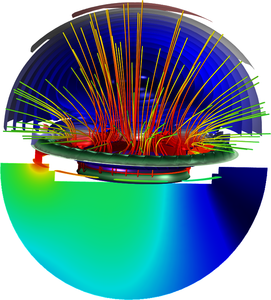
This model analyzes the electromagnetic, mechanical, and acoustical characteristics of the OWS-1943T-8CP (discontinued) speaker. Beside certain details, the geometry, material properties, and measurements are copyright by Ole Wolff. Starting from the geometry of the speaker, an ... Read More
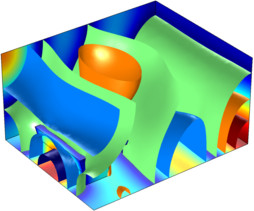
When designing a concert hall, it is extremely important to take the resonances into account. For a clear and neutral sound, the eigenfrequencies should be evenly spread through the registers. For the home stereo owner, who cannot actually change the shape of his living room, another ... Read More
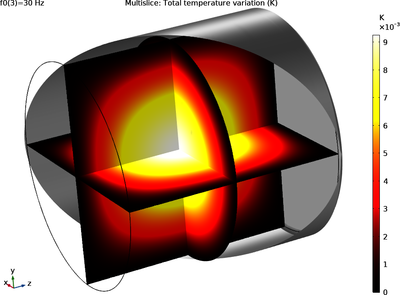
When high-fidelity measurement microphones are calibrated, a pressure reciprocity calibration method is used. During calibration, two microphones are connected at each end of a closed cylindrical cavity. For the calibration procedure, it is important to understand the acoustic field ... Read More
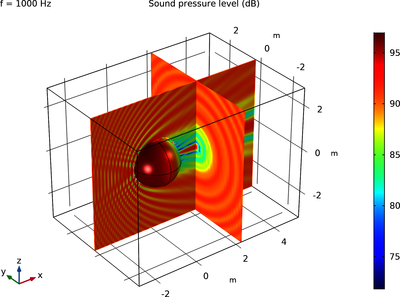
In this classical benchmark model, a spherical scatterer is placed in a plane wave background field. When the sphere is modeled as sound hard, the problem has an analytical solution. The model compares the results using the Pressure Acoustics, Boundary Elements interface with the ... Read More

The elastoacoustic effect is a change in the speed of elastic waves that propagate in a structure undergoing static elastic deformations. The effect is used in many ultrasonic techniques for nondestructive testing of prestressed states within structures. This example studies the ... Read More
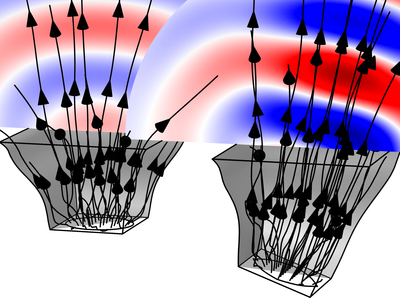
This model demonstrates how to use the Control Function feature to perform shape optimization on a rectangular horn for an improved on axis response. The results of the initial design are exported to a new component via a Filter dataset. Further, the off-axis spatial response is improved ... Read More

Headphones are closely coupled to the ear, and so it is not possible to measure their sensitivity in a classical acoustic free-field setup used for loudspeakers. The measurement requires the use of artificial heads and ears to accurately represent the usage conditions. This model shows ... Read More
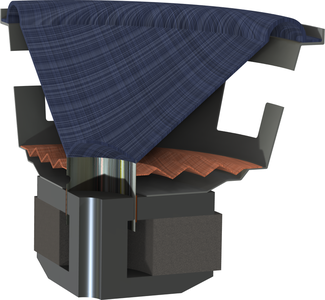
This tutorial shows how to best solve full 3D vibro-electroacoustic multiphysics models of loudspeakers. The model is based on a 3D representation of the existing 2D axisymmetric Application Library model loudspeaker_driver found in the software. The setup of the physics is essentially ... Read More