
COMSOL Conference 2026 Proceedings
Collection of Papers, Posters, and Slideshows Accepted by the Program Committee
At the COMSOL Conference 2026, engineers, researchers, and scientists from around the globe showcased their use of modeling and simulation across all major industries and in academia. Use the Quick Search tool to find a specific presentation or filter by topic or event location.
We present a software tool for simulations of subsurface flow and solute transport in combination with comprehensive intra-phase and inter-phase geochemistry. The software uses PHREEQC as a reaction engine to COMSOL Multiphysics®. The coupling with PHREEQC gives major advantages over ... Read More

We are developing a solid state gas sensor that combines a small form factor with the high sensitivity of optical gas detection. The gas sensor is based on an optical resonant microsystem that is penetrated by gas molecules. This microsystem consists of an array of vertical rods in air ... Read More

Impact monitoring has been extensively studied by several researchers and it has been shown that damage extent can be correlated with the impact magnitude. In order to make the process cost-effective, simulation of the impact has been performed, to get the big training data set from ... Read More

Direct numerical simulation of single- and two-phase flow in real pore systems is addressed in our paper. The X–ray computed micro-tomography technique has been applied first to reconstruct in details a real pore space of a subcentimetric sample. Making use of dedicated software (ScanIP) ... Read More

Lab-on-a-chip devices for cell culturing are becoming imperative in order to satisfy the needs for point-of-care or decentralized laboratory testing. Towards that goal we have developed miniaturized membrane based cell culture chambers for use within the field of chromosome analysis. The ... Read More

Based on recent results from seismology, geochemistry etc. the distinct chemical character of the D’’ layer (lowest part of the mantle around the Earth’s core) has appeared unequivocally. Numerical calculations have been carried out to investigate the effect of the disintegration, mixing ... Read More
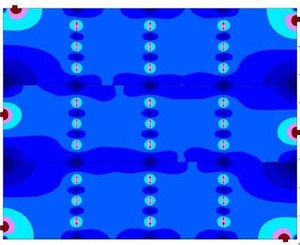
A Computational Fluid Dynamics study has been performed for a Gas Electron Multiplier (GEM) detector of high energy charged particles, currently under development as part of a new tracker of the high luminosity spectrometers in Hall A at Jefferson Lab. By gradual modifications of the ... Read More

The safety of large civil structures is often evaluated by means of numerical models based on the Finite Element Method. In this frame, the choice of a constitutive law able to represent the complex mechanical behaviour of concrete is a key point. This paper deals with a detail ... Read More


