
Explore the innovative ways multiphysics simulation is being used worldwide to advance research
Multiphysics modeling and simulation drives innovation across industries and academia — as is evidenced by the many uses showcased in the technical papers and posters presented by engineers, researchers, and scientists at the COMSOL Conference each year.
Draw inspiration from the recent proceedings collected below, or, to find a specific presentation or filter by application area or conference year/location, use the Quick Search tool.
View the COMSOL Conference 2025 Collection
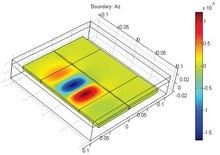
A 3D model of a magnetic rotor both rotating and translationally moving at high-speed over a conductive guideway is modeled in steady-state using the convective A*-Φ formulation. The presence of the magnetic rotor (source field) is incorporated into the formulation via the boundary ... Read More
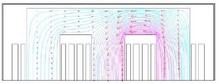
This work is concerned with the study of the asymmetrical phenomenon observed in three-phase transformers during the standard short-circuit test. The purpose of our work is to see if the asymmetric measurements can be predicted with the use of 2D finite-element models. To this end, we ... Read More

Charged particle beam manipulation requires magnetic dipoles for steering and quadrupoles for focusing. Conventional magnets are currently used leading to very large and heavy systems. Miniaturization of the optic magnets would enable the development of more affordable systems and ... Read More
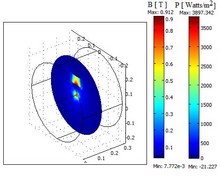
This paper describes a type of didactic material used when teaching electromagnetism. The purpose is to guide the students to verify the results of a Finite Element (FE) simulation using those obtained analytically. This procedure has shown to be of great help during their learning of ... Read More

Magnetorheological Elastomers (MREs) are a composite that consist of magnetic micrometer sized particles suspended within rubber matrix filler. By placing this material within an external magnetic field during the rubber curing process, the poles of the particles are forced to align and ... Read More
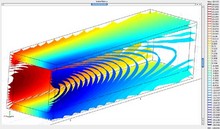
Traditionally the design cycle for magnetic fields involves guessing at a reasonable conductor / magnetic material configuration, using FEA software to calculate the resulting field, modifying the configuration, and iterating to produce the desired field. Our method involved solving the ... Read More
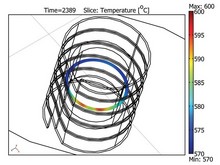
The induction heating coils used in the plutonium casting furnaces at the Los Alamos National Laboratory are studied here. A cylindrical graphite test article has been built, instrumented with thermocouples, and heated in the induction coil that is normally used to preheat the molds ... Read More
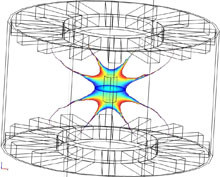
For low-field NMR (Nuclear magnetic resonance), NdFeB permanent magnet arrangements are proposed to provide the static polarizing magnetic field. Especially a parallel and a circular arrangement of the permanent magnets, iron yokes and small shim magnets were tested and improved by ... Read More
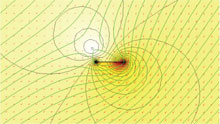
This work presents a method to calculate AC losses in thin conductors such as the commercially available second generation superconducting wires through a multiscale meshing technique. The main idea is to use large aspect ratio elements to accurately simulate thin material layers. For a ... Read More

Two simulations of the performance of a Paper Insulated Lead Covered (PILC) Medium Voltage (MV) underground cable are presented. The first presents the thermal response of a cable, over seven days, to a realistic load with a diurnal variation. The second concentrates on the variation of ... Read More


