
Explore the innovative ways multiphysics simulation is being used worldwide to advance research
Multiphysics modeling and simulation drives innovation across industries and academia — as is evidenced by the many uses showcased in the technical papers and posters presented by engineers, researchers, and scientists at the COMSOL Conference each year.
Draw inspiration from the recent proceedings collected below, or, to find a specific presentation or filter by application area or conference year/location, use the Quick Search tool.
View the COMSOL Conference 2026 Collection

Piping is a kind of internal erosion that occurs under water retaining structures lying on a sandy soil. In an attempt to reproduce the growth of erosion channels in sand, a small scale physical model has been set up in the laboratory and a finite element model that reproduces the ... Read More
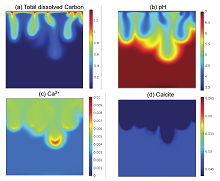
The capture and storage of CO2 in deep geological formations is one of the proposed solutions to reduce CO2 emissions to the atmosphere. CO2 is injected as a supercritical fluid deep below a confining geological formation that prevents its return to the atmosphere. A configuration of ... Read More

Thermal Response Tests (TRTs) are the state-of-the-art method to obtain the thermal conductivity of the subsurface in the nearby ambience of a borehole heat exchanger (BHE). The results of TRTs are used to determine the necessary depth of the borehole and to make long time predictions ... Read More

Düsensauginfiltration (DSI),‘nozzle-suction-infiltration’, is a new method for dewatering that avoids groundwater abstraction from the aquifer. Drawdown is achieved via pumping of groundwater at upper abstraction section, meanwhile, all the pumped water is injected through the same ... Read More

The effective modeling of enhanced geothermal systems (EGS) requires the coupling of geomechanics, fluid flow and thermal processes. An understanding of the complete system with these coupled processes is vital, not just for reservoir stimulation targeted at enhancing reservoir ... Read More
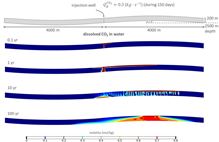
The capture and storage of CO2 in deep geological formations is one of the proposed solutions to reduce CO2 emissions to the atmosphere. CO2 is injected as a supercritical fluid deep below a confining geological formation that prevents its return to the atmosphere. In general, four ... Read More

Although there are porous media and subsurface flow modes available in a toolbox of COMSOL Multiphysics®, some common requirements in hydrogeological models can not be easily accessed in the graphical user interface. Most crucially, there is no distinction between confined and unconfined ... Read More

CO₂ geological storage can help to provide a “bridge” from a fossil-fuel dependent system to a more diversified energy portfolio. Pressure monitoring for an injection zone (IZ) and an above-zone monitoring interval (AZMI) has been under operation at a field-scale CO₂ injection site, ... Read More


