
See How Modeling and Simulation Is Used Across Industries
Multiphysics modeling and simulation drives innovation across industries and academia — as is evidenced by the many uses showcased in the technical papers and posters presented by engineers, researchers, and scientists at the COMSOL Conference each year.
Draw inspiration from the recent proceedings collected below, or, to find a specific presentation or filter by application area or conference year/location, use the Quick Search tool.
View the COMSOL Conference 2025 Collection

In this work we present a novel approach to enhance energy efficiency in cooling intake air for air conditioning (AC) systems in harsh environments using geothermal energy. We developed a 3D finite element model to simulate the heat transfer between underground soils/gravels and cooling ... Read More

The process-induced deformation in the DED fabricated part is a critical issue to the scaling of the technology. Currently, an inefficient and expensive experiment trial-and-error approach is utilized to tackle this issue, however it is not feasible for large parts. Researchers have ... Read More
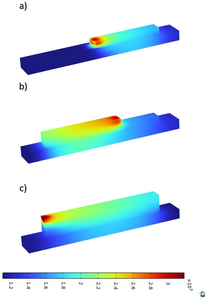
In this paper, we present a study of the simulation of Directed Energy Deposition (DED) Additive Manufacturing (AM) using a multiphysics approach. We use a combination of Heat Transfer in Fluids, Solid Mechanics and Laminar Flow physics to accurately simulate the DED process. The ... Read More

While common hot water storage geometries are slim and high, this work deals with the conversion of a preexisting cellar room into a hot water storage with an area of 550 m² and a height of only 2.9 m. Next to the poor area-to-height ratio, the room contains columns and bearers for ... Read More
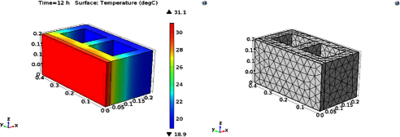
A time-dependent study was conducted using COMSOL Multiphysics® (Conjugate Heat Transfer interface and Heat Transfer with Phase Change feature) for the numerical investigation of the thermal performance of novel Phase Change Material (PCM)-enhanced plasters for their incorporation in ... Read More
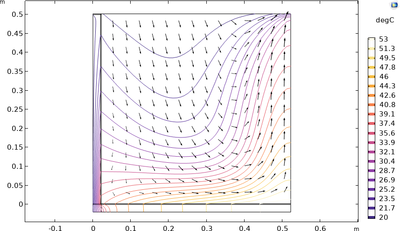
In view of an energy system based on fluctuating renewable sources, the use of thermal energy storage (TES) systems plays a crucial role. In particular, large-scale underground water-based TES represent a promising solution as demonstrated by a number of cases currently being established ... Read More

High power consumption chips have already become a major challenge for modern processors causing low thermal performances. Existing thermal solutions are not able to solve these high temperature issues efficiently. Two-phase cooling devices such as heat pipes and vapor chambers have ... Read More

Simulation of laser processes are more and more efficient. In some cases, as welding and additive manufacturing, the physical phenomena are complex, multi-physics and multi-phases, thus some assumptions have to be done. For Laser Powder Bed Fusion, a laser beam melts and vaporizes the ... Read More

Friction Stir Welding (FSW) is a solid-state joining technique that has become increasingly popular and efficient for welding both similar and dissimilar metallic materials. Despite its success in joining dissimilar materials, further development is necessary to meet industry ... Read More
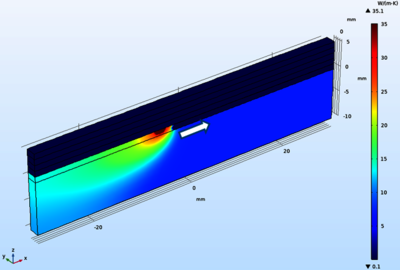
Additive manufacturing processes are increasingly used for designing metallic parts with complex geometries. The current needs are focused on the manufacturing of large-scale parts, typically of meter range. However, for such dimensions, the traditional trial-and-error methodology used ... Read More


