
Explore the innovative ways multiphysics simulation is being used worldwide to advance research
Multiphysics modeling and simulation drives innovation across industries and academia — as is evidenced by the many uses showcased in the technical papers and posters presented by engineers, researchers, and scientists at the COMSOL Conference each year.
Draw inspiration from the recent proceedings collected below, or, to find a specific presentation or filter by application area or conference year/location, use the Quick Search tool.
View the COMSOL Conference 2025 Collection

COMSOL® software was used to simulate the conductive heat transfer with phase change in the geological formations encompassed in permafrost surrounding a shallow thaw lake. The purpose of the simulation was to verify the adequacy of COMSOL to model such phenomena by comparing the COMSOL ... Read More

A simple steady-state photo-fermentative biochemical model was developed using the COMSOL Multiphysics'® Transport of Diluted Species physics interface. A dimensionless model seeks optimal physical parameters based on given biochemical parameters found in literature. A parametric sweep ... Read More
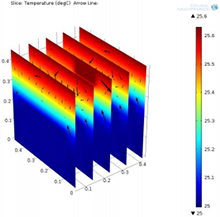
This paper presents a study on the heat generation of Valve-Regulated Lead Acid (VRLA) batteries used in off-grid streetlighting applications from PoleCo, a Halifax based company. One goal of the project was to produce validated COMSOL® models of the enclosure that holds these VRLA ... Read More

Steam generators (SGs) are used in CANDU® nuclear reactors as heat exchangers to convert water into steam using heat generated in the reactor core. Ferrous trefoil broach support structures prevent excessive vibration of thousands of SG tubes. A probe that uses pulsed eddy current (PEC) ... Read More

A planar anode-supported intermediate temperature solid oxide fuel cell operating on syngas fuel at 750°C was analyzed in this study. The effects of varying syngas fuel inlet compositions on species and temperature distributions, water gas shift reaction rate, potential for carbon ... Read More

A key issue for the development of a LENR power unit involves the measurement and energy output of the reaction. Our team is currently studying a gas loaded nanoparticle-type cluster power unit [1] which pressurizes various nanoparticle alloys with either deuterium or hydrogen. The ... Read More

Fischer-Tropsch synthesis (FTS) is a highly exothermic polymerization reaction of syngas (CO+H2) in the presence of Fe/Co/Ru-based catalysts to produce a wide range of paraffins, olefins and oxygenates, often known as syncrude. Multi-Tubular Fixed Bed Reactors (MTFBR) and Slurry Bubble ... Read More

Introduction: Development of next-generation chemical processes that have zero emissions is a key environmental objective for sustainable development. The manufacture of H2SO4 by the air oxidation of SO2 to SO3 is an important technology where an opportunity exists for new catalyst ... Read More

Introduction: Development of next-generation chemical processes that have zero emissions is a key environmental objective for sustainable development. The manufacture of H2SO4 by the air oxidation of SO2 to SO3 is an important technology where an opportunity exists for new catalyst ... Read More
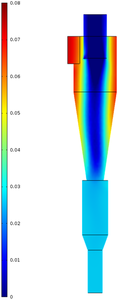
Fluidized Catalytic Cracking (FCC) regenerators utilize a fluidized bed to facilitate catalyst regeneration. Cyclones are used to separate the catalyst from the gas stream and return the catalyst to the fluidized bed; as the gas progresses through the system for further processing. This ... Read More


