
See How Modeling and Simulation Is Used Across Industries
Multiphysics modeling and simulation drives innovation across industries and academia — as is evidenced by the many uses showcased in the technical papers and posters presented by engineers, researchers, and scientists at the COMSOL Conference each year.
Draw inspiration from the recent proceedings collected below, or, to find a specific presentation or filter by application area or conference year/location, use the Quick Search tool.
View the COMSOL Conference 2025 Collection

Nowadays mathematical models are applied in almost every field of our life to predict how real systems behave. Computational Fluid Dynamics (CFD) has become a standard tool for analyzing various situations where fluid flow has a significant effect on the studied processes. Complex models ... Read More
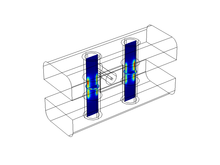
ICP reactors are usually meter sized and driven at RF frequencies, for example at 13.56 MHz. We developed a miniature resonator allowing an inductive type of coupling of microwaves at 2.45 GHz to a plasma jet, flowing in ceramic tubes. Previous experiments and simulations show an ... Read More

One challenge with converting nuclear research reactors to low enrichment fuels is the thermal-fluid performance. Local areas of high temperature, known as hotspots, limit reactor performance and thus require accurate modeling. A simplified fuel plate model is eveloped to compare ... Read More
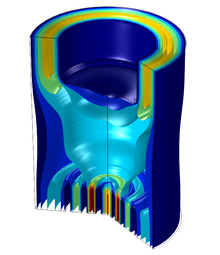
Gallium nitride (GaN) and its related nitride alloys with special physical properties are in technical areas of high interest. The growing of gallium nitride boules on non-native sapphire or silicon carbide requires complicated mechanisms of defect reduction in the lattice structure. ... Read More

The stellarator concept developed by Renaissance Fusion makes use of a lithium free surface flow surrounding the plasma fusion core. Understanding the instability mechanism of this flow is of primary importance for controlling it. We use COMSOL Multiphysics® to solve the 1D linear ... Read More
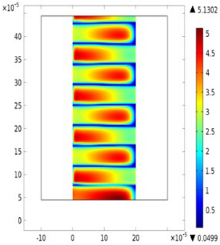
Fixed nitrogen is used in many forms ranging from nitric acid to hydrogen cyanide and is used as such for industrial applications. The reactions to produce these products are highly endothermic and favored by high-temperature processing. The most basic route of chemically fixing nitrogen ... Read More
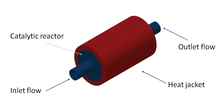
A biogas steam reforming reactor has been developed in order to be integrated into a proof-of-concept SOFC system, able to operate with biogas produced in an industrial waste water treatment unit. A mathematical model, aimed at describing the performance of the reactor, has been ... Read More
The findings presented in this report are results of a five-year effort led by the Research Reactors Division (RRD) of the Oak Ridge National Laboratory (ORNL), which is focused on research and development toward the conversion of the High Flux Isotope Reactor (HFIR) fuel from high ... Read More
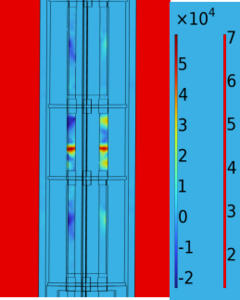
Liquid Metal Fast Breeder Reactor (LMFBR) employs molten sodium as coolant due to its suitable neutronic and thermal properties. Measurement of coolant flow rate is a very important factor both from operational and safety aspects of a fast reactor. Good electrical conductivity of liquid ... Read More
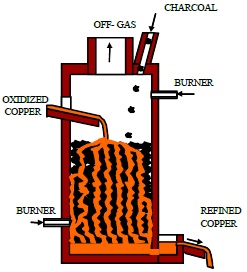
Throughout history, the copper pyrometallurgical processes have been carried out mostly in discontinuous or batch systems. In recent decades new continuous technologies have been developed but focused only on Smelting and Converting stages leaving aside the Refining one. In 2002 a novel ... Read More


