
See How Modeling and Simulation Is Used Across Industries
Multiphysics modeling and simulation drives innovation across industries and academia — as is evidenced by the many uses showcased in the technical papers and posters presented by engineers, researchers, and scientists at the COMSOL Conference each year.
Draw inspiration from the recent proceedings collected below, or, to find a specific presentation or filter by application area or conference year/location, use the Quick Search tool.
View the COMSOL Conference 2025 Collection

Atmospheric-pressure plasma jets (APPJ) are devices that generate chemically reactive species and operate at atmospheric pressure and ambient temperature for a wide range of applications. Plasmas jets produce charged particles (electrons and ions), neutral metastable species, radicals, ... Read More

Introduction Fluid flow patterns in research or process-scale equipment where a fluid is contained between concentric rotating cylinders in the absence of bulk axial flow has received notable attention in the field of fluid mechanics. Annular flows occur in many practical applications, ... Read More

A numerical multiphase flow model is proposed to predict the behavior and motion of entrained inclusions in liquid steel, as they enter the orifice of a LiMCA (Liquid Metal Cleanliness Analyzer) sensor for assuring steel quality. The method of measurement is based on the electric sensing ... Read More

This paper presents a preliminary analysis of the coupled thermo-hydrodynamics and neutronics of circulating nuclear fuel systems in a nuclear reactor that adopts a molten salt mixture. This flows up through channels in a graphite moderated core and plays the role of both heat generator ... Read More

Array-based technologies are important for many applications in drug discovery, microbiology and cell biology. A large-scale array of single cells allows high-throughput monitoring of behaviors of individual cells in parallel, avoiding the lack of cell specificity inherent to bulk ... Read More

A magnetic colloid, also known as a ferrofluid, is a colloidal suspension of single-domain magnetic particles with typical dimensions of about 10nm, dispersed in a liquid carrier. Since the 1960, when these materials were initially synthesized, their technological applications are ... Read More

Process Hardware for heating, etching and plasma deposition in vacuum processes on Silicon wafers or glass substrates face challenging requirements due to very shallow and extended structures. Molecular Flow calculations are used to evaluate staggered shields with the aim to protect ... Read More

Electron beam welding process is a high-energy welding technique that uses a focused beam of electrons to join metal components. It is widely used in various industries, including aerospace, nuclear industry, automotive, and electronics, due to its ability to produce high-quality welds ... Read More

Metal hydride based thermal energy storage systems belong to the category of heat storage systems which rely on reversible thermo-chemical reactions to store and release heat. Specifically, these systems utilize metal/alloy hydride decomposition (endothermic) and formation (exothermic) ... Read More
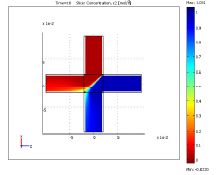
In this work, a COMSOL model that predicts velocity and concentration fields inside an X-shaped millichannel (4 mm diameter) is developed. Water and a ink low concentration are injected simultaneously in the two inlets of the device. The mass transfer problem is solved by a Fickian ... Read More


