
See How Modeling and Simulation Is Used Across Industries
Multiphysics modeling and simulation drives innovation across industries and academia — as is evidenced by the many uses showcased in the technical papers and posters presented by engineers, researchers, and scientists at the COMSOL Conference each year.
Draw inspiration from the recent proceedings collected below, or, to find a specific presentation or filter by application area or conference year/location, use the Quick Search tool.
View the COMSOL Conference 2025 Collection
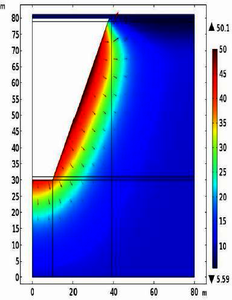
Seasonal thermal energy storage (STES) systems are key components for expanding the renewables share in the energy scheme as they offer the dispatchability and flexibility. Therefore, thermal behaviour of such systems is of interest. STES can influence the surroundings causing a ... Read More
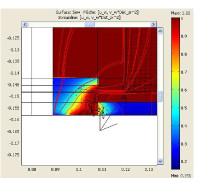
CO2 capture and storage constitutes a promising solution to control and reduce these emissions. Wellbore integrity is a key challenge to ensure long term safety and for public acceptance. For this objective, a two-phase flow model in porous media based on Darcy’s law has been proposed to ... Read More

We narrow the consideration to HV cylindrical parts, typically with axial leads located on the opposite sides. They are tens of millimeters long, so at moderate frequencies of up to 10MHz they may be analyzed as lumped elements (not as transmission lines), although in some cases they may ... Read More

Renewable energies generate temporary mismatches between energy demand and supply. The conversion of surplus energy to hydrogen and its storage in geological formations is one option to balance this energy gap. Storage in deep saline aquifers is the most cost-effective option for ... Read More

Geologic carbon storage that involves injecting carbon dioxide (CO2) into a subsurface sequestration site provides the vital approach for reducing CO2 emissions into atmosphere and thus addressing climate change issue. One challenge associated with CO2 geologic storage is that pore ... Read More

Solar energy storage has been an extensive research topic among the several thermal energy applications over the past three decades. Thermal energy storage (TES) systems in general, improve the energy efficiency of systems and sustainability of buildings by reducing the mismatch between ... Read More

The most common cause of lithium ion battery failure is high temperature. Improper thermal management strategies can contribute to the temperature related premature battery failure. Excessive heat significantly impacts the performance, safety and cycle lifetime of the lithium ion ... Read More

The performance and rechargeability of zinc-air batteries are found to be significantly influenced by the microstructure of the zinc anode [1]. It is evident that features such as porosity, connectivity, and spatial distribution of solid phases exert a considerable influence on ionic ... Read More

In Borehole Thermal Energy Storage (BTES), also called closed loop ground source heat pumps (GSHP) or closed systems, the thermal energy is stored and recovered with a closed hydraulic circuit consisting of one or more boreholes with vertical heat exchangers. The heat exchangers consist ... Read More

This work concerns the performance of an oxidation catalyst used in a NOx storage and reduction system. The oxidation of NO is the main objective of this study, where the presence of CO and propene has also been taken into account. Experimental data has been determined on a monolithic ... Read More