
See How Modeling and Simulation Is Used Across Industries
Multiphysics modeling and simulation drives innovation across industries and academia — as is evidenced by the many uses showcased in the technical papers and posters presented by engineers, researchers, and scientists at the COMSOL Conference each year.
Draw inspiration from the recent proceedings collected below, or, to find a specific presentation or filter by application area or conference year/location, use the Quick Search tool.
View the COMSOL Conference 2025 Collection

Aerosol and colloid aggregates are complex fractal-like structures composed of primary spheres. The drag force exerted on a fractal-like object is usually determined by solving numerically the Stokes equation. In this study we calculate it by relating it to a molecule-aggregate collision ... Read More

This paper discusses the simulation studies on a vibration based energy harvesting system to convert the undesirable mechanical vibration to useful green power. The design consists of a resonating proof mass and a spring system enclosed in housing and fixed on the source of vibration. A ... Read More

Currently there is much interest in electromagnetic metamaterials [1-9]. In our work we have focused on design of tunable metamaterial which can be made within available technology. In proposed design we use metallic split-ring resonators and thin-wires (Figure 1). Moreover we have ... Read More

This paper describes the numerical modeling of a key material-stability issue within the realm of Molten Carbonate Fuel Cells (MCFC). The model describes the morphological and attending electrocatalytic evolution of porous NiO electrodes and is apt to predict electrochemical observables ... Read More
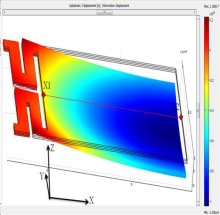
Variable capacitors between the fF and pF range are very interesting for high frequency applications like variable filters, resonators, etc. For radio astronomy applications variable capacitors, realized by electrostatically actuated, micromechanical Meanders-suspended bridges (MEMS) ... Read More

This work presents acoustic attenuation performance of helicoidal resonator due to distance change from different cross-sectional elements of cylindrical duct. The helicoidal resonator properties are described mainly in in infinite long cylindrical duct. For practical applications it is ... Read More

S. V. Kulkarni a Professor in Electrical Engineering Department, Indian Institute of Technology, Bombay, India. Previously, he worked at Crompton Greaves Limited and specialized in the design and development of transformers up to 400 kV class. He has authored book \"Transformer ... Read More

PEM fuel cells are very promising for portable applications. A key component of fuel cell is the flow field plate through which hydrogen will reach the anode, oxygen will reach the cathode and electron collection. Flow field plate made of silicon is not a good electrical conductor , so ... Read More
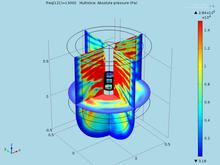
Logging-while-drilling (LWD) acoustic transducers provide real-time data about the geologic and geophysical properties of the borehole that ensure safety margins and optimize completion. It is important to understand what causes the different resonance modes in the transmitter and obtain ... Read More

A wide variety of near-field optical phenomena such as apertureless near-field scanning microscopy (ANSM) at optical and terahertz (THz) regimes and surface enhanced Raman scattering relies on the electric field enhancement at the end of a sharp tip. Achieving and controlling this ... Read More


