
Explore the innovative ways multiphysics simulation is being used worldwide to advance research
Multiphysics modeling and simulation drives innovation across industries and academia — as is evidenced by the many uses showcased in the technical papers and posters presented by engineers, researchers, and scientists at the COMSOL Conference each year.
Draw inspiration from the recent proceedings collected below, or, to find a specific presentation or filter by application area or conference year/location, use the Quick Search tool.
View the COMSOL Conference 2025 Collection

Magneto-Hydrodynamic (MHD) power generation systems were originally investigated starting from the fact that the interaction of a plasma with a magnetic field must take place at much higher temperatures than could be observed in a mechanical turbine. The main problems of traditional MHD ... Read More

Ar/H2 discharges are frequently used in various industrial applications, such as etching processes, surface treatment, and film deposition. In the discharges, the active species, such as ions and hydrogen atoms, are responsible for surface reactions, which could be considered as the ... Read More
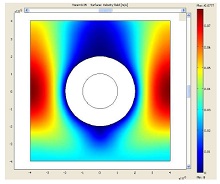
Because of its high enthalpy of combustion, aluminum has been added to energetic materials. In this paper, a two dimension thermal model is developed and assessed to describe the interrelated processes of Aluminum particle oxidation by using the software COMSOL Multiphysics. The thermal ... Read More
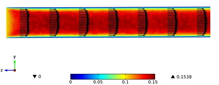
Microchannel heat sinks designed for applications in electronic cooling and having microscale heat transfer combine the attributes of high material compatibility, high surface area per unit volume ratios, and large potential heat transfer performance with a highly sophisticated and ... Read More
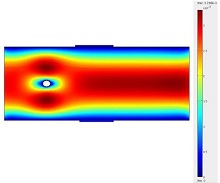
Testing and verification is very important to increase reliability of a system. In water analysis its purity is verified using different test methods. Biosensors are very useful to detect the microorganisms present in water. This paper presents a method to detect E.coli bacteria in water ... Read More
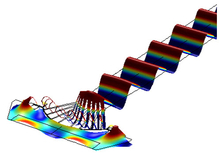
A compression driver is a certain type of electrodynamic loudspeaker which has a phase plug with slits in front of the diaphragm. The slits are narrow enough that the so-called viscothermal effects are of significant importance. In this paper a 2D axisymmetric finite element model of a ... Read More
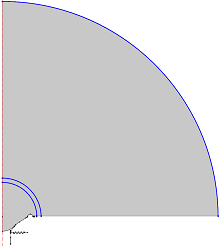
Simulation on loudspeaker drivers require a conventional fully coupled vibro-acoustic model to capture all effect. An accurate vibroacoustic model can be time-consuming to solve, especially in 3D. In practical applications, this results in poor efficiency concerning the decision-making ... Read More

This paper shows a model to estimate the scaling parameters for reverse osmosis membrane processes. The model takes into account the concentration polarization of ionic species in the membrane channel of spiral-wound modules and the effect of the spacers on the flow. The scaling ... Read More
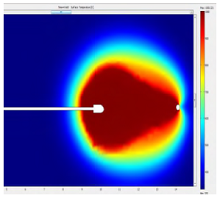
Underground coal gasification (UCG) has received renewed interest due to its potential for utilization of the vast amounts of coals available in deep underground seams and the current drive towards clean coal utilization. UCG process involves the reaction between air/steam and coal in ... Read More

This work enunciates the principles of SAW design from a physical perspective, examining the standard engineering modelling assumptions in some detail. An integral form analytical expression based on 2D elastic isotropic theory is validated against a COMSOL Multiphysics® simulation, ... Read More


