
See How Modeling and Simulation Is Used Across Industries
Multiphysics modeling and simulation drives innovation across industries and academia — as is evidenced by the many uses showcased in the technical papers and posters presented by engineers, researchers, and scientists at the COMSOL Conference each year.
Draw inspiration from the recent proceedings collected below, or, to find a specific presentation or filter by application area or conference year/location, use the Quick Search tool.
View the COMSOL Conference 2025 Collection
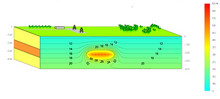
Disposal in deep clay geological formations is one of the promising options for disposal of high-level radioactive waste. Yet, they can generate considerable amounts of heat as a side effect of radioactive decay. This paper shows how COMSOL Multiphysics has been used to evaluate the ... Read More
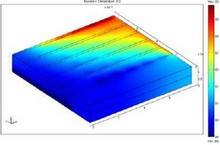
COMSOL Multiphysics provides a powerful numerical platform where various models for microchemical process technology components can be readily created for both education and research. This modeling tool allows chemical engineering students to focus on understanding the effects of various ... Read More
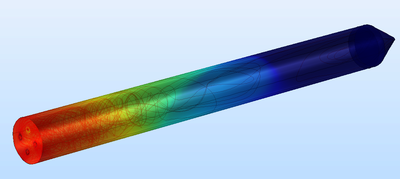
Oxygen delignification is a technology established worldwide and a common operation in pulp mills that use Kraft cooking. The reasons for using this technology are the reduction of organochlorine compounds in the effluents, and economy of chemicals in the bleaching stage. The objective ... Read More

In volcanic areas, the presence of heterogeneous materials and high temperatures affect the rheological behaviour of the Earth's crust that calls for considering the anelastic properties of the medium surrounding the magmatic sources. A thermo-mechanical numerical model is performed for ... Read More

Calorimetry is the method of choice for determining one of the most elementary physical quantities: heat, Q [in J]. Depending on the individual issue a wide range of techniques, devices and methods are available for users [1]. One approach is called isothermal microcalorimetry (IMC). It ... Read More
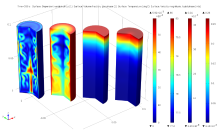
We investigate a prototype concept of a back-up electricity device where we use liquid formic acid (FA) to produce a mixture of carbon dioxide (CO2) and hydrogen (H2) which is used in a PEM fuel cell, Fig. 1. In the fluidized bed reactor the liquid FA is decomposed to a gaseous mixture ... Read More

This paper presents a snap shot of experimental work, which has been conducted at NTNU on billet heating with induction coils. A significant volume of experimental data have been collected for coils running with up to 0.2T: high accuracy Hall probe readings (+/-1%), metal ... Read More

Gas-liquid falling film microreactors carry out fast exothermic and mass transfer limited reactions. Since the major rate limiting steps occur on the liquid side, it is important to account for a realistic liquid film profile within the reactor simulation. Based on realistic channel ... Read More
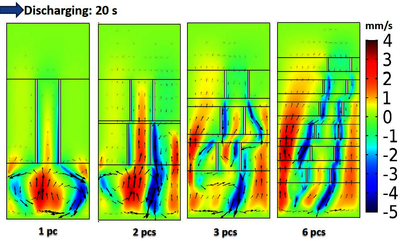
Harvesting of renewable energy requires efficient energy storage systems. Rechargeable flow batteries offer certain advantages over other energy storage techniques in use, such as the lifting of water, compression of air, flywheel, etc. In a flow battery, electrolyte flowing through ... Read More

Reperfusion injury is caused by the rapid restoration of blood flow to oxygen-starved tissue. Animal studies show that intermittent periods of occlusion (also called post-conditioning) during reperfusion can limit tissue damage to vital organs such as the heart and brain. These studies ... Read More


