
See How Modeling and Simulation Is Used Across Industries
Multiphysics modeling and simulation drives innovation across industries and academia — as is evidenced by the many uses showcased in the technical papers and posters presented by engineers, researchers, and scientists at the COMSOL Conference each year.
Draw inspiration from the recent proceedings collected below, or, to find a specific presentation or filter by application area or conference year/location, use the Quick Search tool.
View the COMSOL Conference 2025 Collection

Laser metal deposition is widely adopted for coating, reparation and 3D printing. Using COMSOL, we have developed a numerical model with full coupling of laminar fluid flow and heat transfer. The Marangoni effect is considered to capture the enhanced convective heat transfer as well as ... Read More

1.Introduction Transparent conductive oxides (TCOs) operating near their epsilon-near-zero (ENZ) point have recently been shown to exhibit strong and ultrafast intraband optical absorption processes, whose excitation results in a variation of the effective mass and electrical conductance ... Read More
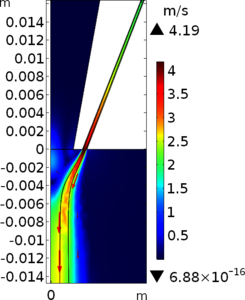
The Laser Metal Deposition process (LMD) is a rapid free form fabrication method which can be used to manufacture new near net shape metallic components, to repair used ones or to add functional parts on existing ones. This process is composed by multiple gas streams flowing inside a ... Read More

The IR CO2 laser powered chemical conversions in the gas phase are intriguing and the researchers’ attention was focused on this transformation a while ago. The method, known as Infrared Laser Powered Homogeneous Pyrolysis, or IR LPHP opened reaction pathways not reached by conventional ... Read More
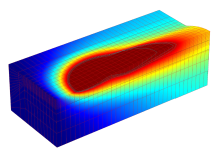
Additive manufacturing is attracting more and more interest. Laser Cladding is one of these additive manufacturing processes. For this a quasi-stationary physical based 3D process model is presented, which has been developed taking into account heat transfer, melt pool fluid flow ... Read More

Spot laser welding is largely used in industrial manufacturing, especially in the case of small penetration depth. Unfortunately, welded joins are often polluted by porosities. The formation of porosities depends on complex thermo-hydraulic phenomena. During the interaction, a deep and ... Read More

This study presents a combined simulation and experimental investigation of mixing performance in a batch mixer, with the goal of validating simulation results and identifying optimization potential. The focus is on evaluating mixing times and flow fields to enhance process efficiency, ... Read More

Laser-based powder bed fusion (LPBF) is a promising additive manufacturing technology, where metallic parts are produced in a layer-wise manner. At each step, a rapid-moving laser irradiates and subsequently melts predefined zones of a relatively thin layer of fine spherical metal ... Read More
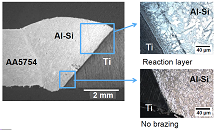
Laser assisted brazing with Al-Si fillers in V-shaped groove configuration is a perspective method for joining of aluminum alloys to titanium. The present work introduces multiscale model that allows estimating diffusion process at titanium/melted zone interface in function of thermal ... Read More
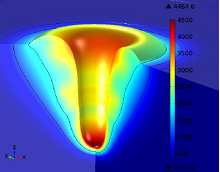
The formation of porosities in spot laser welding depends on complex thermo-hydraulic phenomena. To understand and control these mechanisms, the COMSOL Multiphysics® software is used to model both the interaction and cooling stages of an isolated impact made with a Nd:YAG pulsed laser. ... Read More


