
Explore the innovative ways multiphysics simulation is being used worldwide to advance research
Multiphysics modeling and simulation drives innovation across industries and academia — as is evidenced by the many uses showcased in the technical papers and posters presented by engineers, researchers, and scientists at the COMSOL Conference each year.
Draw inspiration from the recent proceedings collected below, or, to find a specific presentation or filter by application area or conference year/location, use the Quick Search tool.
View the COMSOL Conference 2026 Collection

Radionuclide sorption is often simulated using a lumped approach where retention processes are represented by the distribution coefficient (Kd), which relates the radionuclide mass retained in the solid phase to its aqueous concentration. Classical Kd-based simulations rely on two strong ... Read More

In boreholes nozzles have to be found advantageous to increase the infiltration rate of water into the subsurface ground. Studies and practice in the field shows that the infiltration of water into permeable aquifers can be improved, if the flow in the borehole is modified. Due to the ... Read More
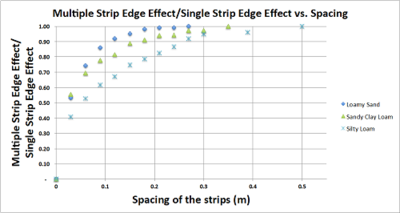
This analysis evaluates the importance of the lateral component of flow on the infiltration of water from parallel strip sources of water on the soil surface. Flow from such sources will be two-dimensional, having both vertical and lateral components. Here we examine the effect of the ... Read More
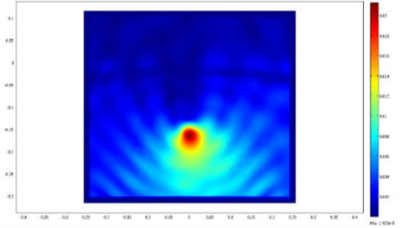
The detection, characterization, and classification of underground environmental hazardous objects [mines, IEDs, and other unexploded military hardware] is a worldwide problem that needs urgent attention and solution. While electromagnetic sensor technologies have been applied to ... Read More

Poroelasticity equations describe the interaction between fluid flow and solids deformation within a porous medium. Modeling of poroelasticity is coupling between elastic deformation of porous materials and Darcy’s law. Poroelasticity has numerous real world applications such as in ... Read More

In the context of increasing demographic pressures around the world, soil improvement techniques constitute viable alternatives to expensive foundations. Among these techniques, the biocalcification of granular soils appears as a promising alternative relying on the formation of calcium ... Read More

The block caving mine is considered by the mining industry as one of the natural replacements of the current open cut mines in the near future. The block caving technique is based on the extraction of small broken rocks, created by blasted initially large solid rocks, and the fracture of ... Read More

In underground mining operations, the mined-out spaces (called stopes) need to be backfilled to maintain the stability of surrounding rock mass and increase the ore recovery. Cemented paste backfill (CPB), a mixture of water, binder, and tailings, has been intensively utilized in ... Read More


