COMSOL Blog

Learn How to Model Electrochemistry with an Orange Battery Tutorial

Electrochemical | Posted on June 3rd, 2013 by

Did your chemistry teacher use an orange or lemon to demonstrate the concept of a battery, back in the day? You might remember how she magically produced electricity by sticking a couple of metal nails into the citrus fruit, as the whole class watched in awe. What if we now used simulation tools to demonstrate how an orange battery works, and then use that as an intro to electrochemistry modeling?

Read more on: Learn How to Model Electrochemistry with an Orange Battery Tutorial

3D Printed Cloaking Device in a Matter of Hours

News | Posted on May 31st, 2013 by

It’s been almost a year since we declared 3D printing the hottest topic in manufacturing, and it hasn’t cooled off yet. If anything, 3D printing has seen a recent surge in popularity. By now you’ve heard a lot about the technology and what you can print with it, but did you know you could print invisibility cloaks this way, too?

Read more on: 3D Printed Cloaking Device in a Matter of Hours

This Just In: COMSOL Multiphysics 4.3b

News | Posted on May 3rd, 2013 by

We’ve been dropping hints for the past few weeks here on the blog, and the time has finally come when we can officially unveil the release of COMSOL Multiphysics 4.3b. Five new products extend our product suite, and there are plenty of new features to enhance your simulation experience. The latest version of COMSOL Multiphysics is here, and you do not want to miss out on the news.

Read more on: This Just In: COMSOL Multiphysics 4.3b

The Greenhouse Effect

Heat Transfer | Posted on May 1st, 2013 by

Given the title of this blog post you might expect it to be about global warming, and I won’t blame you for it; greenhouse effect has become another popular term used when debating climate change. However, its original and literal meaning refers to a very different process, in particular when it comes to heat retention. Here we will describe the effect of heating up an actual greenhouse and suggest steps for optimizing its design.

Read more on: The Greenhouse Effect

Wave Optics, to Approximate or Not?

Electrical | Posted on April 30th, 2013 by

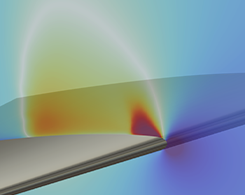
Engineers working with lasers, optical fibers and waveguides, nonlinear optical processes, metamaterials, and other large photonic devices ultimately deal with wave optics. Photonic devices are considered “large” when they are larger than a wavelength of light. In that case, you deal with optics frequencies as opposed to radio frequencies, and the device is not complex enough to justify approximating with rays.

Read more on: Wave Optics, to Approximate or Not?

2013 U.S. Government COMSOL Workshop

Events | Posted on April 25th, 2013 by

Each year in May we host a multiphysics simulation workshop specifically for U.S. government employees. This year’s agenda will provide attendees with an overview of COMSOL Multiphysics, tutorials, a user presentation, and more — all in a setting that allows classified work to be shared among federal employees and contractors only.

Read more on: 2013 U.S. Government COMSOL Workshop

Cooling Flange Performance Analysis

Heat Transfer | Posted on April 22nd, 2013 by

Chemical reaction fluids can be cooled using glass flanges. The reaction fluid is passed through the flange and the air surrounding the flange then serves as the coolant. Engineers looking to optimize the cooling performance of such flanges can look to simulation for help.

Read more on: Cooling Flange Performance Analysis

The Graphene Revolution: Part 3

News | Posted on April 10th, 2013 by

Everyone’s talking about graphene right now. When was the last time a material received this much attention? Sure, other materials have peaked our interest before, but when something breaks into more mainstream news you know it’s going to be a very big deal.

Read more on: The Graphene Revolution: Part 3

Barrel Hinge Analysis

Mechanical | Posted on April 9th, 2013 by

We’ve all encountered hinges before; they are frequently used to connect different parts of mechanical assemblies in a way that allows them to move freely relative to one another, in a single degree of freedom. There are several different types of hinges, including everything from barrel hinges to friction hinges, with lots in between. Before incorporating a hinge into a mechanical assembly, you might want to get a sense of how it will hold up by performing a hinge analysis.

Read more on: Barrel Hinge Analysis

Magnetic Bearings

Electrical | Posted on April 1st, 2013 by

In the world of bearings, there are many different types to choose from. For certain applications, magnetic bearings trump their mechanical counterparts in several regards. In order to understand how the bearing will perform, using a simulation tool to calculate design parameters is a good idea.

Read more on: Magnetic Bearings