

This summer, the Institute of Electrical and Electronics Engineers (IEEE) welcomed thousands of engineers and other industry stakeholders to Boston, Massachusetts, for the International MTT Symposia 2026 (IMS2026), a premier global technical conference and exhibition focused on the latest RF and microwave technologies. At this year’s conference, a few main areas of focus arose: moving toward system-level thinking, bridging the gap between industry and academia, and taking a practical approach toward the next generation of wireless networks. Several of my colleagues and I had the pleasure of representing COMSOL at IMS2026, where we met with attendees at our booth on the exhibition floor and sat in on various presentations. This blog post recaps our experience and some of the more impactful trends we saw at this year’s conference.
The Exhibition Floor
At an interactive demo station at the COMSOL booth, engineers spoke with visitors about how they could use the latest features in the COMSOL Multiphysics® software for their RF modeling scenarios. New functionality with practical applications for RF and microwave engineers includes simplified transmission line modeling, a dedicated feature for streamlined metamaterial design, and enhanced far-field functionality for optimization and polarization analysis.
Zhangxing Li was one of the applications engineers who worked with attendees at the demo station. “When I chatted with people, they were happily surprised by how streamlined the process is to set up multiphysics simulations in the software. Everything is done in one user interface, and if the user knows the workflow for one physics, they practically know the general workflow for the others,” Li said. “This streamlined workflow is particularly relevant for anyone in the RF and microwave community who needs to consider multiphysics interactions between electromagnetics, heat transfer, and solid mechanics for a robust representation of their device.”
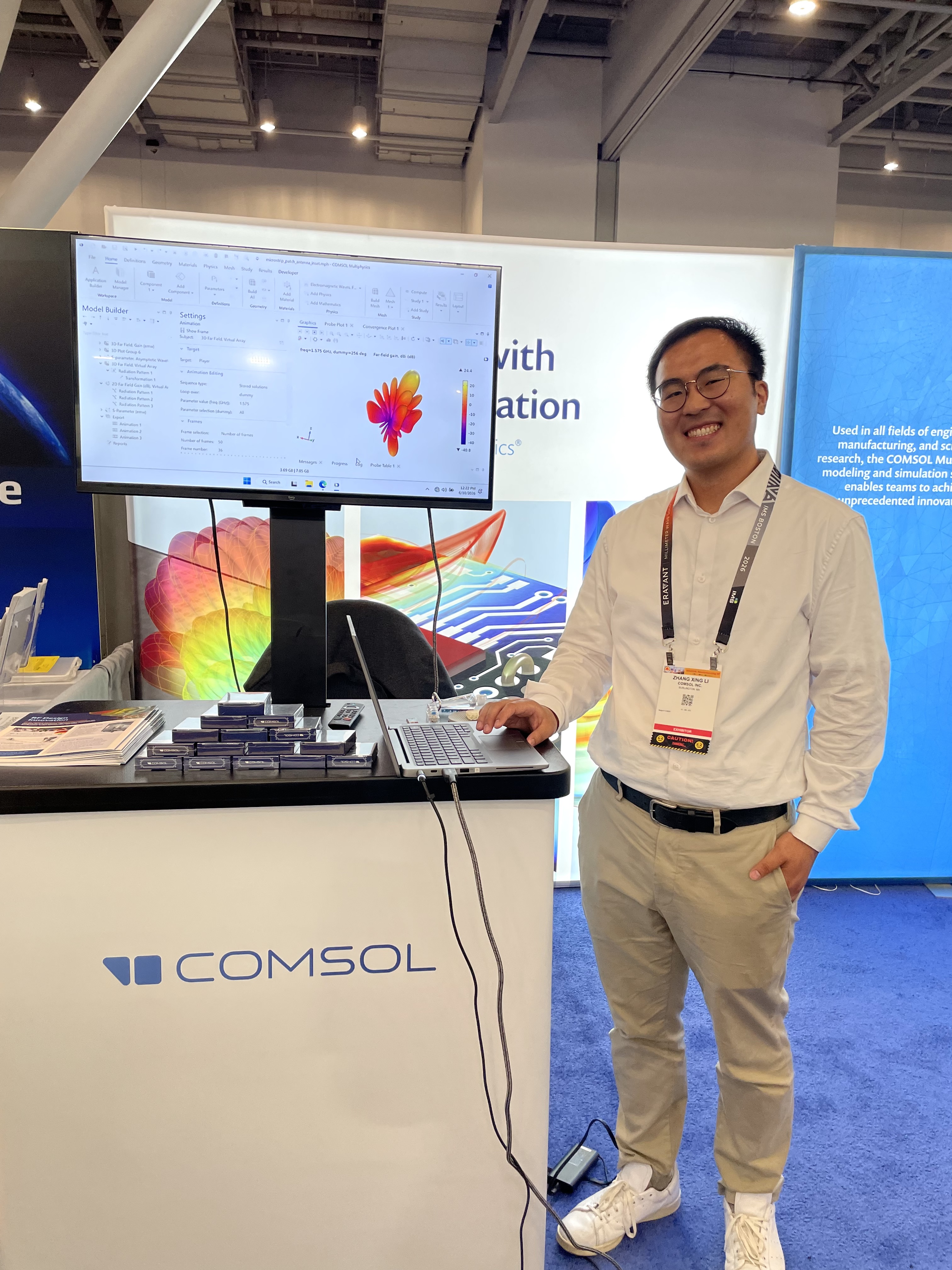
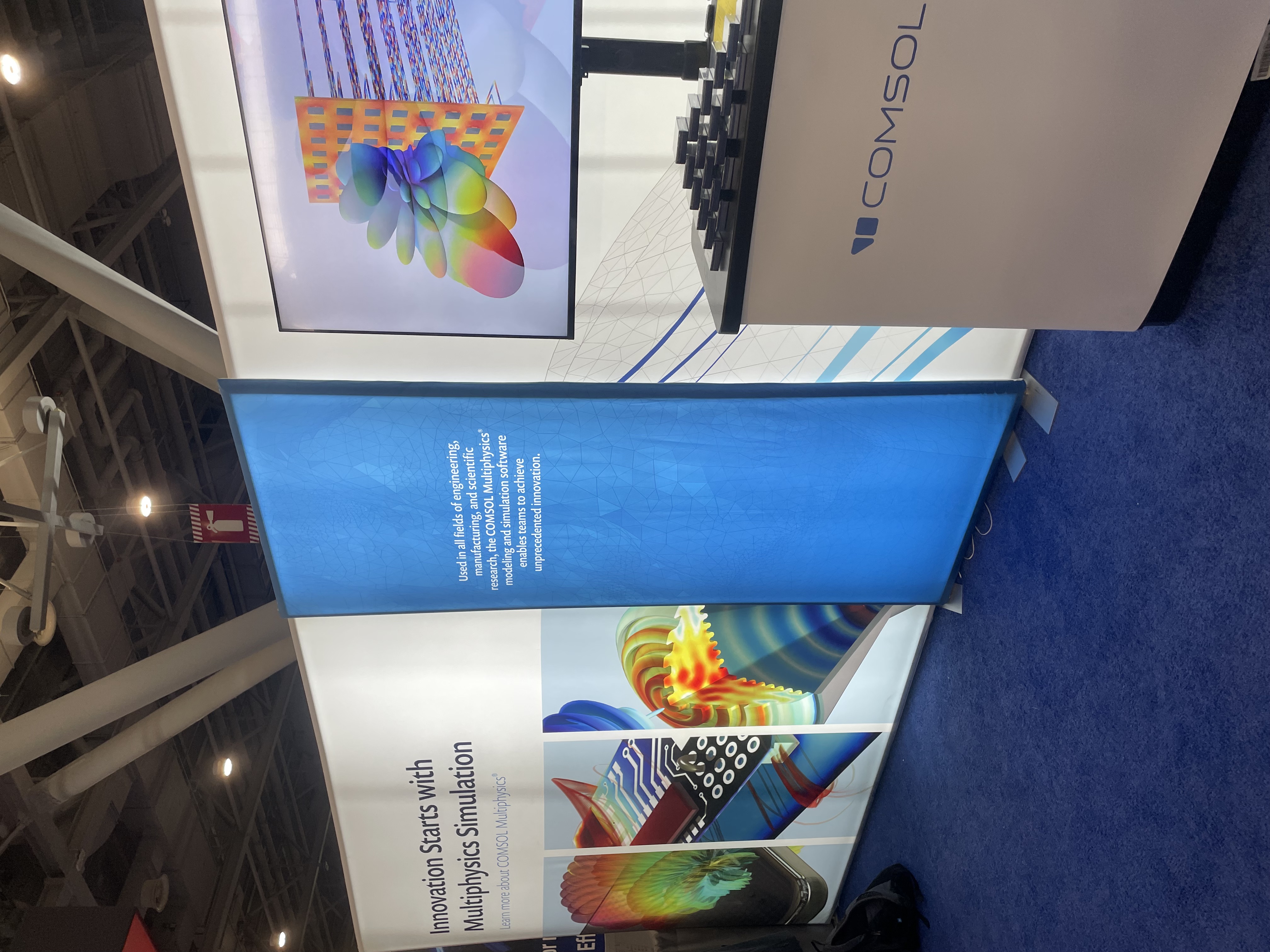
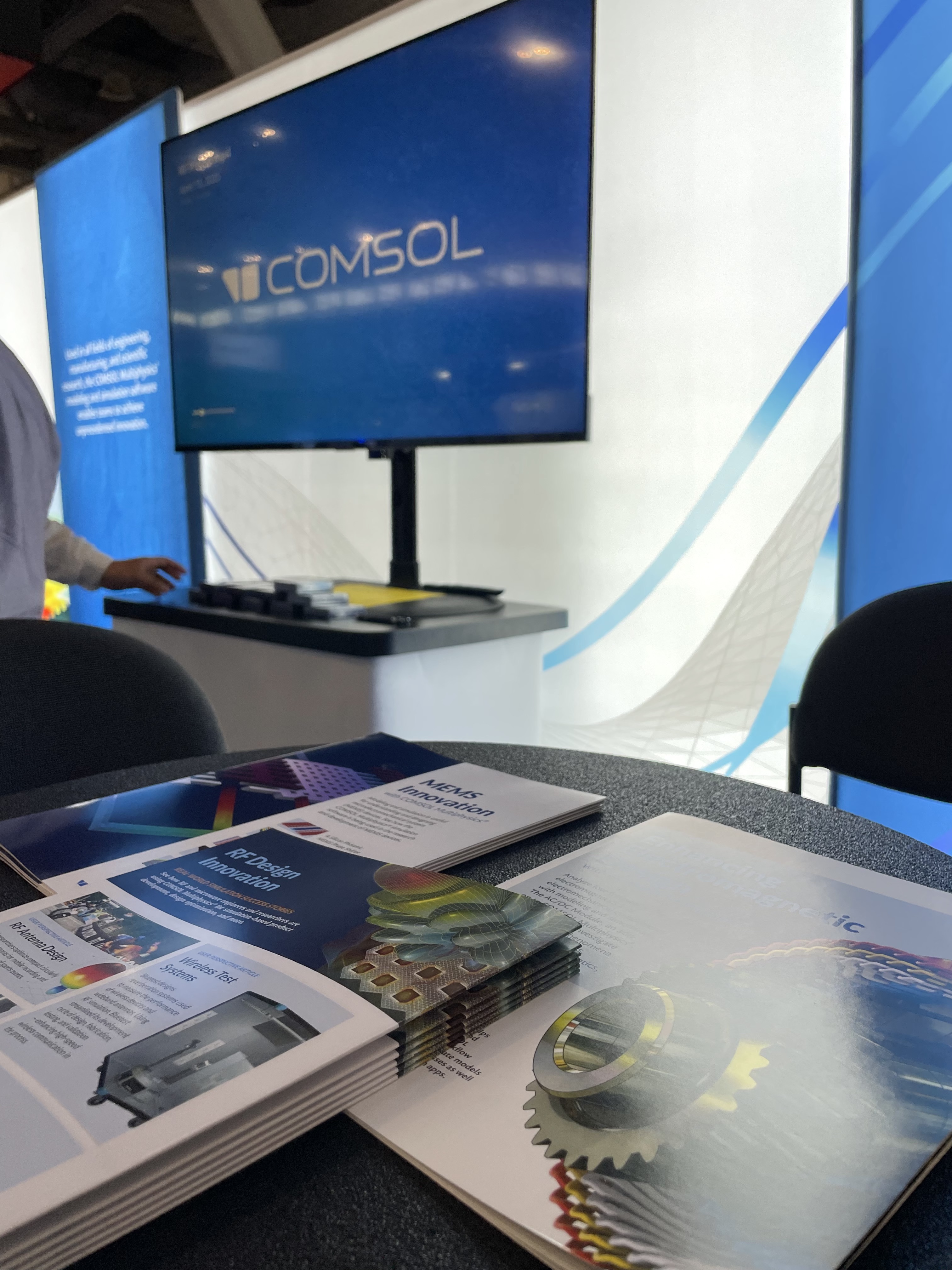
The COMSOL booth at IMS2026 featured a demo station (left), a video featuring multiphysics models (center), and informational materials focused on how the COMSOL Multiphysics® software can be used to develop RF and microwave applications (right).
The theme of IMS2026 was “Revolutionizing RF”, and this year’s conference took a similarly unprecedented approach, splitting itself into three symposia focused on RF integrated circuits, systems and applications, and technology and techniques, respectively.
Papers, presentations, and workshops were categorized into one or more of these symposia, helping attendees quickly assess the application areas. After meeting with visitors to our booth and attending a wide variety of events at IMS2026, we picked up on the following RF and microwave core industry trends.
This Year’s RF and Microwave Trends
Fellow attendee Jiyoun Munn, senior technical product manager at COMSOL, noted that this year’s topics marked a move toward system-level thinking, with more emphasis on real-world applications, the integration of AI and machine learning (ML), and tighter links between academia and industry. A main point of discussion at IMS2026 was the continued development of 6G wireless networks and the technical requirements needed to make the transition from 5G to 6G possible.
“The exhibition area reflected where the market is headed: integration, higher frequencies, better packaging and thermal design, and stronger links between research and commercialization,” Munn said.
AI Integration
Discussions about AI and ML centered on taking these fields of study from hypothetical to practical applications, for example, by integrating them into established modeling workflows, thereby cutting down on the time required to develop RF designs using simulation. In the dedicated AI/ML Bootcamp session, attendees were presented with the basics of AI and ML and how they could be used in microwave engineering. Meanwhile, hardware and connectivity solutions for deploying and integrating AI infrastructure were discussed and displayed across the different symposia and the exhibition hall.
Next-Generation Wireless
The transition from 5G to 6G wireless networks is far from imminent. Implementing 6G will require ultrahigh frequencies, new hardware, and significant infrastructure investment from private and public funds alike. Nonetheless, 6G was on many people’s minds at IMS2026. Andrew Strikwerda, senior applications manager at COMSOL, heard a shift in the conversations about 6G this year.
“Discussions about 6G networks were much more practical than in previous years; participants’ interests in the specific technologies that would be required were more concrete,” Strikwerda said. “Inherently, these conversations touched on simulation of such devices to ensure high-fidelity representation of performance at higher frequency bands.”
The next generation of networks will require the use of the subterahertz spectrum. To make such technology feasible, numerous physics challenges such as attenuation and molecular loss need to be addressed. At IMS2026, there were sessions and papers that discussed finding a balance between bandwidth and system capacity. Notable examples included the workshop “Broadband and Spectrally Agile RF Front-Ends for Advanced Software-Defined Radios” and the article E-Band Wireless Radio Links Deliver High Capacity Backhaul Solutions for 5G Networks from Analog Devices.
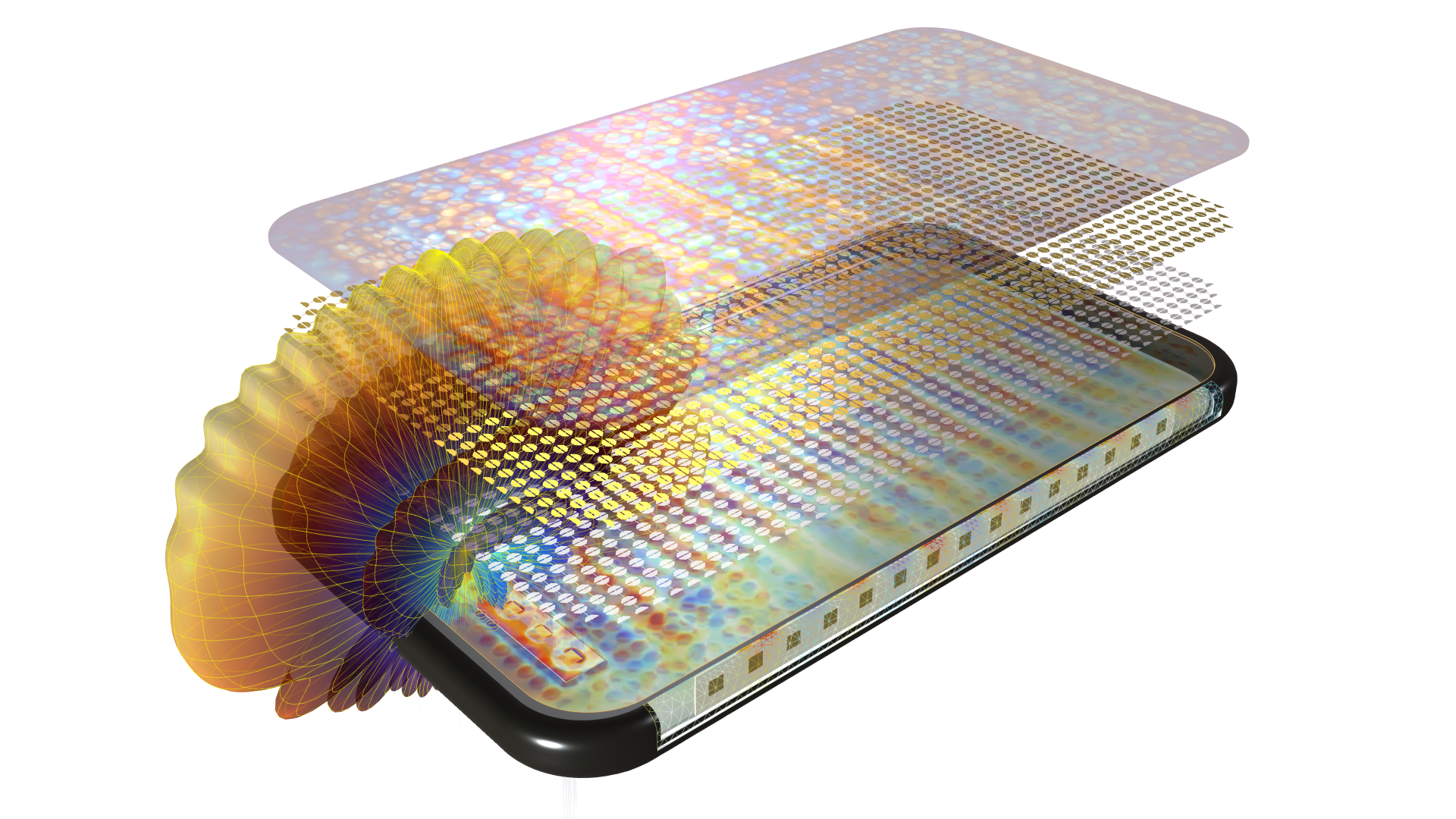 An example model in the COMSOL Multiphysics® software showing a millimeter-wave analysis of a 5G cellphone.
As it stands today, organizations and companies are working hard to overcome the hurdles involved in the transition to 6G, and the developments shown at IMS2026 were promising.
Integrated Sensing and Communication
Integrated sensing and communication (ISAC) combines radar and wireless communications into a cohesive platform and unlocks new capabilities for wireless networks, giving those using it environmental sensing data that wasn’t available before. While deployment of ISAC remains years away, its potential was still a topic of conversation at IMS2026.
“At IMS2026, ISAC was discussed in a speculative way, similarly to how 6G was talked about at previous conferences,” Strikwerda said. “There was a general agreement that ISAC would be coming at some point and in some capacity, but it was still unclear precisely what that would entail.”
The panel discussion “Integrated Sensing and Communication (ISAC)—Enabling the Future of Radar and Wireless Systems” gave an end-to-end view of the topic, featuring invited speakers from organizations such as the Mitre Corporation, Samsung Electronics, and Nokia. Also featured at this year’s conference was a panel session titled “The Rise of ISAC — Opportunity or Hype?”, with industry experts from academia and the commercial sector. Both these sessions and several papers on the topic presented at IMS2026 gave attendees a comprehensive overview of ISAC and its promise.
IMS Heads to San Antonio, Texas
IMS2026 proved once again to be at the forefront of the rapidly evolving RF and microwave sector, with thousands of industry experts sharing their work and discussing the latest developments.
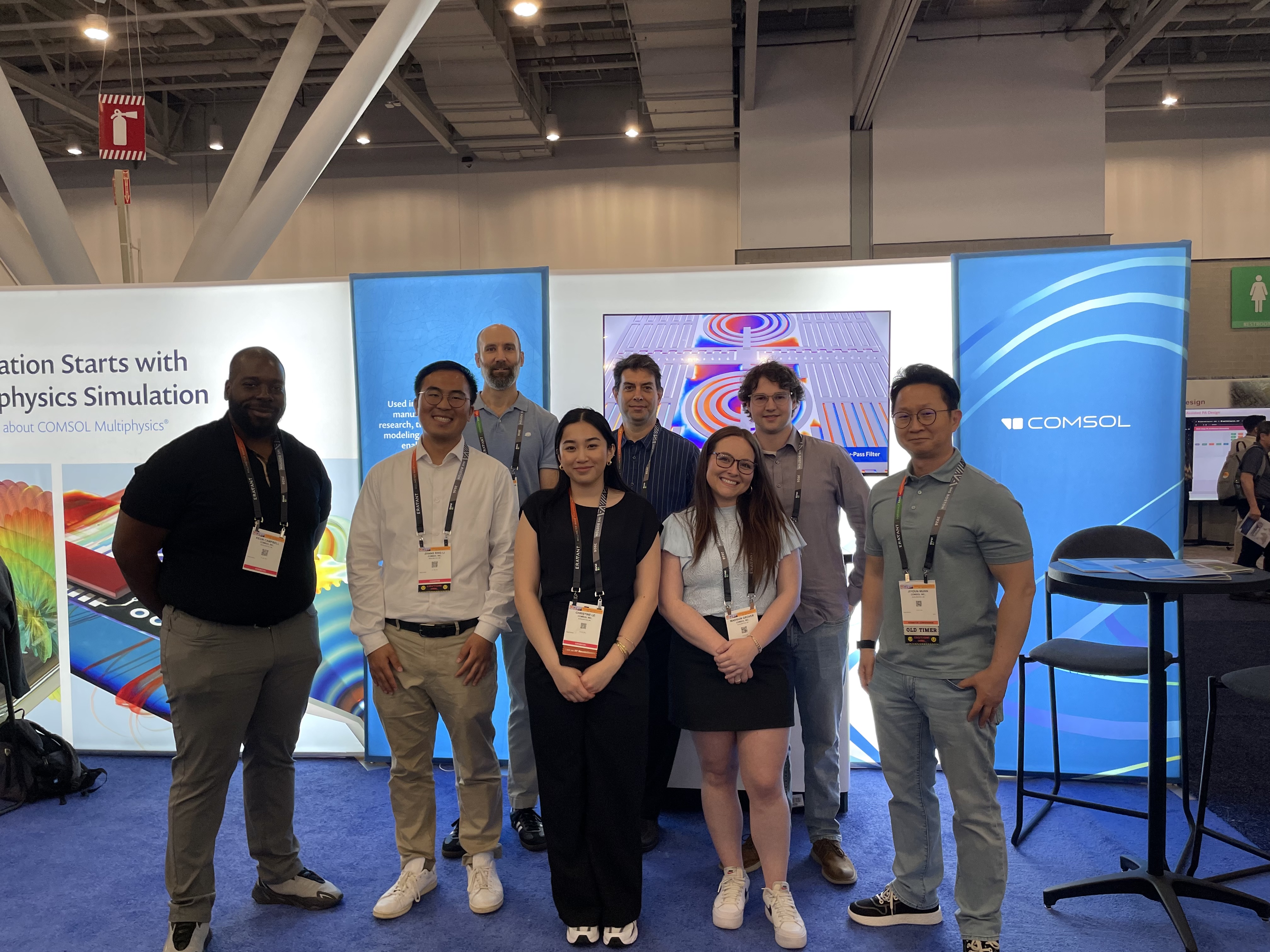 COMSOL was represented at IMS2026 by (from left to right) Keon Campbell, Zhangxing Li, Andrew Strikwerda, Christine Le, Walter Frei, Madison Grover, Ian Woods, and Jiyoun Munn.
COMSOL was privileged to take part in this year’s conference, and we look forward to IMS bringing the RF revolution to San Antonio in 2027.





Comments (0)