
Blog Posts Tagged Physics of Sports

The Sound of the Giant: Modeling the Acoustics of Estadio Azteca
The legendary Estadio Azteca is one of only two stadiums to have hosted the FIFA World Cup® finals. For fun, we simulate the acoustics of this one-of-a-kind stadium.

Tracking Performance in the Beautiful Game
The official match ball for the 2026 FIFA World Cup® has sensors embedded in it that allow for real-time tracking and analysis. For fun, we take a look at how to model such sensors with COMSOL Multiphysics®.

Modeling the Beautiful Game: From Ball Design to Power Trivelas
Let’s explore the aerodynamics of the 2026 FIFA World Cup® ball, the Adidas Trionda®, and the trivela technique.
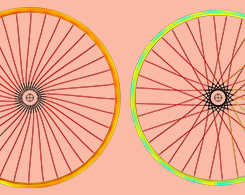
Why Do Road and Mountain Bikes Have Different Spoke Patterns?
Why do some bicycle rims come with warnings? Why do some bicyclists prefer rim brakes? To find answers, we model the forces in a bicycle rim for different brake types and spoke lacing patterns.
Why Do Golf Balls Have Dimples?
Why do golf balls have dimples? Can I model a golf ball with COMSOL Multiphysics? Can I use simulation to optimize my shot and make a par? Find answers to these questions and more…
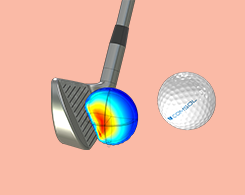
Fore! Analyzing the Performance of a Golf Ball with Simulation
Did you know that golf balls were originally made out of wood? We discuss the evolution of the golf ball and how simulation can be used to analyze modern golf ball designs.
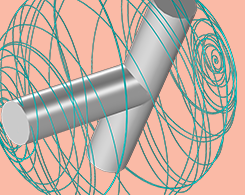
Why Do Tennis Rackets Tumble? The Dzhanibekov Effect Explained…
If you toss a cellphone, tennis racket, wingnut, cereal box, or any object with 3 axes of rotation in the air, it will demonstrate this interesting and unusual effect…
How Do Bicycle Pedals Stay On?
Ever wonder why the left pedal of a bike has left-handed threads and the right pedal has right-handed threads, yet the pedals stay on when riding?


