
General Blog Posts
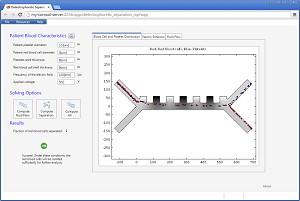
Dielectrophoretic Separation
Dielectrophoresis is a phenomenon in which an electric field is used to control the movement of electrically neutral particles. Learn about how to model this effect in both DC and AC fields.

How to Use COMSOL Multiphysics, a Tutorial Video
New to running simulations in COMSOL Multiphysics®? Get a preview of a step-by-step tutorial video that demonstrates how to set up and solve your first model.
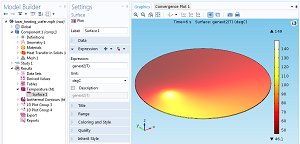
Using General Extrusion Operators to Model Rotation
You can use the General Extrusion operators in COMSOL Multiphysics® to simulate rotating objects exposed to loads. A common real-world example of this is rotisserie-style foods.
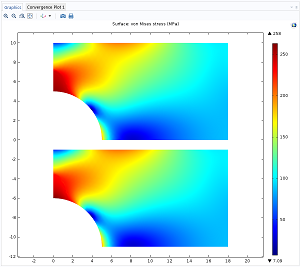
Introducing Nonlinear Elastic Materials
Examples of nonlinear elastic material models: Ramberg-Osgood, Duncan-Chang, Hardin-Drnevich, Power law, and more. We discuss how to apply nonlinear elastic materials in your analyses.
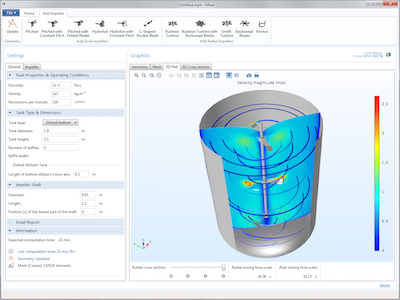
Geometry Modeling in Simulation Apps
See how to use cumulative selections and geometry parts when creating simulation apps that can be used to model geometries based on parameterized CAD models.
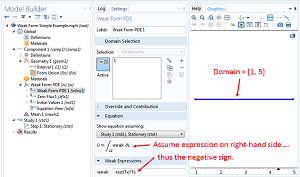
Implementing the Weak Form in COMSOL Multiphysics
In Part 2 of our series on the weak form equations, we demonstrate how to implement and solve these equations numerically using COMSOL Multiphysics®.
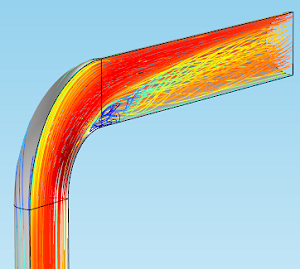
Visualizing Fluid Flow with Streamline Plots
As part of our blog series on postprocessing, we demonstrate the use of streamlines to visually describe fluid flow in your simulations. Learn how with an example of flow through a pipe elbow.
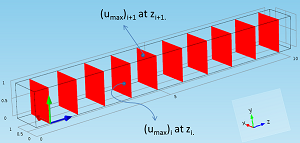
Maximum Evaluations on Parallel Sections
Postprocessing trick: You can evaluate and plot the maximum, minimum, average, or integration value of any variable at various parallel sections along the axial coordinate of your model.
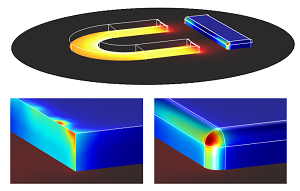
Fillet Away Your Electromagnetic Field Singularities
Did you know that you can use fillets and chamfers in your electromagnetics models to avoid electromagnetic field singularities? Learn how in this tutorial blog post.
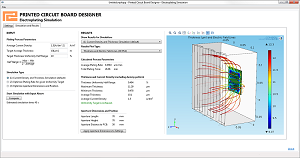
Electroplating Simulations for Printed Circuit Board Designers
The manufacture of a printed circuit board (PCB) often involves a process called electroplating, which can vary from design to design. A simulation app can make it easy to analyze this process.
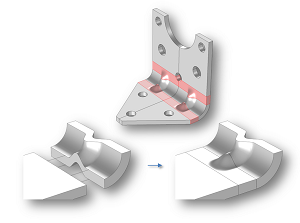
Introducing the Design Module
The Design Module has specialized features for advanced geometry modeling, including the ability to create fillets on 3D designs or generate shell approximations of imported geometric objects.
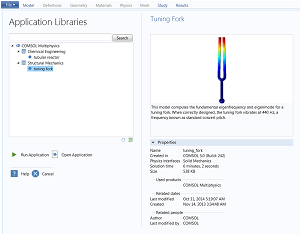
Where to Find Application Builder Tutorial Apps
Did you know that COMSOL Multiphysics® includes an Application Library full of tutorial models and demo apps? Learn how to access this helpful feature for modeling guidance and inspiration.
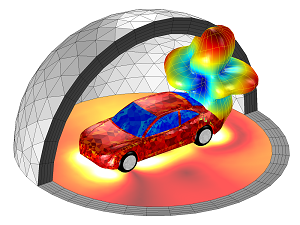
Automatic Meshing for Electromagnetic Simulations
Ever struggle to mesh the infinite elements or perfectly matched layers in your electromagnetics simulations? Automatic meshing can help >>
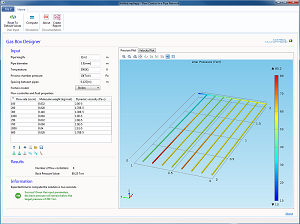
Creating an App for Modeling Flow Control in a Pipe Network
Simulation apps can be used as dedicated tools for modeling the flow and pressure distribution inside a network of connected pipes. This would be useful in, for example, semiconductor processing.
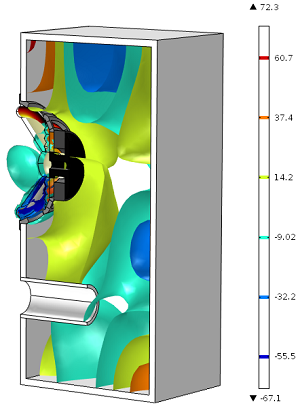
Making Waves with Contour and Isosurface Plots
In this installment of our blog series on postprocessing your simulation results, learn how to use contour and isosurface plots to show quantities on a series of lines or surfaces.
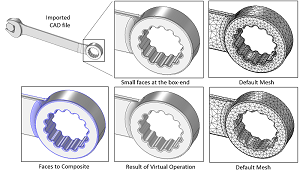
Using Virtual Operations to Simplify Your Geometry
CAD geometry: A set of data structures that provide a very precise method for describing the shapes of parts (called boundary representation, or B-rep).
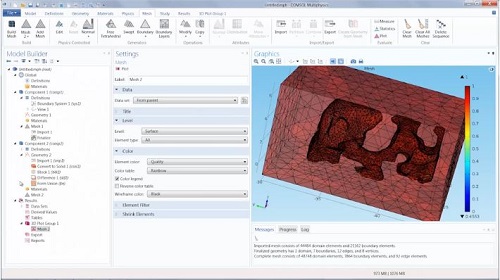
Create Geometry from an Imported Mesh
Did you know that as of COMSOL Multiphysics® version 5.0, imported meshes can easily be converted into solid geometry objects for further investigation and modeling capabilities?
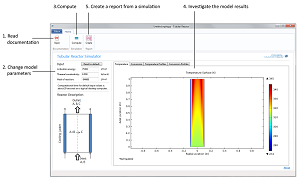
Apps for Teaching Mathematical Modeling of Tubular Reactors
Chemical engineering students can use the Tubular Reactor app to model a nonideal tubular reactor and investigate the impact of different operating conditions. Learn more >>
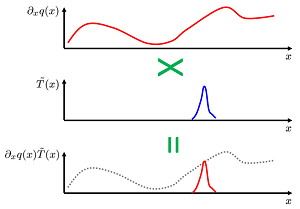
A Brief Introduction to the Weak Form
Whether or not you use finite element analysis and vector calculus in your daily life, you’ll appreciate this introduction to the weak form equations.
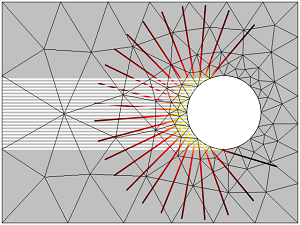
Introducing the Ray Optics Module
COMSOL Multiphysics version 5.0 introduced an add-on module for electromagnetics modeling: the Ray Optics Module. It can be used to perform ray tracing and geometrical optics studies.
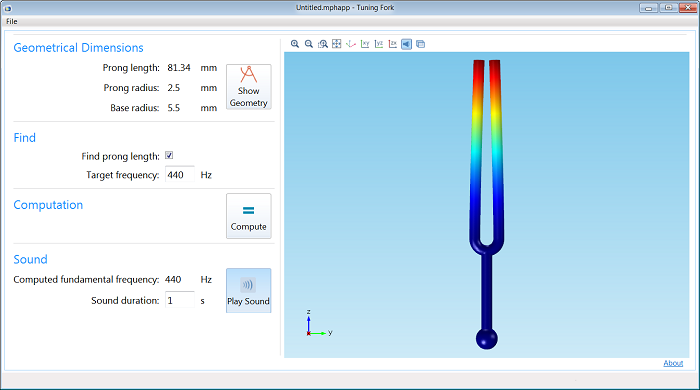
The Tuning Fork Application
Do re mi fa so la ti do! Did you know that the most common standard pitch for a tuning fork is 440 Hz, which forms the note A? See a tuning fork simulation app in action here >>

COMSOL Multiphysics 5.0 Brings User Interface Improvements
Updates to the COMSOL Multiphysics® UI ribbon with version 5.0 include: change in color scheme, additional multiphysics interfaces, a materials tab, global materials, and more.
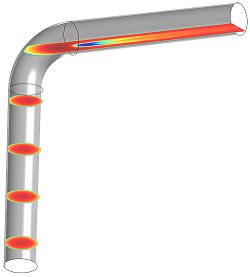
Using Slice Plots to Show Results on Cross-Sectional Surfaces
In this installment of our blog series on postprocessing your simulation results, we demonstrate slice plots, an easy way to visualize physics behavior on many different parts of your model.
Understanding Parallel Computing
Q: Do you use parallel computing to run your COMSOL Multiphysics® simulations? If so, you may enjoy this conceptual overview of computers and the algorithms used by the COMSOL® software.


